Designing Outdoor Science Learning Experiences
Teachers can assign fieldwork that prompts students to make connections between the content they learn in class and the world around them.
Your content has been saved!
Go to My Saved Content.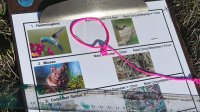
When students have the opportunity to connect what they learn to the real world, teachers can not only boost engagement, but help students engage with content in a more meaningful way. Curiosity is sparked by noticing rainfall erode a hill, imagining how the land beneath your feet was once covered by a mile-high glacier, or observing tracks in the mud or snow while learning about trace fossils.
At our middle school, we’ve created these kinds of authentic learning opportunities for students by leveraging the world around us, taking students outside into nature and engaging them in experiential, outdoor learning.
We build a weekly routine around place-based learning in what we call Fieldwork Fridays.
WHAT ARE FIELDWORK FRIDAYS?
Every Friday, we apply the week’s learning to the natural world by taking our learning outside for part of or the entire class period. Fieldwork Fridays don’t add time to an already full curriculum; concepts are shifted from indoors to outdoors. We do this every Friday because a consistent routine is important—it lets students know what is expected of them, and content builds up over the week leading up to this experience.
Each Thursday, we review the weather for the next day to prepare for the conditions, ensure that we can safely go outside, and introduce the lesson. Before heading outside on Friday, we review the expectations with a focus on safety and the lesson’s goals. It is helpful to show models so students feel comfortable tackling the tasks. We also help students gather any relevant tools they will need for the activity, like rulers, colored pencils, or notebooks.
Bringing a teacher backpack with a class list, medical alerts, a first aid kit, and extra pencils is important. Clipboards, sit spots, umbrellas, mud boots, and extra winter gloves can help make outdoor learning more comfortable. Equipment can be acquired little by little through grants and donations.
Like any instructional strategy, this approach becomes more effective with practice. As students learn the routines, expectations, and mindset of making connections between content and nature, the learning becomes more meaningful.
4 FIELDWORK FRIDAY ACTIVITIES
The following activities show Fieldwork Fridays in action:
1. Whose Nest Is That? In this activity, students draw upon prior knowledge of nest and animal sightings to practice using the metric system and making close observations.
In small groups, students walk to a predetermined location to view multiple nests. Students then sketch a nest in their notebook, noting nesting materials, and estimate the nest’s diameter. Then, students use string and a meter stick to re-create the estimate of their nest’s circumference. After that, we provide a worksheet that lists the circumference of different animals’ nests, such as a hummingbird, a gorilla, and an alligator, and ask students to re-create the nests using string and rope.
In one lesson, students have practiced recording scientific observations, estimating, and measuring. Additionally, they have learned about nests, including those in our local habitat.
2. “Time Machine” Walk. In this activity, the class goes outside for a walk along a preset course, during which we read a script packed with descriptions of Earth’s history, helping students imagine environments, species, and change over time in which the distance we walk represents the amount of time between different events.
The walk includes 25 events, such as the beginning of photosynthesis (this would be 82 steps from the start, representing 3.2 billion years ago), the first trilobites, and the five mass extinctions, using 460 total steps to represent 4.6 billion years. Students are shocked that humans are less than a half step from where the walk ends.
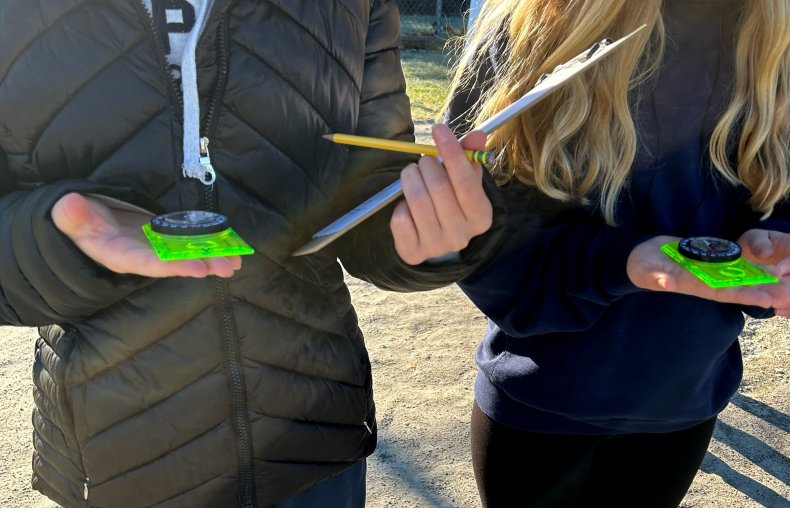
3. Compass Course. In this activity, students use a compass and their knowledge of angles to better understand Earth’s magnetism. Students work in pairs or small groups through several challenges on an athletic field. Challenges include navigating between points by cardinal directions (N-E-S-W) or numerical bearings, taking bearings of each of the bases on the field from home plate, and determining a mystery shape by dropping markers at each bearing and then reflecting on the shape produced by the markers.
As students work together to complete their challenges, they not only build their understanding of magnetism and how to use a compass correctly, but also build their connections to one another as they feel a sense of accomplishment and excitement in completing the tasks.
4. Signs of Spring. This activity is a bit different, as it spans multiple weeks. Over the course of seven Fridays in the spring, students head outside to a designated campus location and make observations about the changing season. Students journal their observations in writing and with drawings. Students focus on a specific spot and return to it each week, noting the changes. After the seven Fridays, students have a collection of drawings and observations that represent the shift into spring.
We then complete a gallery walk back in the classroom, during which students share their work and discuss the signs of spring that they noted.
Nature As A Learning Tool
Just as technology is a classroom tool, nature is a tool in a living classroom. When students take their learning outside, they build a deeper understanding of content and the world around them. Students make important connections: connections between concepts, connections between the built environment and the natural world, and connections as a class through shared outdoor learning experiences.