How to Incorporate the Outdoors Into Elementary Math Learning
Exploring concepts such as observation and measurement in the fresh air can give students a new and playful perspective on math.
Your content has been saved!
Go to My Saved Content.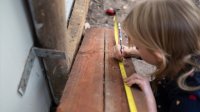
Stepping outside can offer students a fresh perspective on mathematical thinking. The school grounds and other outdoor spaces can provide authentic opportunities for students to observe, measure, estimate, and solve problems in meaningful contexts. Here are some outdoor learning ideas for each math domain.
Measurement and Data
Measurement standards can be practiced in so many different ways outdoors. Consider trying a “Measurement Olympics” type of event. You can set up as many or as few stations as you’d like. Have students rotate throughout the stations, spending about 10–20 minutes at each one, competing with and against each other. This could work before, during, or even after a unit. It would be up to individual teachers or teams of teachers to design how the day would feel: playful and introductory, more structured with a clear teaching/learning component, or a review of all that has been learned with time to practice.
Measurement focused events could include the following:
Measurement hunts: Students measure real-world objects and spaces around school grounds, using a variety of tools and units, and could even work in some conversions.
Water and capacity: Students explore capacity through relays, filling and transfer tasks, and estimation activities.
Design and build: Students create spaces, paths, and obstacle courses while applying area, perimeter, distance, or angle concepts.
Movement and timing: Students collect and analyze data through races or timed challenges.
Chalk, tape, and giant math: Students can use sidewalks and blacktops to create visual representations for angles, area, perimeter, number lines, and measurement comparisons.
Geometry
An outdoor geometry hunt is a simple way to get students outside while still thinking, talking about, and noticing geometric figures. Find space to take students on a walk outdoors to begin exploring. You might give each student a checklist to guide them. Or set students free to explore the playground and school grounds searching for real-world examples of angles, lines, shapes, symmetry, area, perimeter, and more.
They can sketch, photograph, measure, label, or solve geometry challenges using what they find outdoors. The students could even make their own geometry checklist for their peers to complete while on the hunt. This activity allows students to switch hats between being a mathematician and a scientist.
Numbers and Operations
A little fresh air can provide a relaxed setting for students to learn and collaborate with their peers. Students who get to practice math skills outside show more motivation and excitement with the practice and learning. For this specific activity, students roll dice with their peers, multiply the numbers on the dice, and then perform that number of specific exercises. This activity works best with partners. The teacher can decide which exercises they want the students to complete.
For example, in third grade, this routine can be used to solidify addition-focused math facts. Students can sit with partners and each roll two dice. Each partner can add the numbers rolled on the dice together. For example, if Partner A rolls a 6 and a 4, Partner A would have to do 10 jumping jacks. To differentiate this activity, provide students with 10-sided or 12-sided dice. Any math operation could be used, as well. This dice-roll activity is an effective way for mathematicians to practice their facts while incorporating movement into their learning.
Algebraic Concepts
Allowing student mathematicians the opportunity to solve and represent word problems outside is motivating and engaging. Many students struggle with the use of number lines. They are expected to set up the number line as well as use it as a tool to solve problems during instruction.
Number Line Race is an outdoor activity that helps students develop their understanding of number lines and mathematical operations through movement. To set up the activity, the teacher draws a large number line with chalk and labels the tick marks as needed. Students work in teams and are given problems to solve. Team members physically move along the number line to model the operation and determine the answer. The first team to accurately represent and solve the problems earns a point. For example, to solve 3 + 4, a student starts at 3 and moves four spaces forward to land on 7. The activity can be adapted for addition, subtraction, multiplication, division, and fractions while providing students with a kinesthetic learning experience.
In fifth grade, one of the algebraic concept standards revolves around writing and solving simple expressions. Students read a provided expression, such as (4 x 2) + 1. After reading the expression, the group selects a representative for the round, rotating the role so that each student has a turn throughout the activity. The representative then hops intervals of two wholes four times and then hops one more time. At the end, the student should have landed on the number 9.
Giving students an opportunity to practice math skills outside provides them with a different math learning perspective. They get the opportunity to learn math with some movement strategies, but these activities provide students with a safe space to practice math skills with their peers. Moving away from the paper-and-pencil practice motivates mathematicians to try math problems in a different setting, and who doesn’t love a little fresh air?