8 Captivating and Fun Math Writing Tasks
From haikus to math journals and comic strips, there are major benefits when writing is infused into the math curriculum.
Your content has been saved!
Go to My Saved Content.Outside of calculations and formulas, kids don’t expect to write much in math class. Stanzas, paragraphs, and essays typically belong to courses in the humanities, like the study of history and literature.
But mathematics and writing don’t need to be strangers. When regularly paired with math problems, written explanations allow students the time and creativity to articulate their understanding of a solution or concept, opening a window into their mathematical thinking.
By including more writing activities in your math curricula, students “have more opportunities to express their thoughts and ideas in their own words, be creative, and assess their own understanding,” says former math teacher Anthony Persico. From drafting their own word problems to composing math haikus or “shape poems,” writing deepens conceptual understanding, facilitates the precise use of mathematical language, and “makes learning math active, meaningful, and engaging.”
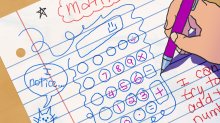
Keep a Math Journal: Whether a student is facing fractions for the first time or working through the intricacies of the quadratic formula, their heads are filled with thoughts about new mathematical concepts, ranging from “this is hard” to their emerging understanding of a thorny new set of problems. Cracking open a math journal gives students time to “try out, explore, and express ideas as solutions evolve,” writes former math teacher Nell McAnelly, recording not only important ideas related to mathematical content but also reflections on the messy process of learning itself.
Encourage students to think about their journal as “a work in progress, without expectation of perfection on every page,” suggests McAnelly, and allow them to express their thoughts in writing, drawings, diagrams, or any other visual element that can help them anchor their thoughts.
McAnelly lists the kinds of journal prompts she likes to use in her class:
- Reflections: These prompts may ask students to reflect on successes and challenges, compare similarities and differences, or identify changes they need to make going forward, McAnelly writes.
- Problem-Solving: A student might articulate their thinking process as they solve a math problem. For example, a geometry teacher might ask their students to explain why they used a certain equation to solve for the missing angle of a triangle, or describe what other methods they might use in the future.
- Topic Development: If students are focused on a specific topic, such as fractions or number lines, a journal can help them track their progress. “Frequent look-backs and corresponding reflections,” says McAnelly, “might provide those aha moments at certain junctures.”
Become a Math Poet: “At first glance, math and poetry seem to be on opposite ends of the academic spectrum,” writes former U.S. Children's Poet Laureate Kenn Nesbitt in his blog. However, when you look closer, you find that both “rely on patterns, structure, and precise use of symbols to convey meaning.”
Nesbitt lists different kinds of poems that can help students reinforce math vocabulary, deepen their conceptual understanding, and view math through their own creative lens.
- Concept Poems: Haikus about symmetry or acrostics on the order of operations infuse playful, personal understanding of esoteric concepts into words and structures that students might feel more connected to.
- Shape Poems: A poem about a shape’s distinctive geometric features, such as a triangle’s sharp angles or a trapezoid’s parallel sides, in the literal shape of a poem (each poetic line creates one side of the shape) helps students “see mathematical ideas in a new way,” Nesbitt says.
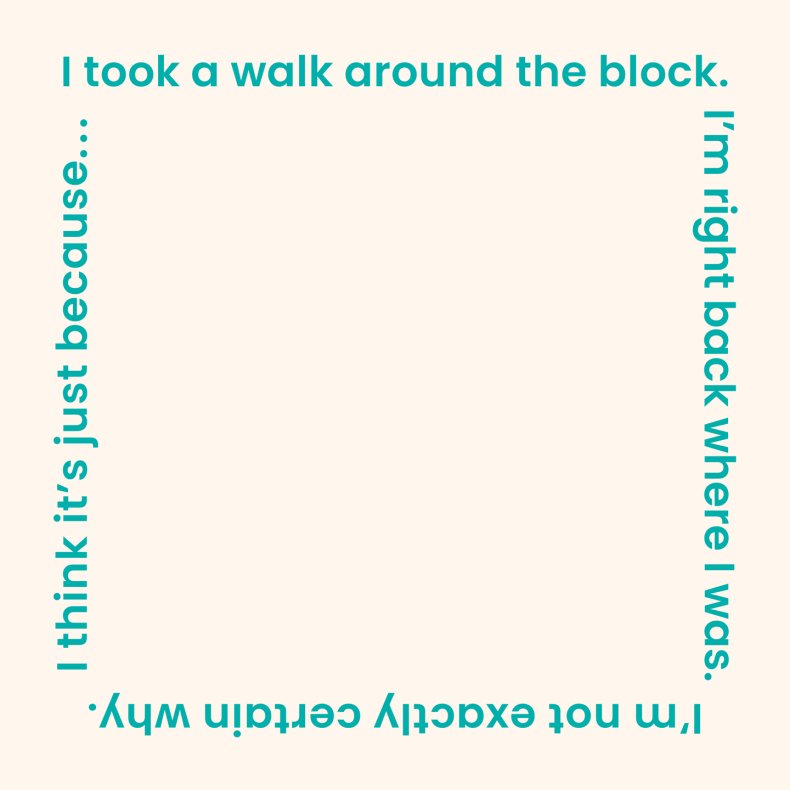
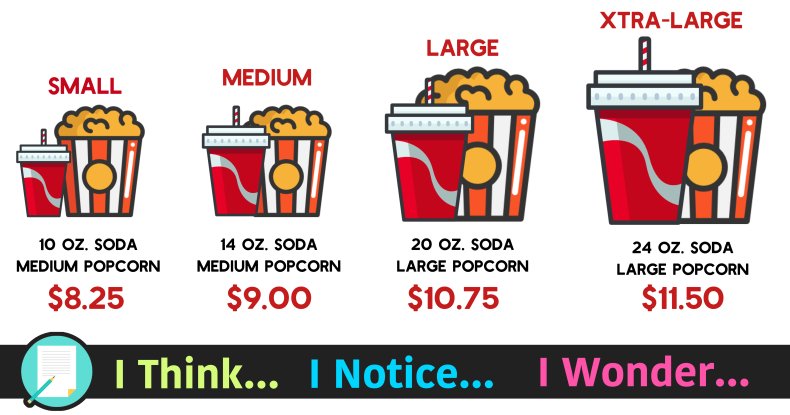
Think-Notice-Wonder: Before embarking on a new mathematical journey, help students organize their thoughts, make connections to real-world applications, and reflect on a brand new math topic with a Think-Notice-Wonder graphic organizer. By finishing and then discussing the open-ended prompts, I think…, I notice…, and I wonder…, students are encouraged “to be more attentive when observing mathematics,” and “identify their own misunderstandings,” writes Persico.
For example, the TNW graphic below encourages students to consider the relationship between the price of a bag of popcorn and a soda based on size. They can write down how they perceive the proportional relationship, “wonder about which option provides the most value, and question how the prices were determined in the first place,” he explains.
Write Your Own Word Problems: Have students apply their own understanding of a mathematical concept by creating their own word problems.
“To create an effective problem, students must thoroughly understand the underlying mathematical concepts, rather than simply applying formulas,” writes former professor of education Matthew Vogel. “Furthermore, writing word problems requires students to develop communication skills that allow them to express mathematical ideas clearly and logically.”
For example, when learning about adding and subtracting fractions, students can write word problems involving recipe ingredients, sports statistics, or distances between locations they frequently travel to and from, suggests Persico. Once their question is drafted, they can swap with a partner and solve each other’s problems.
Some teachers even use student-written problems as bell ringers and exit tickets: Students in Vogel’s class read their problem out loud, then circulate through the room like a teacher as their peers try to solve it, checking in on their progress before finishing the activity by reviewing the solution together.
Break Down Mathematical Thinking: At Concourse Village Elementary, students use a five-step math writing procedure to break down challenging word problems, making these tricky questions easier to understand and solve.
To determine what the word problem is actually asking, the class gets started by reading the problem, annotating it, and then listing all the known variables. Armed with this insight, they describe their goal in an “I have to…” statement—for example, “I have to solve and answer who earned the most points in each round [of a game].” Students then specify the steps they will take on their way to the solution, using “I will” statements like, “I will add all of the points for each player, then compare their total values.” They finish up by sharing observations with their classmates and explaining the connections they made.
The multiple, written steps slow things down for students and allow educators to map student journeys: “we would see their entire thinking process of how to unpack this word problem,” confirms Alexa Sorden, the principal of Concourse Village Elementary.
Ride the Carousel: In this carousel activity, based on the claim-evidence-reasoning (CER) framework, middle school students learn to articulate their mathematical claims, provide evidence for their conclusions, and explain their reasoning. As Connel Cloyd’s middle school math students confront four incorrectly solved math word problems posted around the room, they are required to determine and write down what “Mr. Cloyd did wrong,” and then actively support or refute the claims of other students. By writing and interrogating evidence, they learn the steps of constructing and writing valid mathematical arguments.
“I’d give them a problem, and they’d just want to get to the answer and be done with it,” said Cloyd. Rather than solving to get the right answer, the carousel activity focuses on “slowing down their mathematical thinking,” and building an argument for or against a problem, he says.
Contextualize Math Vocab: “Can we truly pose purposeful questions and facilitate meaningful mathematical discourse if students are unsure of the math terms?” asks fifth-grade educator Kathleen Palmieri in a MiddleWeb article.
No, we cannot.
To ensure that her students understand and can apply terms like “exponent,” “volume,” and “denominator” across lessons, Palmieri has students write out and share definitions with the class. In addition to “math walks,” during which students pre-read new material and decide what math terminology should be added to their shared glossary, Palmieri has developed a range of fun approaches:
- Vocab Posters: Palmieri encourages her students to infuse art into math. On large posters, students pair definitions with graphics, bubble letters, and example problems, making the math more fun and personal. Students then present their posters and define their terms.
- Word Walls: On colorful post-its, students take turns defining key words and then pinning or taping them to a classroom word wall, ultimately helping them remember and deploy crucial mathematical vocabulary as they solve problems or engage in math discussions.
- Word-Problem Group Analysis: As they work to solve word problems, students identify and discuss key words, respond in writing to the problem, and then solve it.
Be a Math Author: Math textbooks are often filled with word problems that depict unfamiliar scenarios for middle or high schoolers, such as homeowners calculating the area of their new rug or landscapers deciding how long to make a fence.
To help her students connect more deeply with math, educator Amy Schwartzbach-Kang has them adapt textbook story problems. As they read chapters of their textbook, they collect and write math problems on index cards, then group similar ones together. Students make up fictional connections between these stories and create backstories and motives for characters mentioned in the problems.
Finally, they develop a longer narrative to connect these scenarios. As authors of chronicles featuring zombie apocalypses or alien invasions, students end up with imaginative stories “rooted in authentic math story problems,” she writes. “When they used creative writing skills to develop math story problems about things they were interested in, students became more engaged.”
Similarly, to inject life into mundane word problems, elementary school teacher Suzanne Ciminesi has her students turn math problems into comic strips, helping students visualize complex word problems full of challenging vocabulary.