Using a Math Menu to Support Student Growth
This workshop-style approach guides students to practice problem-solving independently or with peers while the teacher provides small group or individual support.
Your content has been saved!
Go to My Saved Content.
If you’ve ever found yourself wondering, “What should students who finish early do?” or “How do I find time to work with the students who need me most?” you’re not alone. These are some of the most common pain points in elementary and middle school math classrooms when providing a Multi-Tiered System of Supports (MTSS), and they’re exactly what using a Math Menu as part of your balanced math block is designed to solve.
What Is a Math Menu?
The Math Menu, a concept coined by mathematics educator and author Marilyn Burns, is a workshop-style approach in which students practice computation and problem-solving independently or with peers while engaging with core mathematical ideas (High Leverage Concepts) that anchor grade-level learning and build toward future understanding. At the same time, the teacher meets with small groups for targeted instruction.
Through my work with All Learners Network, I’ve centered Math Menus around three key elements:
- Purposeful, differentiated offerings: Tasks align with important math goals and provide appropriate entry points and challenges for a range of learners.
- Choice and independence: Students choose what to work on, who to work with, and where to work, developing self-management along the way.
- Dedicated small group instruction: Teachers use the time to provide responsive Tier 2 and Tier 3 instruction based on individual and small group goals.
A Completed Math Menu
A well-designed Math Menu typically includes multiple types of offerings. These offerings can be shared in multiple ways, such as on digital learning platforms, through projected slides, writing them on a whiteboard, and via printed menu materials in stapled packets with a cover page (pictured below) or placed in individual folders. Printed materials in stapled packets worked best for my classroom. For my colleagues working with older students, they preferred their materials digitally on their learning management system or digital learning platform.
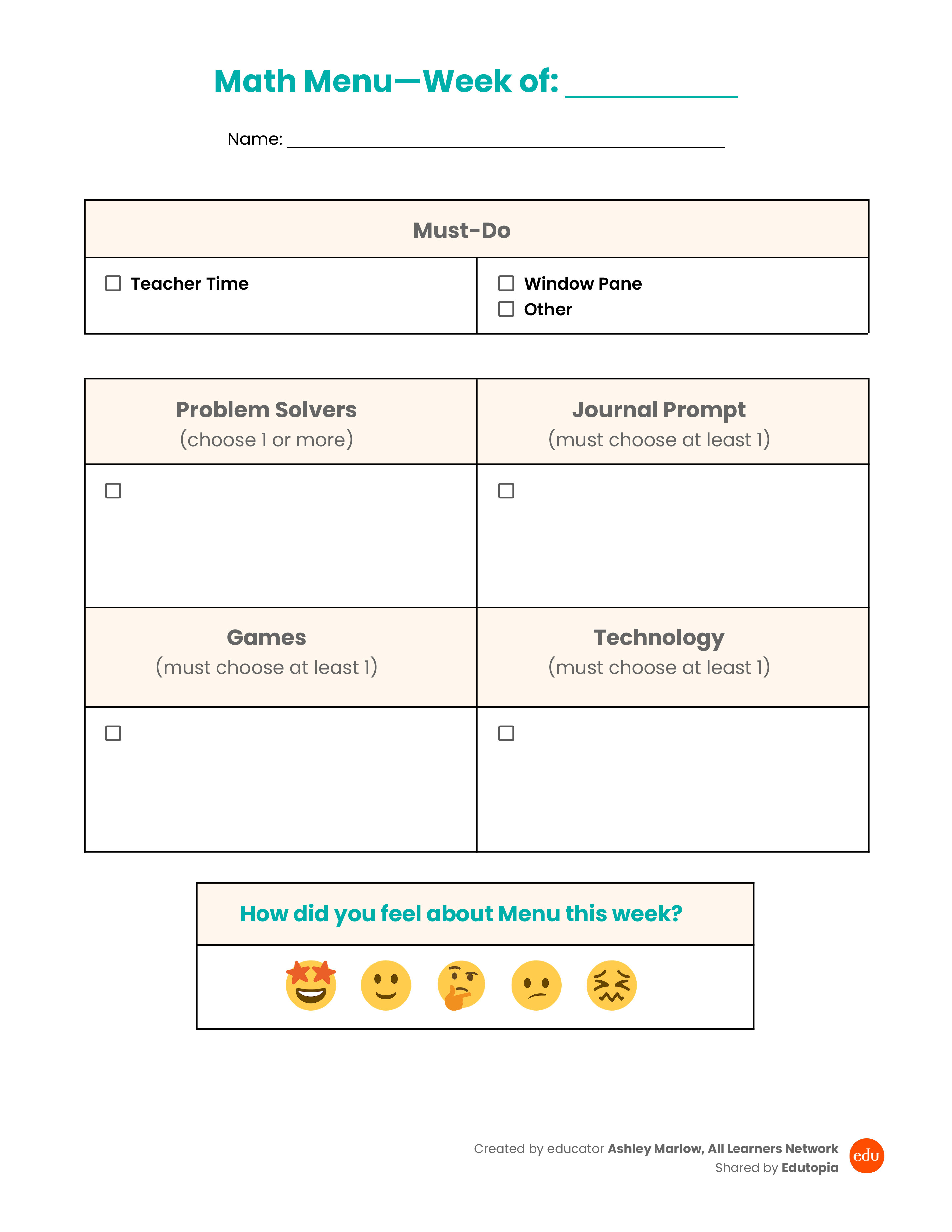
The offerings in a Math Menu can include the following:
- Reflective journals: Students respond to a math prompt, reflect on their thinking, or make sense of a concept in writing. This also includes structured practice in specific skills. For example, a grade six skills practice might include tasks like evaluating expressions and solving percent problems.
- Partner or small group math games: Games promote collaboration and self-selected challenges. Consider the additional practice materials already embedded in your core program and games that use few materials and are easily differentiated.
- Problem-solving: These are open or structured tasks that require mathematical reasoning and problem-solving, but consider context and readability for a variety of learners.
As an elementary educator, I update my menus weekly, but middle-level and high school educators may update theirs every two weeks. My general rule of thumb is to update your menus after four to five sessions.
Overall, a quality Math Menu is designed to help students practice, deepen, and apply concepts they’ve already been introduced to. Because of this, I don’t collect and score every component of students’ Math Menus. I typically determine one “Must Do” that I collect and use as formative assessment to help me make decisions about the next menu.
The Week-by-Week Rollout: Getting Started
The most important advice for launching a Math Menu is to add slowly and build with intention. Don’t try to introduce everything at once. Each week should compound on the last, layering in more components, more choice, and more independence.
Here’s a suggested rollout that I used in my own classroom and continue to use with teachers as a math coach.
Week 1: Introduce Materials and Expectations
The focus is establishing what a Math Menu is and building community agreements. Use a single math game the whole class plays together, while having explicit conversations about the following:
- What does a Math Menu look like?
- What are the students and teacher doing?
- What are our class expectations? (noise level, work spots, partner choice, material management)
Remember, you decide what you’re comfortable with in terms of students generating class expectations. Don’t rush to “do the menu” yet. The time you spend here will pay off for the rest of the year.
Week 2: Introduce Choice
Now students have at least two games to choose from, and they choose their own partner. This is also a good week to introduce some skills practice and a “Must Do” component.
Throughout week two, I also ask students reflective questions like these:
- Which game did you play and why?
- Who did you choose to work with today? How did you know if it was working?
- Where did you choose to sit today? Was that spot a good fit for you?
- What is working well during our menu time? What do we need to improve?
In my experience, even young children are aware of what it looks like to make a “good” choice, because they were able to focus, feel confident, and enjoy the work!
Week 3: Add More Menu Components and Begin Teacher Time
Introduce either problem-solving or reflective journaling (or both, depending on your class). Students should now have multiple game choices, a partner, and at least one “Must Do.”
This is also the week to start bringing students to work with the teacher and/or special educator to receive focused, small group instruction, even for just five to 10 minutes. Clarify what students should do if they need something while the teacher(s) is occupied, and set expectations for how completed work gets turned in.
This is the week you start working on your own organization routines. As you try things, ask your students, “Is this working for you? Do you know how to access the materials for menu time?” to gauge effectiveness.
Week 4: Full Menu Introduction
Students have multiple choices and one or two “Must Dos.” The teacher(s) hold small group practice sessions with each student to build time-management habits and reflect on the choices they’ve been making.
Use this week to troubleshoot and reflect as a class on what is working, what isn’t working, and whether or not students understand all routines.
Weeks 5 and 6: Practice with a Full Menu
These weeks are about solidifying the routine, not introducing anything new. Circulate and reinforce expectations. Pull small groups for short, quick activities and send them back. Gather the formative data you need to form intervention groups. Keep reflecting on norms and routines.
In my experience, the first few weeks of the rollout lost some instructional minutes related to math content goals, but it allowed the rest of the year to go much more smoothly with focused work and small group instructional time. When the routine is running well, every student is independently engaged in meaningful mathematical work at the right level of challenge, and you have protected time to provide targeted small group instruction.