Creating Classroom Community Agreements in the Middle Grades
Through purposeful questioning, teachers can empower students to agree on norms that foster trust, belonging, and shared responsibility.
Your content has been saved!
Go to My Saved Content.
When I was a student in the 1980s and ’90s, we called them “classroom rules.” They were usually posted somewhere prominent, read once by the teacher at the beginning of the school year, and enforced sporadically. I’m old enough to remember when expectations or agreements for classroom behavior, collaboration, and engagement were established solely by the teacher or administration and posted as a rigid, unchanging set of rules. Fortunately, brain and human development research has guided most educators toward a different way.
My own process for establishing classroom norms, expectations, and agreements has evolved over my 25-year career as an educator. While I never implemented an old-school, teacher-established list of rules, even when I talked about cocreating norms, I often had my own list tucked away in the back of my mind, and I secretly wanted students to (rapidly) get to my rules. As a novice educator, I would not so subtly guide them there, completely unaware that I was effectively eliminating genuine curiosity, student choice, and culturally sustaining practices from the process.
Shifting from a direct-instruction, teacher-centered mindset to an inquiry-based, student-centered mindset when creating authentic community agreements all hinged upon one important shift: I needed to start asking good questions. And in order to ask the best questions, I needed to get intensely curious about my students, while acknowledging that they are different (from me and from each other) in so many ways.
Asking the Best Questions
When I design professional development opportunities for educators, I love to ask them a series of questions starting with the prompt: Think back to a time when you learned something (skill or topic), and you valued the experience. The full list of questions is in this document:
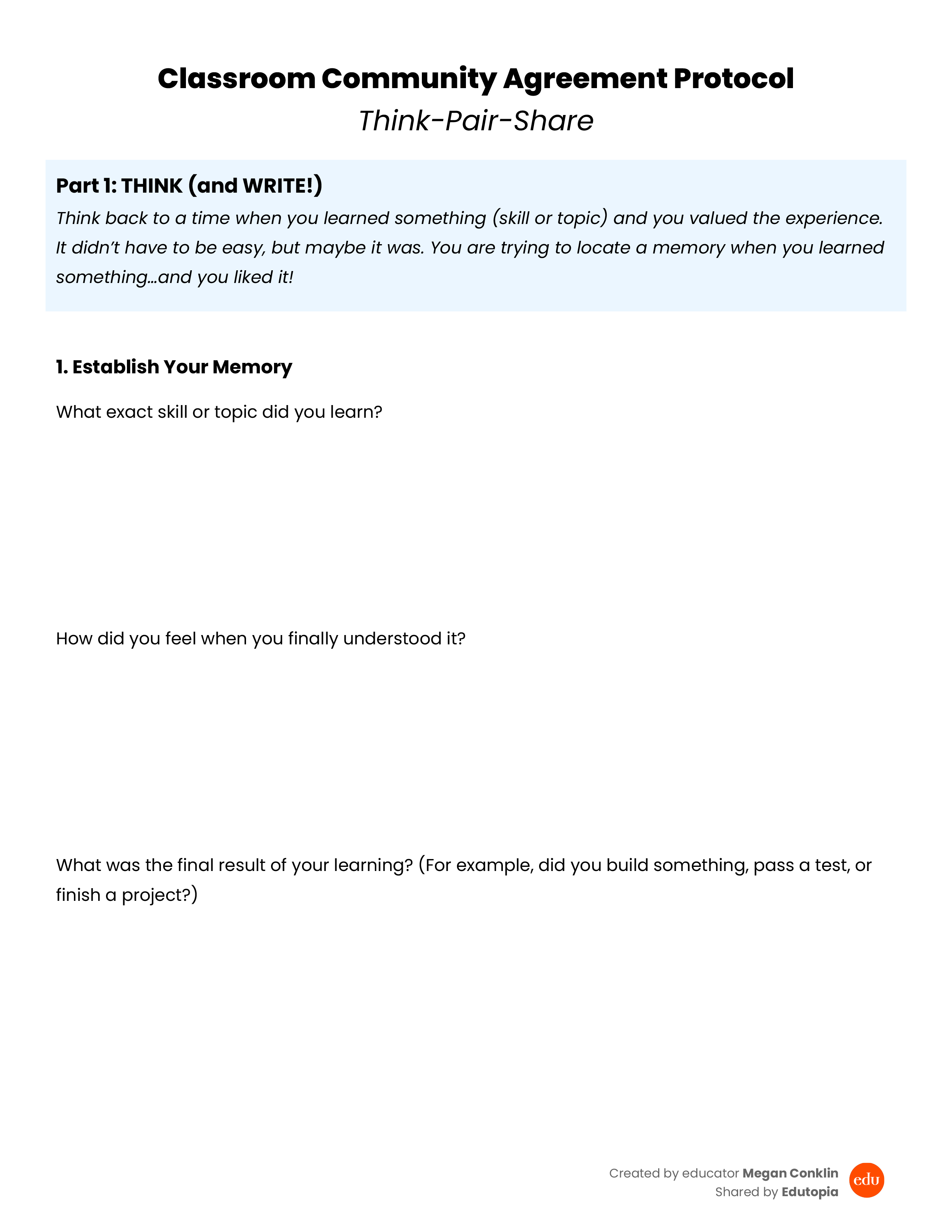
This series of questions allows teachers to reflect on their own learning experiences and recall what it was like to have both productive and unproductive ones. This is a powerful exercise with educators, but it was even more useful when I brought it to my students. This reflection process takes about 30 to 45 minutes and is best implemented at the very beginning of the school year, term, or semester. It establishes a baseline of trust right from the start of class.
To move from students’ individual memories to a community agreement, transition the class through the handout’s prompts to recognize common themes. During the Pair step, ask students to share patterns they noticed, such as times when they needed a quieter room or appreciated mistakes being normalized and treated as learning opportunities. During the Share step, guide the whole class discussion by asking, “Since we all value learning environments where we feel supported and can make mistakes, what do we need from each other to make this classroom feel that way?” Then, translate the answers—like needing patience or uninterrupted work time—directly into a cocreated list of community agreements.
An Alternate Approach
Corey Jackson, an elementary principal in Hillsborough County Public Schools, uses a different five-step process that acknowledges the importance of making the community agreement process recursive.
His final step is the one we ignore the most: reviewing and updating class agreements. I often spend a lot of time making these agreements at the start of class, only to forget about them. Instead, educators and students need a plan that forces us to review and adjust our agreements together as a community.
I build our agreement revisits into established routines and procedures to ensure that we don’t skip this essential step. For example, our school community has a “Word of the Month” program, and each word teaches a focused character or social and emotional learning skill. Each month, when we introduce the new word, such as compassion or perseverance, my class rereads our community agreements and highlights places where the word is relevant. We then have a chance to edit or add to our community agreements.
The benefits of student voice
Allowing time for students to share core beliefs and reflect upon their own cultural norms, when done in a way that allows for differentiated participation, can be a valuable, culturally sustaining practice to establish in a school or classroom environment. Teachers play a critical role in establishing classroom rules by acting as expert facilitators and guides. Balancing student voice with teacher-driven expectations requires co-creating a living document where students’ core values align with essential, nonnegotiable boundaries for safety, respect, and learning.
When teachers provide the core framework—such as physical safety and academic integrity—they may then invite students to define what those expectations look, sound, and feel like in practice. Our job is to translate the student-generated ideas into positive, actionable norms, while ensuring a balance where authentic student voice drives the classroom culture and the teacher maintains consistency and impartiality.
Rachael Grech-Scott, a gifted intervention specialist in Ohio, centers student voices when establishing agreements and expectations in her classroom: “One year, I had a group that really wanted a quiet environment, but half the class liked music and noise. This was a middle school class—seventh or eighth grade—and I remember that year, we took some time to hammer out what ‘quiet’ meant.… There was conversation—student-led—about productive noise versus disruptive noise, and I was able to give labels to their examples. In the end, they came up with an agreement everyone could live with, and I strongly believe that was because students felt heard, and students were able to have a say about their learning environment.”
Research supports Grech-Scott’s assertion that including student voices in establishing interpersonal agreements in classrooms can foster student success. The 2024 research brief Strengthening School Connectedness to Increase Student Success concurs that “when teachers proactively address social dynamics and foster positive interactions in the classroom, students report feeling more connected to their peers.”
There are no “perfect” questions to ask when brainstorming community agreements; rather, it is about taking the time to ask both educators and learners to reflect upon their own needs and experiences in order to create a productive and equitable learning environment for many different humans.