What Is Your Building Communicating to Students?
It can be eye-opening to walk through your school with a student persona in mind, and the audit tool included here can help you find and fix friction points and improve students’ sense of belonging.
Your content has been saved!
Go to My Saved Content.A student in a wheelchair sees the front stairs and scans the building for an accessible entrance.
A student with ADHD is bombarded with posters and flyers on every wall—so much information that they can’t concentrate on the simple task of finding the flyer for the next art club meeting.
A student with anxiety sees a huge campus where the 500s hallway leads to the 700s hall and immediately panics, clueless about where classroom 205 might be. Many schools, including our own, ask students to navigate spaces that can feel unfamiliar and confusing.
What do they all have in common?
The building doesn’t feel like it’s designed for them—instead it seems to be purposefully putting obstacles in their path.
Educators spend tremendous amounts of time discussing curriculum, instruction, assessment, and school culture. Yet sometimes simple solutions that truly move the needle are hiding in plain sight, in the building itself.
The Hidden User Experience of School
What the students above experience are not curriculum problems but rather problems of user experience, which refers to the ease with which a person interacts with a product or system.
We can connect user experience to students’ interactions with the school building using psychologist James Gibson’s concept of affordances, the cues in an environment that communicate what actions are possible. A ramp affords access. An uncluttered environment affords focus. A clearly marked hallway affords navigation. When affordances are clear, people move confidently through a space. When they are unclear, confusion, frustration, and anxiety often follow.
Educators rarely think of their buildings as user interfaces, yet students interact with hundreds of design decisions every day. Signs tell them where to go and communicate whether they are welcome. Common areas signal where students belong. Before a principal sets expectations or a teacher explains classroom rules, the environment is already teaching students something.
Research consistently shows that students who feel the environment communicates that they are safe, welcome, and connected are more likely to engage in learning, build relationships, and persist through challenges. And the environment communicates those messages even before instruction begins.
In other words, belonging starts before the first lesson.
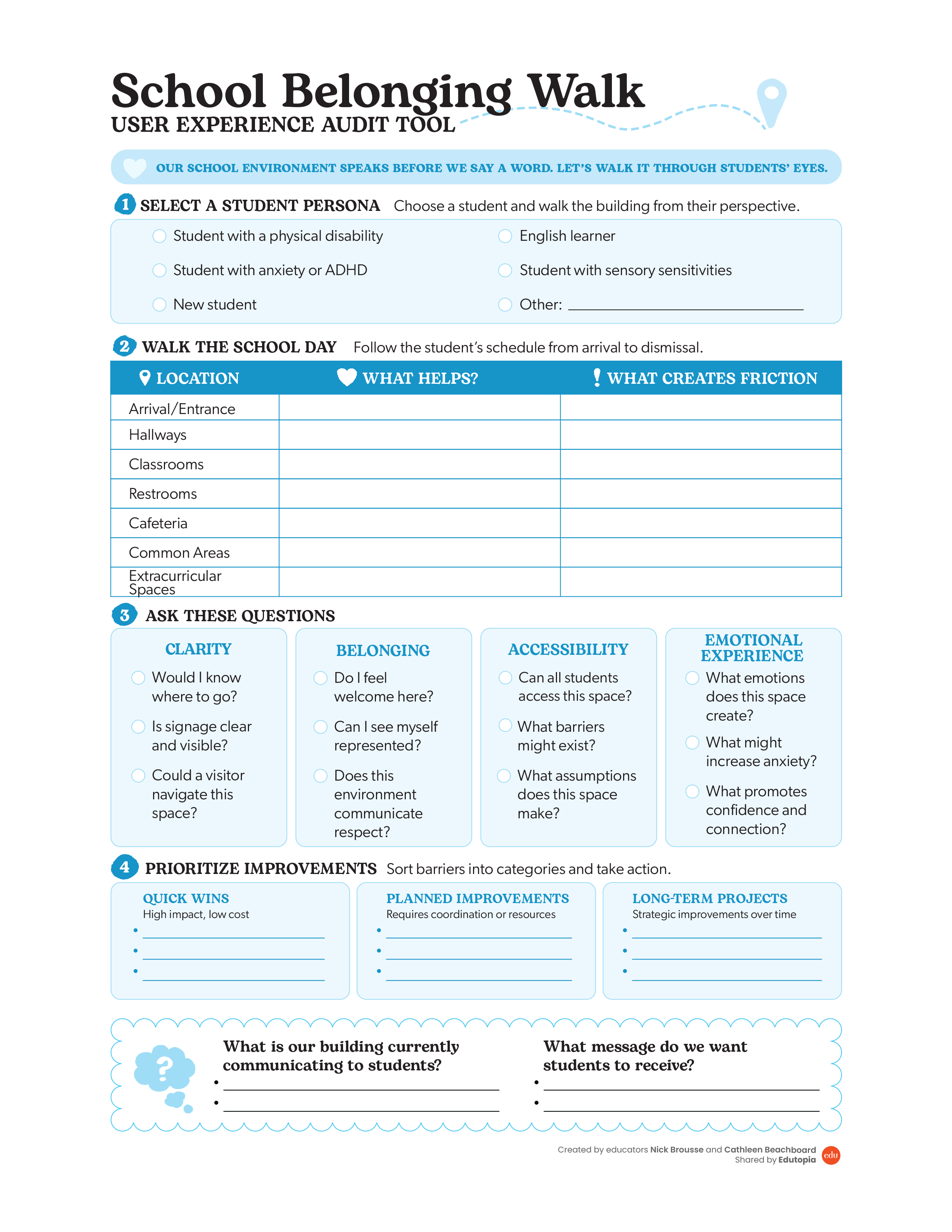
One way schools can uncover barriers hidden in plain sight is through what we came to call a Belonging Walk, a user experience audit that allows educators to experience school through the eyes of their students. To help, we’ve created this free one-page School Belonging Walk User Experience Audit Tool for you to download.
How to Conduct a Belonging Walk
1. Walk the building using a student’s viewpoint. Cathleen and I assumed the roles of two different students in our building: one with a physical disability and one with anxiety. We printed their schedules and moved through their entire school day, start to finish.
We began at the bus ramp and followed their route to classrooms, restrooms, the cafeteria, the common areas, places to meet friends, and rooms for after-school activities. No shortcuts. No assumptions. We simply experienced the school exactly as those students would.
How to do this: Imagine three to five students who face barriers to learning or belonging. Consider students with disabilities, anxiety, ADHD, language barriers, or mobility challenges, or those who are new to the school. As you begin your walk, step into those students’ thought processes, and along each part of their day, stop and consider everything from seasonal changes to big school events to common activities like visiting the clinic or participating in a fire drill.
2. Notice what the environment communicates. As Cathleen and I discussed what we observed, we had to resist our natural urge to immediately solve problems. Instead, we focused on identifying every barrier we could find, regardless of how large or small it seemed.
We stopped frequently and asked ourselves questions:
- How does this space make me feel?
- What is helping me?
- What is making this experience harder?
- What might feel confusing, stressful, or overwhelming?
In one department, we immediately noticed that excessive visuals made it hard for Cathleen, who was role-playing a student with anxiety, to concentrate and find her way. Other areas were cleaner, calmer, and easier to process. Those spaces became examples of how to reduce friction and increase comfort.
How to do this: Bring a notebook and document everything. Follow the students’ schedules from arrival to dismissal. Pause at intersections, stairwells, bulletin boards, entrances, and gathering spaces. Ask yourself:
- Is this clear?
- Do I feel welcome and included?
- What assumptions does this space make?
- What barriers affect specific students?
- Which barriers affect everyone?
The goal is not to judge the school but to understand the experience.
3. Fix the friction points. When Cathleen and I reviewed our notes, one opportunity immediately stood out: better signage.
Our gymnasium, auditorium, and cafeteria regularly host school and community events, and navigating those spaces is not always intuitive. Clearer signs would improve the experience for students, visitors, families, substitute teachers, and staff.
What surprised us was how many people would benefit from the same solutions. Better signage would help freshmen navigate a large campus, reduce anxiety for new students, improve accessibility for visitors, and create a stronger sense of confidence and belonging.
These were not expensive renovations. They were friction points that could be addressed quickly.
How to do this: Gather your observations and sort barriers into three categories:
- Quick wins: High-impact changes that can be implemented immediately. For us, clearer directional signage would help students, families, substitute teachers, and visitors navigate with confidence, and designated sign protectors would reduce visual clutter by keeping announcements organized and ensuring that important information was easy to find.
- Planned improvements: Changes requiring additional resources or coordination. In our building, replacing the unreliable wheelchair lift in the annex with a permanent ramp would communicate that accessibility is an expectation, not an afterthought.
- Long-term projects: Larger, systematic improvements that require strategic planning. Adding benches to our outdoor classrooms would make those spaces more accessible and inviting, while furnishing larger common areas would allow teachers to move learning beyond the traditional classroom, collaborate more easily, and provide flexible spaces for small-group instruction.
Start with the quick wins. These small improvements help build momentum and demonstrate that student experiences matter.
You can’t create a perfect building in one day, but you can continually remove barriers that prevent students from fully participating in school.
The Bigger Message
We often try to build belonging through programs, assemblies, posters, and initiatives. Those efforts matter, but belonging is not created by posters that say “You Belong Here.” Every hallway, sign, staircase, doorway, bulletin board, and classroom sends a message.
The question is: What is your school communicating?