Setting Up Environmental Challenges to Boost Students’ Sense of Community
From outdoor cleanups to plastics reuse, an environmental challenge can foster school pride and students’ appreciation for where they live.
Your content has been saved!
Go to My Saved Content.
How do you mobilize 600 students to get excited about recycling, passionate about their local environment, and empowered to engage in civic responsibilities?
Here’s how you can bring schoolwide environmental events to your school, along with three events we’ve used at our school to create a culture of stewardship and help students develop the confidence to grow as future changemakers.
Getting Started
Stewardship challenges can encourage civic responsibility and pride for the place in which they live. At our school, we foster this by challenging students to participate in stewardship activities, which include everyday actions to reduce, reuse, and recycle. We provide students with the choice board pictured below that is filled with actions that young students can do independently or with some support.
Participation is optional, but our students and families love this challenge and are excited to participate. The choices on the board have some flexibility, as we understand that some of our students may not have the ability to participate in all of the optional activities. To encourage participation, we will have days throughout the month of April (Earth Month) when we clean our school playground and sign off on choice boards for students who participate. We also give a small prize like stickers to students who complete a minimum of three activities during Earth Month as a way to increase engagement and participation and create an inclusive environment to participate.
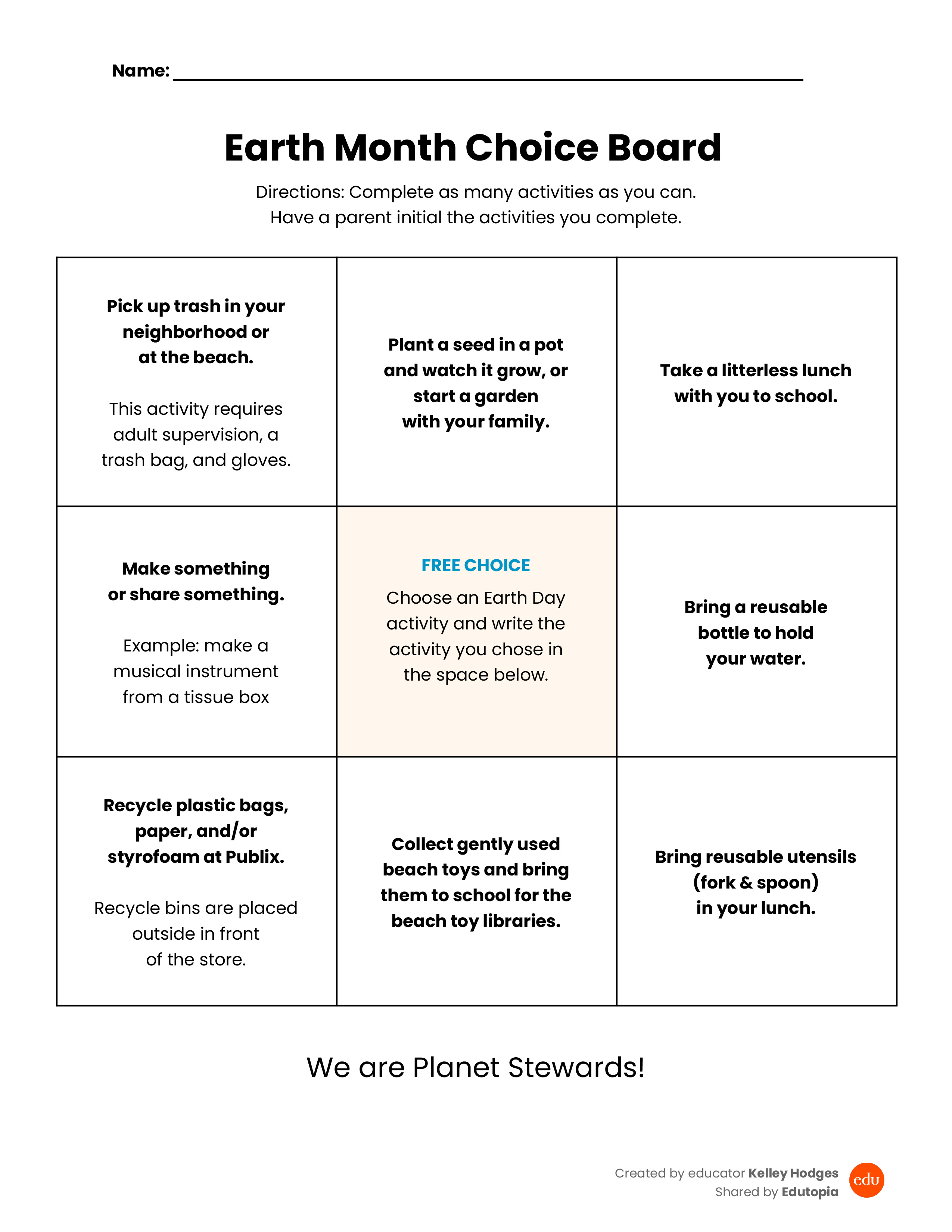
Here’s how our school channeled this eager participation into schoolwide activities.
1. Coastal Cleanups
Our school and community are just miles from a major body of water and surrounded by interconnected waterways. Our first schoolwide challenge happened after a virtual field trip with Turtle Trash Collectors, where students learned that one of their favorite animals was ingesting plastic bags, straws, and other marine debris. Shortly after the virtual field trip, we discovered that many of our students were asking family members to stop using plastic straws to save the sea turtles.
Encouraged by their desire to make a difference, we decided to take our ideas a step further by participating in the International Coastal Cleanup Day. This worldwide event encourages individuals and organizations to remove trash from communities and waterways around the world.
We collaborated with a local beachfront restaurant to host an event on a Saturday morning that all of our school families were invited to attend. We had support for the event from the restaurant, which provided parking, a meeting space, and trash cans. We also had support from our local high school and university, with students earning volunteer hours to help with setup, cleanup, and trash removal. About 100 school community members showed up and removed more than 100 pounds of trash that day.
We collected, cleaned, sorted, and displayed the trash in our STEAM Lab so students could incorporate it into NGSS-aligned science lessons. Examples of lessons include Watersheds to Whales and Who Polluted the River?
2. Transforming Plastic
Listening to students, it became clear they were eager to do more. We reached out to a regional company that recycles plastic into benches, tables, chairs, and garden beds (Green Tree Plastics) and connected with local organizations that had successfully collected and recycled plastic lids into benches and tables.
We learned that we needed 350 pounds of plastic lids to create a buddy bench and a plan for cleaning, sorting, and storing the lids. We met with our principal and fellow educators for permission and support. During the meeting, we communicated an ongoing interest from students to engage in stewardship, shared our plan for collecting and storing the plastic lids, and shared our idea for generating interest and excitement for the project. We also communicated that the project would expand on school and district goals, which include increasing engagement, bringing hands-on learning experiences that build student learning, and providing opportunities for students to lead and serve.
Upon receiving approval, we moved forward with sharing the project with our school and community through classroom newsletters, student-made posters placed around our school’s campus, and social media.
The challenge started in August, and by October, our school collected more than 500 pounds of lids—surpassing our goal of 250 pounds—which were transformed into a buddy bench for our school. This project provided the opportunity for students to see that their actions could improve the world in which they live; the more they realized that they were changemakers, the more they wanted to be them.
3. Art Contest
We also host a yearly schoolwide art contest, encouraging students to draw pictures about their stewardship actions and favorite animals. Our themes are directly connected to the place in which we live; beaches and waterways are our backyard and playground. Recent themes included “Be a Hero for the Ocean: Imagine you and your friends and family as ocean protectors helping clean up marine debris” and “If the Ocean Could Talk: Marine animals share messages about keeping their home clean.”
Students draw pictures on 8.5x11 plain paper using markers, crayons, or paint, and the art is then displayed in our STEAM Lab. Some students may have limited resources; we also provide opportunities for them to participate during normal school hours or provide materials, such as paper and markers. Students who participate in the challenges get small prizes like stickers.
At the end of the contest period, all submitted artwork is displayed in the STEAM Lab, and winners are chosen based on the artwork’s connection to the theme. We also choose one to two winners per grade level. Once the winning artwork is chosen, the artwork is sent to a local sign maker who takes the images and turns them into large vinyl stickers that are installed on trash cans. When the trash cans are complete, we share the winning artwork with our community at district events, at our local civic centers, and throughout our school campus.
Starting Your Own Challenge
Other stewardship challenges can include recycling used broken crayons through the National Crayon Recycling Program, pop tabs for the Ronald McDonald House, children’s books and toys for free book libraries, or cardboard for STEM projects at your school.
When organizing your own schoolwide challenge, it’s important to consider the following:
- Researching the idea and communicating with local organizations that have done similar programs
- The extra planning time a project may take
- Making the schoolwide challenge accessible and relevant to student interests
- Connecting the schoolwide challenge to science standards so students can make real-world connections to their learning
- Making it fun and joyful by providing small incentives to participate (e.g., lunch with the teacher, extra recess time, stickers)
- Sharing the challenge, updates, and data in classroom newsletters, on social media platforms, with local conservation organizations, and at schoolwide functions