Building Students’ Scientific Skills Through Observation
Feathers provide students the opportunity to explore how the particular form of an object impacts its function.
Your content has been saved!
Go to My Saved Content.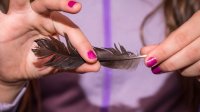
“Form follows function” is a commonly referenced design principle that basically states that the design of a building should reflect the purpose of that building. That idea got me thinking about how this could also be true in nature: There are many examples of how the relationship between how something in nature is shaped and what it does. Building on this, I’ve found that if students closely observe natural artifacts, they can generate meaningful hypotheses about how the details they notice help the organism survive.
Children understand this almost instinctively, even if they can’t immediately articulate the principle. If you ask a child why a frog is green, they might say something like, “The frog is green because it lives in a green place.” That is basically correct; natural selection tends to favor organisms that blend into their surroundings—so it is likely that most frogs are green because that is beneficial for blending into a green environment.
I wanted to find a way to help students practice this kind of close observation and hypothesis creation. I found that feathers offer students the opportunity to observe very closely, create descriptions, and generate hypotheses that ultimately improve their understanding of evolution. Plus, they are very easy to collect, so teachers can quickly create a collection for their classroom.
A note on collecting: Under the Migratory Bird Treaty Act, it is illegal to possess feathers from most native North American birds, even feathers found on the ground, so teachers should build their classroom collections from lawful sources (e.g., feathers from non-native species like rock pigeons, house sparrows, and European starlings, or from the feathers of domestic birds like chickens, turkeys, and peacocks, all of which are widely available from craft and science suppliers). Eagle feathers are subject to even stricter protections.
Feathers are beautiful to look at, do not break down easily, and don’t require anything to preserve them, so they provide a great artifact to collect in your classroom. Once you have a collection, students can use them to practice making measurements, writing observations, and generating questions.
3 WAYS TO USE FEATHERS IN THE SCIENCE CLASSROOM
Below are three ways feathers can be used to help middle and high school students build their scientific skills. Each activity introduces more rigor, allowing teachers to choose what works best for their classroom.
1. Carefully observing a single feather. A single feather offers a great opportunity for students to closely observe an object and generate questions. For example, students can observe the color, texture, and size of each quill and measure the length of a quill or the entire feather. From there, students can generate questions about what kind of bird it may have come from, why certain characteristics are present, and what those characteristics allow a bird to do.
As students are working to describe a single feather, it is important to encourage them to use scientific vocabulary. To help, I provide a worksheet with relevant vocabulary to help my students write their observations more scientifically.
2. Comparing feathers within and between species. Feathers generally fall into one of seven different categories. Each type of feather is helping the bird do something different. When you have a large collection of feathers, you are able to compare them and get a bigger picture of a species.
Because of that, it is helpful to have students examine different kinds of feathers from either the same species or different species so that they can make comparisons and draw conclusions about what those feather may do. For example, I will give students multiple different kinds of feathers, like down, contour, and wing feathers, to examine and discuss.
Students may notice that wing feathers have a natural waterproofing and are more rigid, while down feathers have a much looser structure and are shorter. These observations allow students to recognize how the structure of each feather is aligned with the function it serves, reinforcing the idea that form follows function.
3. Using feathers to help students explore evolution. In my class this past year, I taught a unit on evolutionary biology using the New York City rock pigeon as the focal species to help students understand natural selection.
Students began by closely examining different types of feathers in class, and then went outside to observe pigeons in their natural habitats. I encouraged students to look for pigeons as they walked home from school, or anytime they were outside in the city. Students observed pigeons hanging out in groups on perches and traffic lights, playing in water and puffing their feathers in displays of machismo.
After observing the different feathers and watching the pigeons in real life, students were able to draw conclusions between the behaviors they saw and the different feather types they explored. From there, we were able to explore as a class why the New York City rock pigeon was so well suited for its environment.
We then compared the New York City rock pigeon with other birds through online research to note how birds in other environments had evolved to have different feathers that led them to be better equipped to survive in different habitats.
Rather than exploring a different species as a class, you can also have each student select their own species of bird to learn about through online research and compare with the New York City rock pigeon. Once each student has identified notable differences, they can share out in small groups or with the entire class, allowing for greater participation and exploration of the evolutionary differences present in different birds.
This activity helped make the evolutionary process more concrete, as students could see the results both through the feathers we explored in the classroom and through the pigeons they observed outside.
By spending time closely observing something as simple as a feather, students can build an appreciation for the world around them and learn to get curious about what they notice.