Letting Student Questions Guide Learning
When preschool teachers use students’ natural curiosity to set up activities, lessons become more meaningful and engaging.
Your content has been saved!
Go to My Saved Content.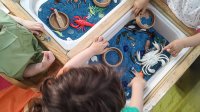
After reading the story Tadpole to Frog, my pre-K students were suddenly very interested in creating a pond with real frogs for the classroom. Unfortunately to them, that wasn’t an option. But I still wanted to leverage their excitement and their curiosity about pond life into something productive. We decided to create a pond in our classroom sensory bin.
Even without real frogs, the children were excited and curious. They looked around the classroom for materials and used their creativity and imagination to turn their excitement into a pretend pond.
They began drawing what they imagined belonged in a pond: fish, ducks, and turtles. Some children chose toy frogs and ducks from our table toys bins, and others used glass fillers and blue construction paper to represent water.
As students excitedly worked to put their pond together, I heard them continuously ask questions like “What else lives in a pond?” “How many fish could be in our pond?” “How much water should be in the pond?” “Can we have ducks in this pond?” As I heard their questions, I knew they were truly engaged in what we were doing.
LETTING STUDENT CURIOSITY LEAD LEARNING
From our pond activity, I learned that the more time I gave students to think about and explore content, the more questions they asked, and the easier it was for me to align activities with their interests.
In one example of this, I wanted students to learn about seeds and how things grow. Instead of just telling students, I began by giving each small group of students a collection of different kinds of seeds all mixed together and asked them to sort the seeds.
I didn’t tell students what the seeds were or how to sort them, I just told them to sort. Students began asking questions about what each seed could become, why some were bigger than others, and why some had harder outsides than others. After students sorted their seeds, each group shared how they sorted, and this sparked even more questions about colors, shapes, and textures.
Students were eager to learn what would grow from these seeds, so I let that curiosity guide our next steps and decided that we would plant some of the seeds as a class. Students asked if we could plant all the seeds together, how much water and soil they needed, and how much sunlight they would need.
All of these questions shaped our planting. I let students try placing their seeds in different arrangements and in different places around the room.
After this, students would check on their seeds during the week and make observations and ask more questions. They noticed when tiny roots started growing and how much their seeds changed over time and questioned what the seeds of different plants might look like.
In another example, students turned our class discussion about Earth Day into an active sustainability walk around our school. I started the discussion by asking students how we could take care of the Earth. Students began sharing ideas, and I encouraged them to ask each other questions about those ideas.
In one example, a student shared that we should not litter, and another student asked what we should do if we see litter and why some people litter to begin with. This led to even more questions about why there aren’t always garbage cans around, who should clean up, and what happens to the litter that stays on the ground.;
After this discussion, students asked if they could pick up litter that they had seen around the school. I hadn’t planned to take this activity outside, but their interest made it clear that we should do something to take our learning from discussion to action. Students got rubber gloves and garbage bags, and we took a litter-pick-up walk around the school together.
Students excitedly stated how they were helping the Earth and improving the community together.
ENGAGING STUDENTS IN ONGOING EXPLORATION
In addition to letting student curiosity guide our activities, I’ve worked to find ways to extend their curiosity into an ongoing exploration. This not only keeps students engaged for longer, but also teaches them to revisit a topic and add new information to their understanding.
In one example of this, we brought real tadpoles into the classroom. They weren’t in a pond, but in a small fish tank. The students named them Pickle and Sues. Students began asking questions about them right away: “What do they eat?” “Do they have a mom?” “Are they looking for their family?” We talked about what living things need, helped feed Pickle and Sues, and kept checking on them each day. Soon, the children started noticing small changes, making guesses about what might happen next, and talking with each other about what they saw.
Over time, Pickle and Sues changed and became frogs. When it was time to release them outside, some children looked sad. They had watched them grow every day and had become attached to them. One child asked, “Can they visit us again?” The prolonged exploration of the tadpoles as they turned into frogs deepened students’ interest in the animals and their life cycle and allowed us to keep talking about them over the course of many weeks.
Releasing them became an important part of the experience. We talked about how frogs, bugs, and other animals belong outside because nature is their home. It also helped the children understand that sometimes we have to let things go, even when we really like them.
When lessons create space for students to be curious—asking questions, exploring, and interacting with one another—they build understanding that stays with them. In my own classroom, I’ve been able to leverage students’ curiosity to create activities and have discussions that my students are genuinely interested in. Sometimes, all you need to do to boost engagement is slow down and listen to what children are asking, and create enough space for them to keep asking questions.