Developing Real-World Skills in the Classroom
Small, intentional adjustments in instruction can help teachers foster students’ communication, critical thinking, and social and emotional skills.
Your content has been saved!
Go to My Saved Content.
Students today are living in a very different reality to those from 50 years ago. But much of what makes a capable young adult, and the skills we as teachers are hoping to help our students build, haven’t changed.
In most classrooms, teachers are already building these important skills, like communication, creative thinking, and problem-solving, in their everyday classroom moments. The trick is to notice those moments and use them more deliberately. In my own classroom, I’ve relied on a number of low-lift, high-impact strategies that help students build the skills they need to successfully enter the workforce and navigate the world beyond our classroom.
BUILDING COLLABORATION AND COMMUNICATION SKILLS
Every teacher has had that moment when we’ve sent students off in pairs or small groups and they just can’t seem to get a conversation going.
While sometimes it is because students don’t know the content information needed to answer the question, often it is because students don’t have the skills they need to engage in a productive discussion.Communication skills allow students to develop language, build relationships, express ideas, and collaborate. Collaboration, in turn, helps them grow metacognitively; learn how to listen, negotiate, and problem-solve; and become more confident public speakers.
In my classes, I intentionally plan for these moments. If students are struggling to get started in a discussion, I will display a slide with discussion points and sentence stems to support dialogue, such as “I found it interesting when… because…” or, “I disagree with X because I remember that…”
When students are working in groups of four or more, I’ll also assign group roles so that students know how they can contribute meaningfully, building the range of skills that successful teamwork needs. In this way, not only are students developing language, but they have a purposeful place to practice it.
BUILDING CRITICAL THINKING SKILLS
As students get older, they will increasingly need to evaluate information and make decisions. The ability to think critically will influence both minor and major life choices, from whether to trust a headline to choosing a career. The first, zero-prep way I help students build their critical thinking skills is through guided self-correction via questioning.
This means instead of giving students answers, I guide them toward an appropriate conclusion. When they say, “I’m stuck,” I ask questions like these:
- What have you tried?
- Why do you think that didn’t work?
- Can you break this into smaller steps?
- If you had to guess, what would you guess, and why?
These open-ended questions model the internal monologue of a critical thinker, which—with enough practice—they will start to do independently. I also help students learn how to constructively evaluate the thinking of their peers to continue to deepen their critical thinking skills.
I introduced a protocol called Praise-Question-Polish in which students give one piece of positive feedback, then ask a question, and then offer a suggestion to further improve their peer’s work.
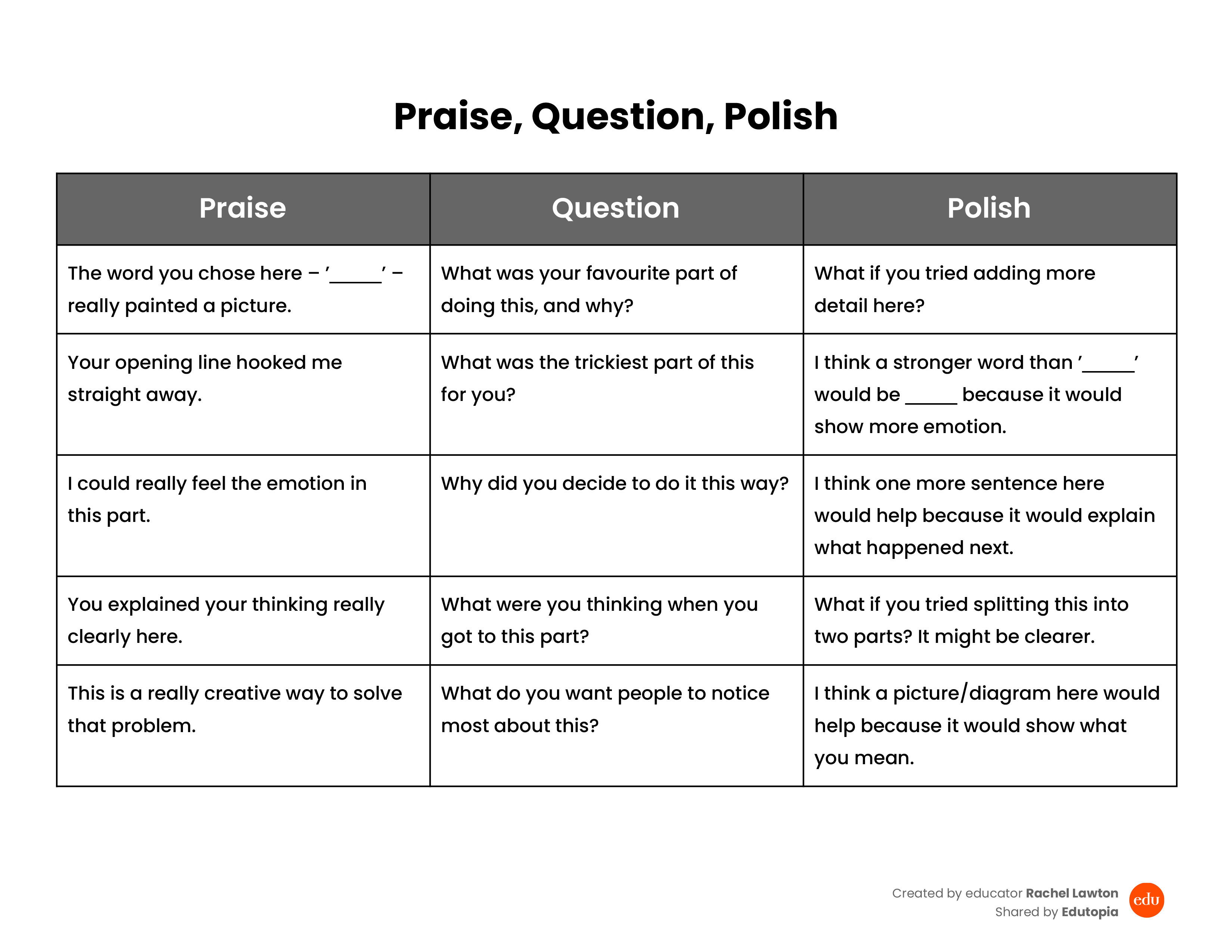
I have a classroom anchor chart with this protocol to remind students of it and ensure that they can effectively use it as they practice the critical thinking skills of noticing, questioning, and improving.
BUILDING CREATIVE-THINKING SKILLS
Creativity is one of the most prized professional skills. Although it’s often associated with the arts, being a creative thinker means being able to look at challenges with an open mindset and find original solutions. It’s intrinsically motivating, building mental flexibility and a growth mindset.
One way I plan for creative thinking is through varied lesson starters. I might give students a sentence or image and ask them to create a story around it. Or I’ll shift the thinking responsibility to them with a reversible question, such as “The answer is yellow; what’s the question?”
Another way to promote creativity is to give students choice over how they express their learning. They may choose to write or to draw, to speak their answer or show it through movement.
BUILDING EMOTIONAL INTELLIGENCE
Feeling emotions is not a uniquely human experience, but deciding what to do with those emotions is. Being emotionally intelligent can make the difference between being hired or fired, or between being an inspiring leader versus a leader who inspires fear.
One way I build emotional intelligence among my students is through offering specific praise when students demonstrate emotionally intelligent behavior. This can sound like “You really persevered through that challenge, even though it was hard” or “You clearly explained why you were upset and worked with your friend to find a way forward.”
BUILDING TRANSFER SKILLS
I believe that transfer thinking is education’s ultimate goal. We can’t train students for every scenario, but we can give them enough opportunities to apply their learning across subjects, texts, and time, until they start making those connections on their own.
In my experience, transfer thinking happens in three stages: abstraction, identification, and adaptation. Students first pull an idea free from where they learned it, they spot it somewhere new, and then they use it to reason about that new situation.
The simplest way I help students build this kind of thinking is by asking, “Does this remind you of anything you’ve seen before?“ It’s a low-stakes question that pushes students to search their own memory for a matching moment.
For example, in our class novel The Lion, the Witch, and the Wardrobe, when a robin appears, I ask students if they’ve ever read about or seen one. From reading The Secret Garden the year before, they remember the robin as a symbol of hope (abstraction), recognize the pattern in our new text (identification), and use it to predict and justify what they think the characters should do next (adaptation).
With practice, students start spotting patterns in less obvious places, such as a math strategy that fits a new problem, or a way of resolving a disagreement that can be used during group work.
Supporting students in becoming capable, confident young adults doesn’t require a new initiative or a curriculum overhaul. It’s about noticing what’s already going on in class and planning in moments where students can build the tools they need.