Making Your Driving Question Board More Than a Bulletin Board
Having students post their questions on a Driving Question Board helps ensure that science lessons tap into their curiosity.
Your content has been saved!
Go to My Saved Content.
As a new teacher stepping into the role of an eighth-grade science teacher using the OpenSciEd curriculum, I was excited to dive right in. And, you know, decorate my classroom. I quickly realized that I wanted my room to support my students and my role as a facilitator in their science learning.
Something that I wanted to experience was the full OpenSciEd expectations—to understand what it looked like to implement the Driving Question Board (DQB) routines as the curriculum intended, rather than completing it as another step in the lesson, then coming back to it at the end of the unit. I wanted the space where I kept my DQB routines to be purposeful, but I also understood that just having a DQB area didn’t automatically create student-driven sensemaking. This is how I changed that.
Implementing Students’ Questions
I knew that I wanted my DQB area to be where my students could see it at least once a day, which led me to place my anchor charts for all four of my classes by the door. As students come into our classroom or leave, I often see them looking at other classes to see what they have come up with for questions.
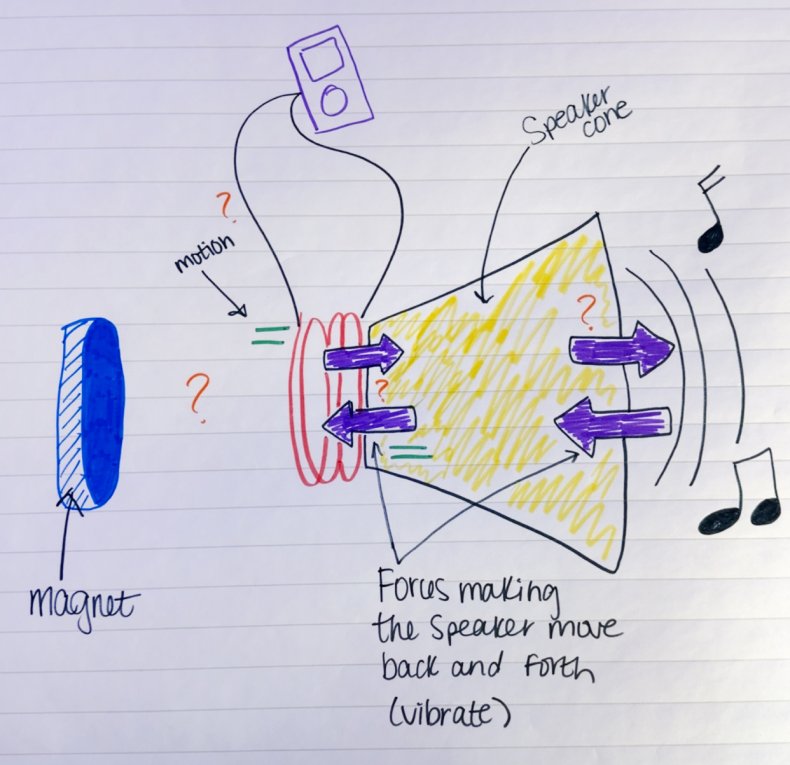
Then I started to focus more on the types of questions students were asking, what they already knew, what they wanted to learn, and what they could connect with what they had started to learn through the unit. I wanted this space to be a reminder of where they just were, and what more they could find out.
When starting the first unit’s DBQ, I tried to guide students through thinking about questions. First, we had a few lessons to set the stage for the science phenomenon. Students had an idea of what we were going to start learning, but just enough to get them interested and excited about what was to come. I then gave them four to five minutes to write down as many questions related to the lesson as they could think of in their own interactive science notebooks, with a few guiding questions to get started:
- Is the question clear and focused?
- Can we investigate it?
- Does it make us think about how or why something happens?
- Will answering it help us better understand what we are investigating?
Then, they had a chance to write down one or more questions from their notebook on a sticky note. One by one, I called on a student to share their question and put it on the DQB anchor chart. Some students did not want to read their question aloud; in this case, I had other students volunteer to read that student’s question.
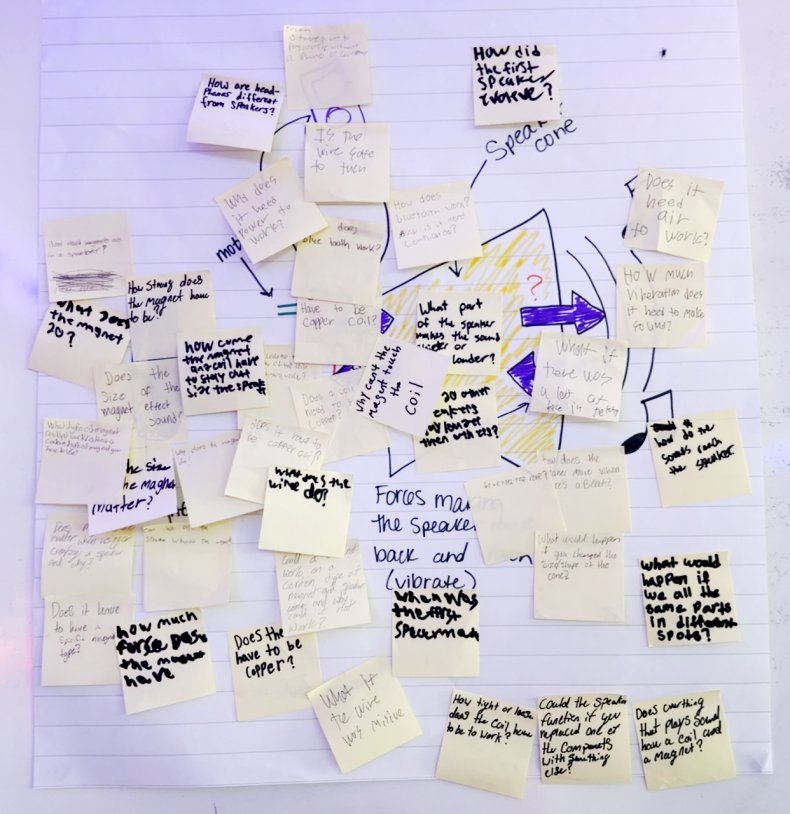
Once all students finished bringing their questions up to the anchor chart, we worked on organizing our sticky notes into different ideas. For example, we chose forces, variables, impact/energy, resistance, breaking/bouncing, and random. For each of my classes, I had the other DQBs out of sight, so each class came up with their own questions. The following day, I posted the DQBs back on the wall for them to look at.
Each lesson and day has its own question we answer, but does it match the questions on the anchor chart? After a summative assessment and starting the second lesson set, I thought this was a good time to pause and look back on our DQB.
I had three students volunteer to pick a sticky note from the DQB and read it aloud for the class to decide if we had answered that question. They stayed by the DQB, alternated reading the sticky note, and moved on to the next question once our class discussed whether we had the knowledge from the unit to answer it.
The discussion was facilitated by me, but the students went back and forth with sharing their ideas. Sometimes, we had a respectful argument about whether we could answer a question. The students discussed evidence from class to support their answer of “Yes, we did answer this question” or “No, we did not yet.” When we answered the question, that student got to put the sticky note on the wall above the DQB. Great! We just freed up a little bit of space for more sticky notes. Students were then instructed to write down another question on a sticky note and add it to the DQB.
Since we started a new lesson set in our unit, students are now thinking about something else, and their brains are naturally curious thinking about what experiments we get to do next. This time around, the students are more excited to ask questions to see if we are going to investigate and answer them. They just got to see the sticky notes that we answered move off of our DQB paper and onto the wall.
The Power of Answering Students’ Questions
The students have been driving their learning, with a little bit of guidance from me as the facilitator. They look to me for more questions and get excited to see how they did on their first summative. They also see that science is actually pretty fun because they get to let their minds not only ask the questions, but also search for the answer.
I find myself asking more questions when they seem stuck on their formatives/summatives. For example, if I see that a student has stated a claim but is stuck on obtaining the evidence, I would ask them, “Have you seen this in our labs before? What did we do then?” They have found that when I ask questions during their learning throughout our unit, it’s to get them to continue thinking, rather than second-guessing themselves.
The goal for our DQB is not to create random questions or fill a board with as many questions as we can, but to help students see themselves as people who can ask the questions, gather evidence, revise their own thinking, and contribute ideas to understanding a phenomenon.
It’s the exciting look in your students’ eyes when they realize they are figuring out the question they asked a few weeks ago when we started the DQB. It’s the elation in the classroom when they realize they are investigating their own question on the DQB. The DQB becomes more meaningful not when the questions go on the board, but when the class continues to use those questions to figure things out.