5 Thinking Habits That Help Students Tackle Complex Math Problems
Elementary teachers can foster the critical thinking skills that help students develop independence in working through math scenarios.
Your content has been saved!
Go to My Saved Content.
In preparing students for the future, we often focus on the knowledge and skills they’ll need to be successful. While we can’t predict the problems students will encounter in their future careers or even the types of jobs that will exist, we do know that they’ll need to make sense of unfamiliar situations, recognize relationships, organize information, make decisions, and adjust their thinking when something doesn’t work.
Mathematics provides a powerful opportunity to develop these skills. While computational fluency is important, the value of mathematics extends beyond finding correct answers. Complex problem-solving teaches students to think critically, consider different approaches, and persevere when solutions aren’t immediately obvious.
These habits don’t develop simply by giving students challenging problems. They require intentional instruction, modeling, and opportunities for independent application. Explicit instruction and complex problem-solving aren’t opposing approaches. As we teach mathematical concepts and procedures, we can also explicitly teach habits that help students navigate complexity without removing the thinking that makes the task valuable.
Here are five habits that help students develop the skills to become more independent problem solvers.
Habit 1: Visualizing
Before students can solve a problem, they need to understand what’s happening. One way to support comprehension is to teach students to create a mental movie of the situation being described. Too often, students search for numbers and operations before making sense of the context. Visualization encourages them to understand the situation before deciding how to solve it.
Teachers can model visualization by reading a problem aloud and describing what they picture. Students can then retell the problem in their own words, act it out, or discuss what is happening with a partner. Another strategy is to temporarily remove the numbers or replace them with smaller values so students can focus on the relationships rather than the computation.
Habit 2: Representing
Students sometimes resist drawing models because they believe representations are unnecessary when they can calculate mentally. Rather than requiring students to show their work for compliance, it’s important to explain why representations are valuable.
We might tell students, “Your brain is doing several jobs when you solve a word problem. You have to understand the story, remember the numbers, figure out how they connect, and decide what to do. A representation helps organize that information so your brain can focus on solving.”
When students create strip diagrams, number lines, tables, or other models, they make mathematical relationships visible. Representing serves as a bridge between understanding the context of a problem and determining the mathematics needed to solve it. When students label quantities within models, they can reduce unnecessary demands on their working memory. Rather than holding every detail mentally, students can reference their representations as they reason through solutions.
Students need explicit instruction to understand how different models represent mathematical relationships. For example, a strip diagram can represent part-whole relationships, comparisons, or multiplicative situations. Exploring these structures helps students select representations because they’re actually useful, rather than because a teacher requires them. The goal isn’t simply for students to show their thinking, but to use representations to develop their thinking.
Habit 3: Organizing
As problems become more complex, it’s essential for students to learn how to manage information and determine how the steps of a solution connect. In multistep problems, students may understand individual calculations but struggle to determine where to begin. They might use every number immediately without considering how each calculation contributes to answering the question. Graphic organizers provide a temporary scaffold for organizing these decisions. For example, a multistep problem-solving graphic organizer can help students identify the final question, determine what information is missing, and recognize the hidden question they must answer first.
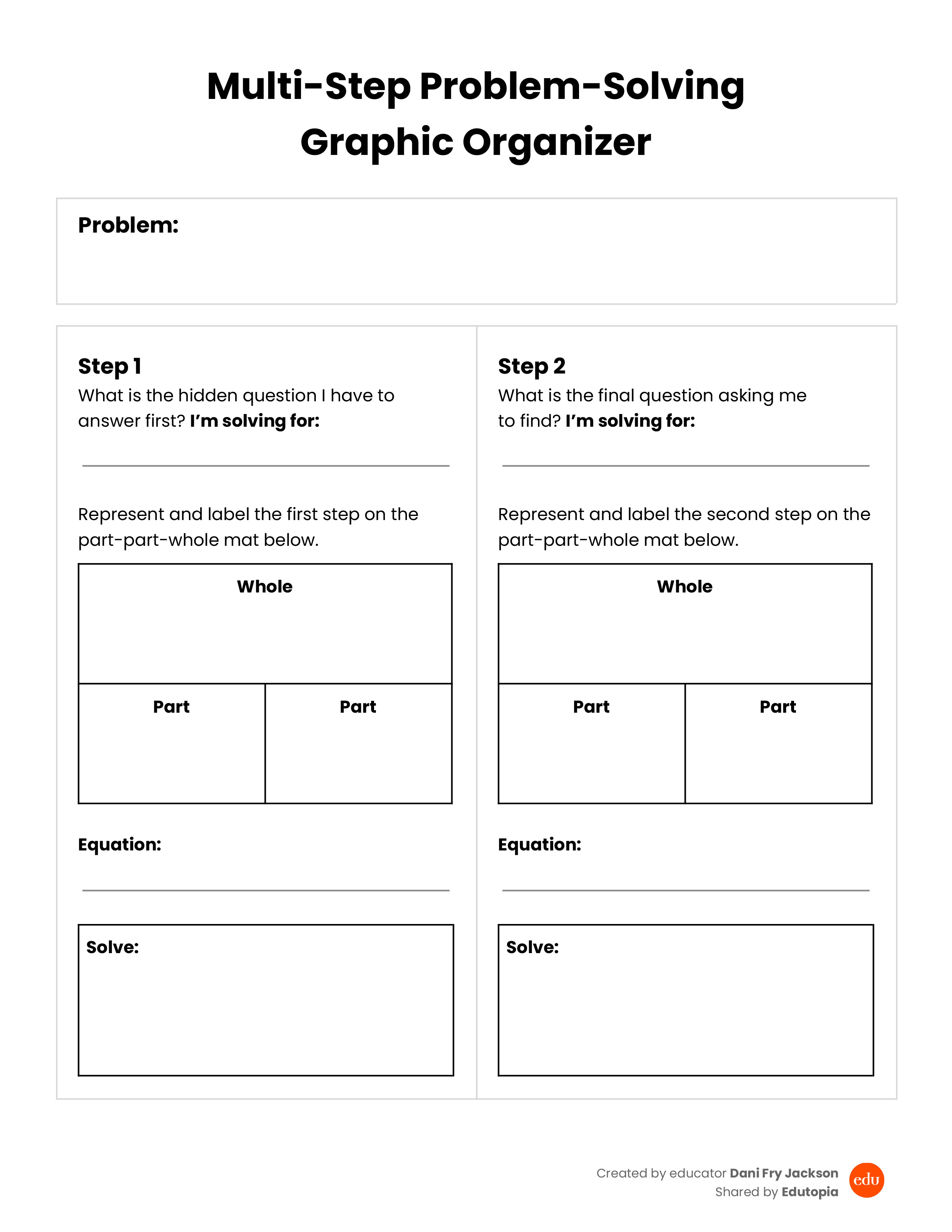
Teachers can model this process by thinking aloud: “I know what the problem is asking, but I don’t have all the information yet. What could I figure out first that would help me?” This shifts the emphasis from immediately calculating to developing a plan. As students become more proficient, the organizer can be gradually removed so they internalize these questions and use them independently. Organizing teaches students that complex problems can be broken into manageable parts while keeping the larger goal in mind.
Habit 4: Recontextualizing
For many students, solving a problem ends when they complete the calculation. However, finding a numerical answer isn’t necessarily the same as answering the question. Students need to develop the habit of returning to the original context after solving. This process, known as recontextualizing, requires students to reconnect their mathematical work to the situation described. They must consider what their answer represents, whether it is reasonable, and whether it addresses the question. For example, a student might calculate that 4.5 buses are needed for a field trip. While the calculation may be mathematically correct, the context requires the ability to recognize that five buses are necessary.
Teachers can encourage recontextualizing by asking students to reread the problem and consider the following:
- What does my answer represent?
- Does my answer make sense in this situation?
- Did I answer the question that was asked?
Labeling answers to connect their calculations to the context is an important practice for students. Recontextualizing reinforces the fact that mathematics is manipulating numbers and making sense of situations to make informed decisions.
Habit 5: Persevering
Complex problem-solving requires students to become comfortable with not immediately knowing what to do, yet classrooms can unintentionally communicate that mathematical success means getting answers quickly and correctly. When students consistently produce correct answers, it can feel like evidence of successful learning. Meaningful learning also happens when students encounter challenges, test ideas, recognize mistakes, and revise their approaches. Teachers can create a culture where messy thinking is viewed as part of learning rather than a sign of failure. Productive struggle requires knowing when to provide a prompt, ask a question, or model a strategy.
When students get stuck, teachers don’t have to immediately provide the next step. Instead, they can use questions that return the thinking to students:
- What have you tried so far?
- Tell me what is happening in the problem.
- What do you know, and what are you trying to figure out?
- What model might help you see the relationships?
These prompts communicate that being stuck isn’t the end of problem-solving. It’s an opportunity to reconsider information, try another approach, or make a new connection.
We can’t prepare students for every problem they’ll encounter in the future, but we can equip them with habits that help them make sense of complexity, navigate uncertainty, and determine a path forward. Students don’t have to always know what to do. The goal is to develop students who know how to think when they don’t.
For further reading and inspiration, I have developed lessons with anchor charts to support teaching students explicit skills to develop these habits of thinking. You can find them in my book, Math Problem Solving Through Small Group Instruction.