A Rubric for Assessing Your Classroom Management Strengths and Weaknesses
This detailed rubric enables teachers to methodically reflect on their routines in order to understand the status of their class.
Your content has been saved!
Go to My Saved Content.
Developing a consistent classroom management system is a common struggle for secondary teachers. Regardless of whether they’re seasoned mentors or newbies, all educators can benefit in some way from a more practical setup that’s tailored to their needs.
As a veteran teacher and professional development presenter for my school district, I’m flattered whenever educators attend my classroom management trainings or are directed my way for advice. My goal is to work with teachers so they can consider the status of their classroom’s organization and day-to-day operations, rather than immediately aiming for a “prescription” that will fix perceived issues.
In order to target teachers’ needs, I’ve created a self-assessment rubric so that educators can tweak their classroom organization, strategies, and routines. I call this rubric “status of the class.” I’ll explain how the rubric works, how I use it during advisory meetings with teachers, and how other teacher-mentors can use it, too.
The Self-Assessment Rubric Basics
There are 10 key practices that make up my “status of the class” self-assessment rubric:
- Classroom Setup
- Routines
- Directions
- Time Management
- Task Supervision
- Academic Interaction
- Instructional Strategies
- Feedback
- Behavior Strategies
- Closure Activities
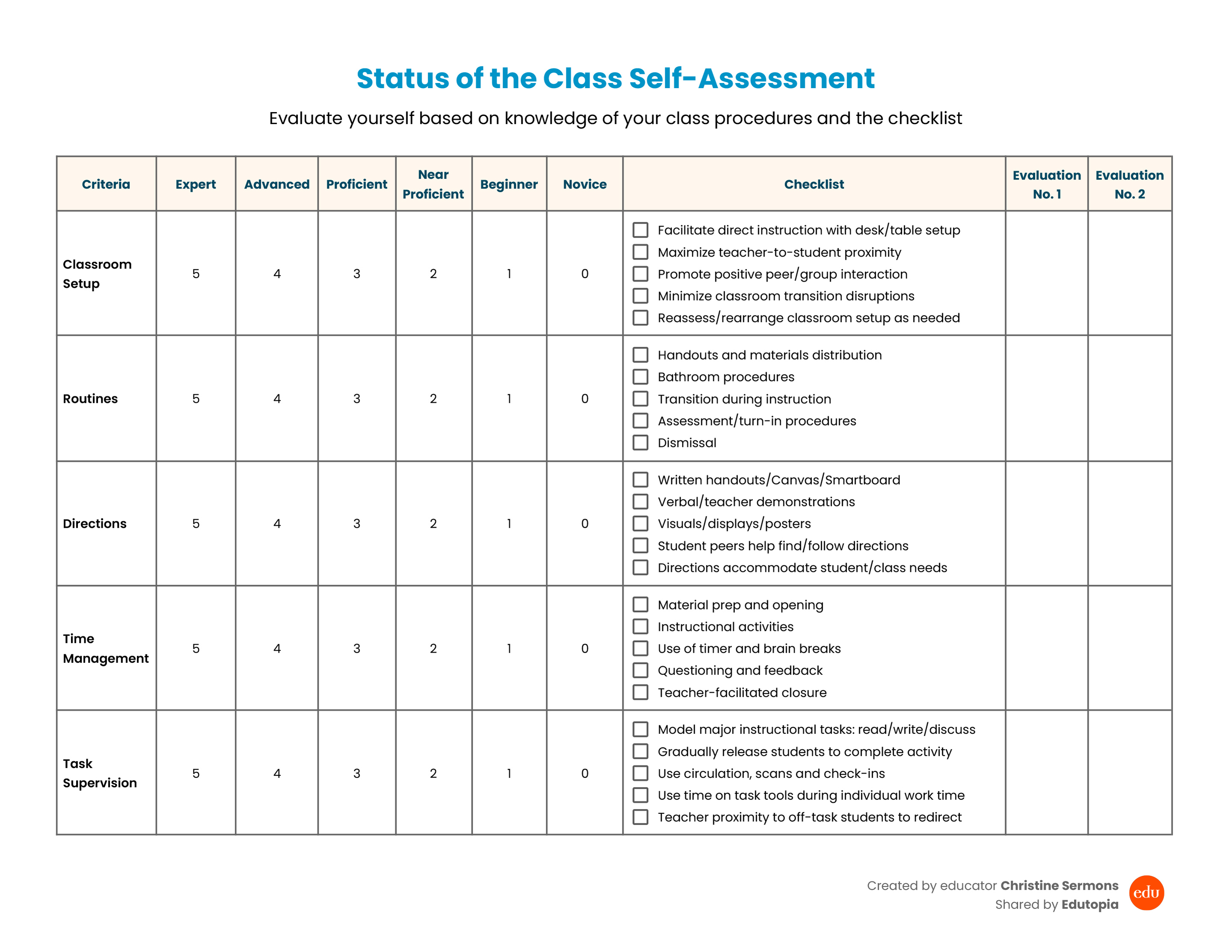
The self-assessment rubric is a checklist of sorts; I encourage teachers to look at each of the key practices independently. For each practice, there are five related procedures that collectively demonstrate mastery. Take “classroom setup,” for example. It includes the following procedures related to the physical arrangement of a secondary classroom:
- Facilitate direct instruction with desk/table setup
- Maximize teacher-to-student proximity
- Promote positive peer/group interactions
- Minimize classroom transition disruptions
- Reassess/rearrange classroom setup as needed
If a teacher feels they can reasonably check all five procedural boxes, they’re an “expert.” Four boxes is “advanced,” three boxes is “proficient,” two boxes is “near proficient,” one box is “beginner,” and zero boxes is “novice.”
Going Over the Self-Assessment Rubric
There’s never a bad time for a teacher to assess their classroom management practices. The best time, though, is at the start of the school year or after winter break.
When I sit down with a teacher, I don’t want them to feel like they’re being overly scrutinized, so I review some of my own classroom practices. I might start by evaluating my classroom routines. Here are the five associated procedures:
- Handouts and materials distribution
- Bathroom procedure
- Transition during instruction
- Assessment/turn-in procedures
- Dismissal
I usually begin with my strengths and suggest that the teacher do the same. I give myself a check for facilitating handouts and material distribution; I explain that I provide a consistent location for materials, model the pickup procedure for my students, and also use a prepared student unit journal. Then I emphasize the reasoning behind my bathroom procedure: Direct instruction is vital to student mastery, so leaving the room during directions, notes, and practice is restricted to emergencies only.
However, I point to clean transitions from one instructional activity to another as an area that needs work. To an outside observer, these transitions look cleaner than they do to me. My daily docket (which is posted on an interactive whiteboard) and my use of shoulder partners help with these movements. I tell my protégé that it’s OK to give yourself a “check-minus.”
We move on. In recent years, I’ve gotten better at measuring assessments and tracking turn-in procedures. This was formerly one of my weaknesses, I tell the teacher, until I began documenting student effort with a more formalized system. Clearly labeled class turn-in tubs near my teacher station have made turning in assessments a breeze.
Unfortunately, my real weakness is how dismissal constantly creeps up on me. On a daily basis, I find myself rushing to wrap up and administer exit tickets. Overall, I give my routine procedures four out of five checks. I definitely feel proficient—advanced, even—but not an expert.
Once the other educator gets a sense of the self-assessment system, I guide them as they score their own classroom setup and routines. While we move through the rubric, we both share and discuss classroom management strengths and weaknesses, which builds trust and helps with submitting honest scores.
Ultimately, teachers should target the practices that they identify as needing the most improvement. Any practice with fewer than three check marks is a good candidate. I recommend to teachers that they select no more than five practices in total. In my experience, classroom setup, routines, directions, time management, and task supervision are the most crucial classroom management practices—especially for newer educators. I refer to these practices as the “principal five.”
A more seasoned veteran might score better on the “principal five” practices than the other five key practices. In my own classroom, I tend to score lower on practices like feedback and closure. Both are closely linked to another practice: time management. I only came to that conclusion after doing some reflection about which boxes I was checking off.
Make Adjustments, Then Reassess
I often tell educators that they can’t “fix” everything at once; I try to adjust my own classroom practices on a quarterly basis. Many teachers I’ve worked with seem surprised that the changes I suggest are not very rigid, nor are they full of rules and consequences.
For instance, if a teacher needs to work on time management, I’ll suggest that they start with a written plan for a single instructional objective. Using a large flip chart or slide on an interactive whiteboard, they should try making a bullet-point list with the instructional objective and any necessary materials. The teacher should also guesstimate timing for each activity that’s part of the objective: direct instruction, peer questioning, three-minute pauses for “think time,” and formal exit tickets.
After jotting down time estimates, the teacher can designate one class period for a trial run. Select a class with care: Don’t experiment with your most challenging group. Explain the plan to students and implement the plan. Practice the pacing and lesson structure on repeat for three to five days. Make detailed notes on what works and the problem areas. Tweak, then gradually expand your tweaked lesson to all of your classes.
At the end of a specified cycle—a month, a grading period, or a semester—I ask the teacher to fill out the self-evaluation again. Hopefully, they should observe improvements, but there’s always another classroom management target to try for next. They’re always welcome to contact me or ask for guidance on their next steps. I assure teachers that my classroom is a work in progress and theirs will be too. Great teachers constantly question their methods and procedures, tweak what doesn’t work, expand best practices, and keep their eye on the “status of the class.”