Using Watercolors to Teach Mood and Tone
When students approach abstract concepts through hands-on activities like painting, their literary analysis skills improve—and their writing does, too.
Your content has been saved!
Go to My Saved Content.For St. Marys Area Middle School English language arts (ELA) teacher Danielle Brody, providing her students with hands-on activities is a surefire way to make the learning stick. One of her (and her students’) favorite activities is called Painted Reflections, an idea she first encountered in a Harvard Project Zero webinar. The activity involves using watercolor paints to better understand abstract concepts. And while Painted Reflections can be adapted for teaching a variety of concepts, Brody finds it especially helpful when tackling a topic like mood and tone in literature, which some students find hard to grasp.
Brody is the first to admit that she has no prior art training. “ I am an awful artist,” she laughs. “I have no skill set whatsoever at all.” But because it involves creating abstract paintings (not people, places, or scenes), it’s less intimidating.
After her class finished reading Jason Reynolds’s Long Way Down, Brody used Painted Reflections to help solidify students’ understanding of mood and tone. First, she handed out a list of descriptive words; then she asked students to circle and discuss the words they felt best matched their own mood while reading, and then Reynolds’s tone in the book. As a class, they then reviewed some basic concepts of abstract painting (think color symbolism, texture, and brush strokes). And then students were off, creating small watercolor paintings, guided by the tone words they chose.
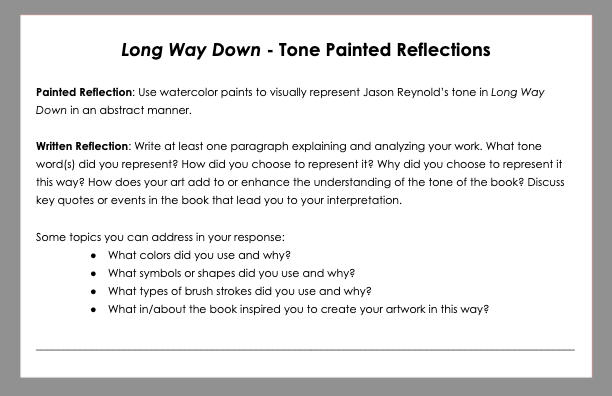
After finishing their paintings, students completed a written reflection. What tone words were they trying to express? Why did they choose the colors and textures they did? What elements of the book supported their artistic decisions? Brody finds that giving students the writing portion after the painting exercise “goes so much better than if I were to just give them a writing assignment of ‘Write about the tone of this piece.’ When they have the art and they get to explain it… now they know exactly what to say.”
The following day, students participated in a gallery walk, in which their paintings and reflections were displayed in the hall. Students left Post-it Notes for each other about their artwork and their writing.
Painted Reflections is on repeat in Brody’s class for many reasons. “It takes the scary writing that students immediately have an aversion to,” she says, “and it tricks them into feeling more comfortable and confident in their writing.” It also unlocks their ability to communicate complex, abstract ideas like mood and tone. It’s low-stakes and low-stress for both students and teachers: “A teacher just needs some paints, some paper, and a topic.” And a final added benefit is that it’s no-tech: “ It allows kids to go back to learning with their hands and really figuring out and problem-solving without being able to google an answer.”
Brody has made her Painted Reflections materials available for other teachers to use—an editable version of the reflection worksheet students fill out at the end (requires Google sign-in to make a copy) and the slides she projects during the lesson.
For more ideas to bring more hands-on creativity into ELA classes, read Andrea Tamayo’s article for Edutopia, “6 Cool Visual Thinking Activities That Strengthen Student Writing.”