Teaching a Deeper Understanding of Language With a Yearlong Word Journal
Guiding elementary students to dive into learning about how a single word can boost their curiosity and vocabulary skills.
Your content has been saved!
Go to My Saved Content.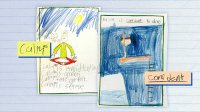
As a reading specialist, I’m always looking for new and interesting ways to infuse my love of language into my daily practice.
When second graders at my school were tasked with writing a class manifesto, I was more than happy to lend a helping hand. The students were supposed to draw from a list of words describing personal values and decide which ones were most pertinent to their own lives. The words were largely abstract nouns like love, courage, and truth. I wondered: Did these young students fully comprehend a list of complex words representing ideas that cannot be seen or touched? How might I teach them to not only deeply understand these words, but also use them as a tool for clarifying choices about how they live their lives?
I decided to create a word journal for each student. In the journal, students would examine one word, with sustained curiosity and attention, for the entirety of the school year. My goal was to make the learning process systematic and cumulative, so that each month, students could dig deeper into their word’s meaning and begin to notice how language affects the ways we think about, see, and experience the world. I’m happy to report that’s exactly what happened. Here’s how it went.
Journal Entry 1: Definition and Etymology
Students learned and wrote about the classic definition of their chosen word. They also learned the etymology of their word. For example, did you know that the word wise comes from the Proto-Indo-Germanic word weid, which means “to see” or “to know”? It is also the same root word from which we get the words vision and wit. The suffix -dom comes from the Proto-Germanic word dōmaz, meaning “good judgment” and “rule of law.” Wisdom thus means to see clearly and have good judgment.
Journal Entry 2: Graphic Organizer
In the next entry, we used a variation of the graphic organizer called the Frayer Model to help students move beyond rote memorization of definitions. This graphic organizer included four sections in which the students had to give an example of their word, then use the word in a sentence, then find three synonyms, followed by three antonyms.
This method of word study requires synthesizing the definition and applying it to written language. It also spurs critical thinking by having students explain not only what the word is, but also what it is not. Students are involved in actively generating a word’s meaning, not just passively acquiring it.
Journal Entry 3: Creative Exploration
For this month’s entry, students were encouraged to be creative. I asked them to draw, take a picture, write a poem, or even make up a song about their word. I wanted them to be able to ground the word in something more tangible. I hoped that by using artistic expression, the students could capture their word’s emotional weight. For the word confidence, one student drew a picture of herself at the tip of a diving board, evoking the moment before leaping. Another student wrote a short poem about the feeling of calm and used words like serene and green to portray its nuanced meaning.
Journal Entry 4: Observation
I asked students to look for their word in everyday life and track observations in their journals. They were prompted to look for their word in action, meaning in books, in movies, at home, and at school. I explained to the students that they need not look for dramatic and obvious moments. Instead, they should keep an eye out for places and circumstances where their word might reveal itself: in the middle of a mundane TV show, in a subtle gesture from a friend, or during a quiet moment at home with a book. In this way, I hoped that seeing the word in everyday life might create a “memory anchor” of sorts.
Journal Entry 5: Interviews
This month, students were required to interview a trusted adult in their life about their chosen word. Each student asked three simple questions:
- What does this word mean to you?
- Can you tell me about a time you experienced this word?
- How do you feel when this word shows up in your life?
One student studying the word humor learned how it helps his dad ease daily stress. Another student studying the word truth learned from his grandma that she believes there is only subjective truth, and real truth can only be found in mathematics. Students created audio recordings of their interviews using a parent’s phone. These recordings were converted to QR codes and pasted into their journals. We also created a general QR code with access to classmates’ interviews, because this activity in particular really piqued students’ interest.
Journal Entry 6: Intentional Living
Students intentionally lived out their word’s meaning for the school day. We set the intention in the morning, provided reminders, and then reflected on the experience before dismissal.
A student who was studying the word happiness said that she initially felt bad when she couldn’t find a partner for a paired-up assignment. But then she remembered that her word was happiness and that she was determined to be intentional about practicing happiness for the day. She completed the assignment on her own, and afterward, she said she felt good about herself that she was able to do so. She was truly happy, she said. Then she spontaneously gave me a hug.
It was a special moment. I could see that students were using their words as a tool for clarifying their thinking about who they are and how they want to show up in the world.
Journal Entry 7: Make It a Habit
For the final entry, I had students apply tips from the book Atomic Habits, by James Clear. I encouraged students to make their words a habit and a practice. Clear’s tips are simple: make it clear, make it easy, make it fun, and make it rewarding. My own word for the year was generosity, so I tried the activity myself. Here’s what I jotted down:
- Make it clear: Be generous.
- Make it easy: One generous gesture each day.
- Make it fun: Keep a record of completion. For each generous act, add a sticker to my calendar.
- Make it rewarding: If I completed the activity for one full week without breaking the streak, I treated myself to something special, like my favorite dessert.
The word study project taught my students (and me!) many powerful lessons. We learned that words are magical, but also slippery and shape-shifting. Words have both hidden and obvious meanings. A word can continue to reveal itself even after you think you have it defined and compartmentalized. Words sharpen our thinking and can be tools for better understanding of ourselves and each other. Words not only shape our identity, but also create a lens through which we see the world. And lastly, words can be a call to action—they guide our decision-making about how we choose to lead our lives.