6 Picture Books That Support Grammar Instruction
These mentor texts help students go beyond memorizing grammar rules to see language as a series of patterns for making meaning.
Your content has been saved!
Go to My Saved Content.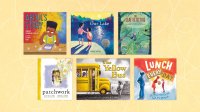
It’s common for students to learn about grammar concepts through a set of worksheets and drills. They practice editing and identifying parts of speech over and over again with very little application to their own writing. They are compliant and complete the tasks given to them. Are they engaged? Do they have a deep understanding of these concepts? Do they view themselves as writers? Probably not.
Now, imagine a classroom where a teacher reads a picture book aloud to students, conversations about the text flow, and a community of readers develops. Then, the teacher selects a beautifully written sentence from the book and asks the students, “What do you notice?” Conversations activate background knowledge about effective writing, and students discover the moves that writers make to create meaning and effect for readers.
Teach Language Conventions Through Pattern Recognition
The Patterns of Power process helps students deepen their understanding of a grammar concept: how words (parts of speech) and conventions (capitalization and punctuation) are formed together into phrases, sentences, and beyond to create meaning.
Patterns of Power introduces educators to a meaningful approach to teaching and learning language conventions. The authors suggest that we use this process to look beyond the concepts of traditional grammar “rules” and invite students to look at language as a series of patterns to make meaning. These invitations are grounded in conversations about the author’s purpose and craft. “Instead of showing young writers the mistakes to avoid, we argue for illuminating the patterns of language that mold meaning and have powerful effects on readers.”
We’ve selected model sentences that showcase a variety of sentence-level craft moves. These methods are easy to teach and can help students intentionally use sentence variety to enhance meaning and strengthen the impact of their writing.
Picture Books That Demonstrate Effective Craft Moves
The following six picture books are wonderfully crafted mentor texts, with stories that help build community and allow students to see themselves and appreciate others. We thoughtfully selected these texts because they provide meaningful learning opportunities for repeated use throughout the year, supporting instruction in reading, writing, language, and other content areas. We encourage educators to focus on one craft move per instructional period in order to spiral knowledge throughout the year:
The Yellow Bus, written and illustrated by Loren Long (grades 3–4), follows the evolution of a school bus through the many stages of life. Long’s illustrations draw readers in to ponder the meaning of resilience, our purpose in this world, and the impact we have on others.
Model sentence: Early one morning, a truck arrived and towed the Yellow Bus through the city, across a bridge, into the country, along rolling hills, and down onto a farm nestled deep in a valley.
The sentence begins with a phrase to introduce time and mood, extends the thought with a compound verb as well as with a list/series, and uses multiple prepositional phrases.
Abdul’s Story, written by Jamilah Thompkins-Bigelow and illustrated by Tiffany Rose (grades 3–4), follows a young boy who loves to share stories orally but struggles to write them. He gives up on himself as a writer until an author visits his class and shares his messy writing with Abdul. Through mentorship and encouragement, Abdul discovers that his words have value, even with mistakes in his writing.
Model sentence: During writing period each day, he wrote, then erased his mistakes… wrote then erased… wrote then erased.
The sentence opens with a prepositional phrase, giving the reader a sense of “when” and “where.” Thompkins-Bigelow extends the sentence with repetition and ellipses for emphasis on Abdul’s frustration, which creates a rhythm that mirrors Abdul’s repeated actions.
Our Lake, written and illustrated by Angie Kang (grades 4–5), follows two brothers as they travel to a nearby lake to swim. This time, however, their father isn’t with them because he died. This debut picture book explores meaningful themes of grief, honoring loved ones, and finding comfort in memories.
Model sentence: At the peak, the domed sky swaddles us in heat, and the water glistens below.
The sentence uses an introductory prepositional phrase that gives the reader a sense of “when” or “where.” Kang demonstrates compound structure by using the conjunction “and.” She also includes dependent clauses with precise word choice and prepositional phrases.
Patchwork, written by Newbery Award winner Matt de la Peña and illustrated by Corinna Luyken (grades 4–6), challenges the labels that society places on children, showing how they can be limiting and fail to capture who kids truly are. Through microstories and Luyken’s expressive illustrations, the book celebrates children’s evolving identities and reminds readers that we are each more than any single label.
Model sentence: And when a restless kid like you lands in the back of your class, you will see her, you will love her.
The sentence opens with the intentional use of a conjunction, uses an introductory dependent clause, and utilizes repeated sentence structure for emphasis to create rhythm through parallel structure. Finally, the sentence begins with a longer opening, followed by short, parallel simple phrases.
The Leaf Detective: How Margaret Lowman Uncovered Secrets in the Rainforest, written by Heather Lang and illustrated by Jana Christy (grades 4–6), tells the true story of Meg Lowman, a scientist whose curiosity and determination led her to develop new ways to study the rainforest canopy and inspired others to explore and protect the natural world. Lang uses rhythmic and poetic language to invite readers to discover their passions and never give up, even when faced with obstacles.
Model sentence: In the dark, damp forest the trees rose up to distant rustling, squawks and screeches, shadows in the treetops.
The sentence opens with a prepositional phrase, giving the reader a sense of “where.” Lang extends the sentence with sensory details to describe the rainforest. She also uses precise word choice, including adjectives and sound words, to create imagery, and utilizes commas in a way to separate the specific details of the sentence.
Lunch Every Day, written and illustrated by Kathryn Otoshi (grades 5–6), follows a school bully as he takes a classmate’s lunch every day until a surprising act of kindness stops him in his tracks. Through the perspective of the bully, this book invites readers to consider why people act the way they do and how kindness can change the course of one’s life. Be sure to read the author’s note at the end!
Model sentence: I see Skinny Kid’s mom inside, holding his birthday cake.
The sentence closes with a participial phrase; uses a description as a name, or proper noun; and capitalizes it (Skinny Kid). It also features “mom” as a common noun, without capitalization.
With encouragement to wonder, ask questions, and play with different strategies throughout the year, students celebrate their experimentation with language and gain confidence as readers and writers. They grow to have a deeper understanding of the author’s purpose and craft, and the power of language.