4 Techniques That Engage the Entire Classroom
The authors of the book Total Participation Techniques share activities that can make 100 percent participation possible.
Your content has been saved!
Go to My Saved Content.
“Who can tell me?”
A hand shoots up. Then another. The usual suspects. Twenty-five other students sit quietly. Some thinking. Some guessing. Some completely disengaged. Seconds later, the teacher moves on, believing the rest of the class understands.
This scene plays out thousands of times each day in classrooms around the world. The traditional Q&A has become fossilized into everyday practice, modeled through years and years of having experienced it, starting on day one of kindergarten. But when it comes to the sequence of questioning, we believe that calling on someone should be the last thing you do.
It is possible to engage every student at the same time. This is the argument we made in the first edition of our book, Total Participation Techniques. Now, 15 years and two editions later, we are more convinced than ever that total participation is not only possible, it’s surprisingly easy to do.
For some educators, the idea of 100 percent participation may feel unrealistic and even impossible. Years of experience have conditioned us to accept that only a handful of students will eagerly engage, while others remain on the sidelines. But we believe that pattern is not a reflection of students’ willingness to learn, but of the structures we have inherited.
We believe it is our responsibility to create classrooms where engagement is the expectation, not the exception.
The Ripple
We believe a simple tweak could change schooling for students. We call it the Ripple, a simple way to visualize the ideal questioning sequence for whenever teachers ask students a question that matters.
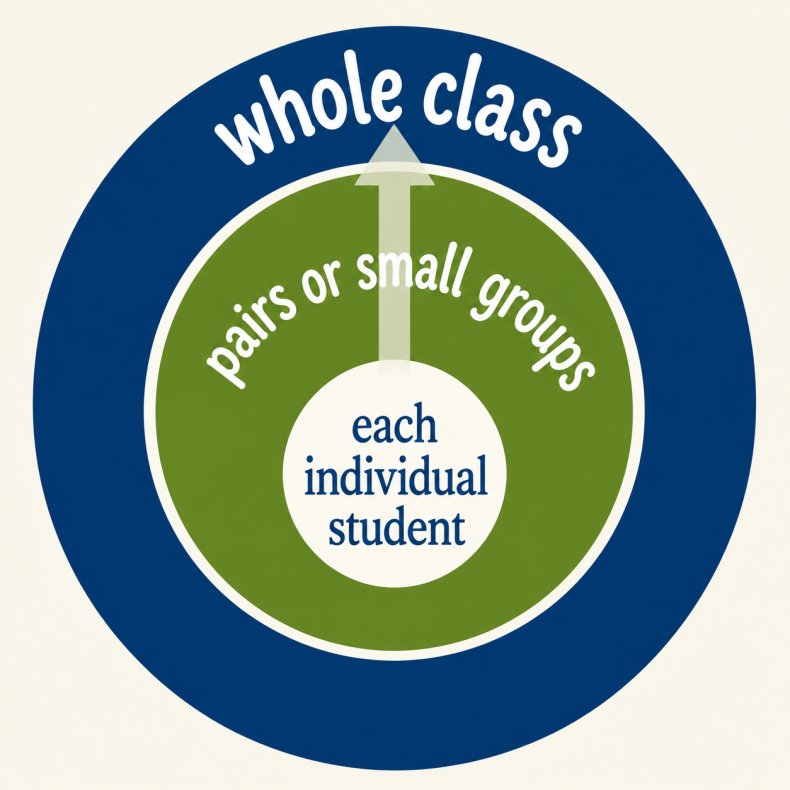
The Ripple consists of three concentric circles that illustrate an ideal series of steps that “ripple out” from the center, like ripples in water. The inner circle is an individual student. The middle circle consists of pairs or small groups, and the outer circle is the whole class.
When you ripple your prompts, you are more likely to get 100 percent participation. And by circulating around the room as students are writing and sharing, you’ll get a much better feel for student understandings, misunderstandings, and any adjustments that need to be made to your instruction.
If you’re short on time, feel free to skip one of the two outer circles of the Ripple, but never skip the inner circle, where every individual student is responding to your prompts.
The Ripple functions as an overarching way to structure questions and student interactions. Here are four total participation techniques you can use within the Ripple framework to engage all students in ways that allow them to demonstrate their learning.
The Quick-Write
Quick-writes allow your students a brief amount of time to individually respond to your prompts before you move on in a lesson. We use quick-writes repeatedly within the same lesson, asking students to write in their notebooks or a dedicated sheet of paper.
Step 1. Each individual student responds to your prompt using a quick-write.
Step 2. Pairs or small groups share their responses with each other.
Step 3. The whole class is brought back together. At this point, feel free to ask “Who can tell me?” (Now that everyone has processed the question, you’ll likely get quite a few more hands raised, and calling on someone becomes the last thing you do.)
The Relevance Wheel
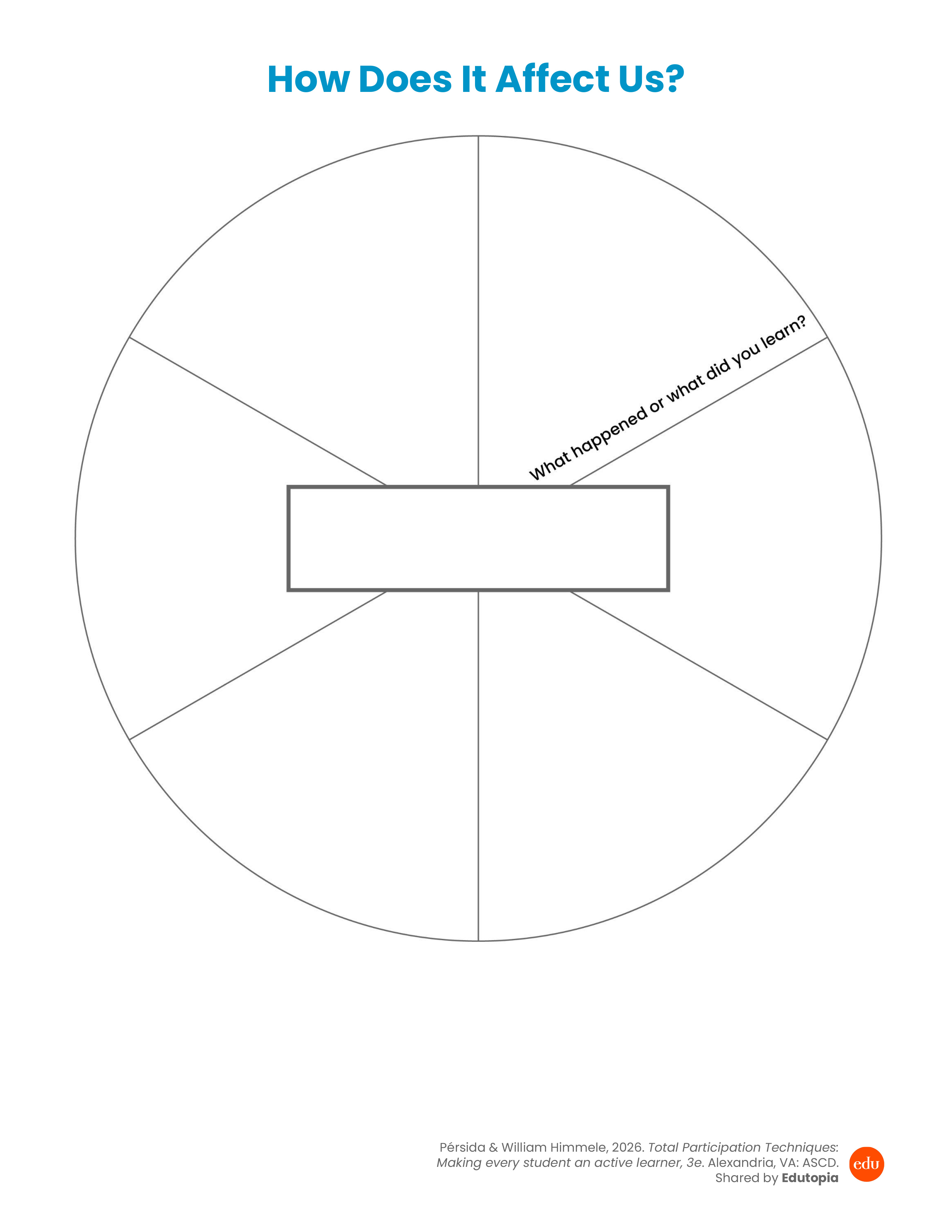
The relevance wheel provides time for students to record what they’ve learned and then analyze its importance.
Step 1. Each individual student writes down what they have learned on four of the six spokes of the relevance wheel. The students then analyze why each item matters and record their thoughts on the outer rim of the wheel.
Step 2. In small groups, students share what they’ve written on their spokes. They then borrow ideas and complete the two remaining spokes on their relevance wheels.
Step 3. Volunteers are called on from the whole group to share one spoke and a corresponding rim.
The Likert Scale
Chances are that at some point in your life, you have completed a survey that involved a Likert Scale, in which options are ranked from lowest to highest, often a range of 1 (“strongly disagree”) to 5 (“strongly agree”). The Likert Scale activity allows students to rank their agreement with a provocative statement based on a reading or curricular presentation. For example, you might phrase a content-based statement like this: Preserving Earth is more important than exploring other planets.
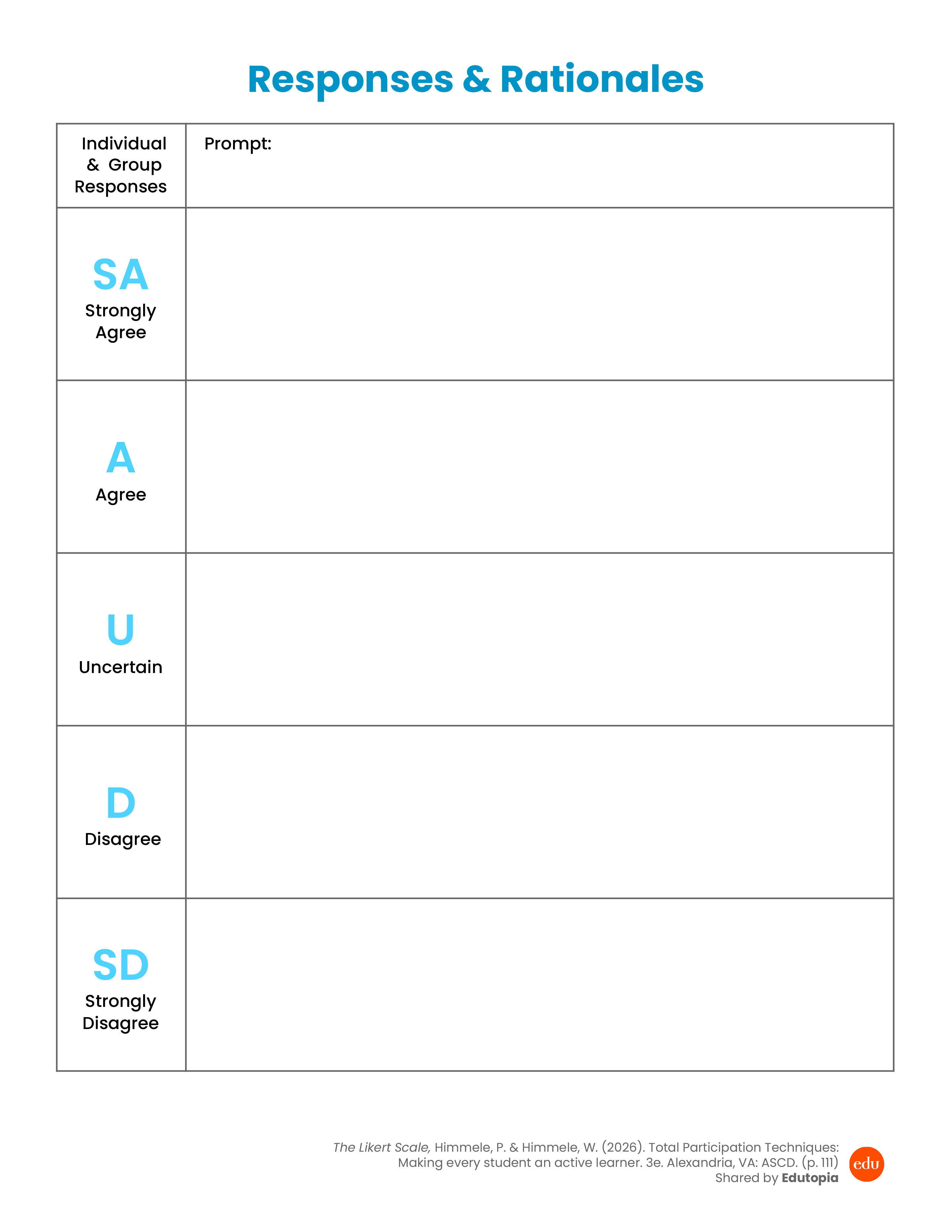
Step 1. Individual students select their level of agreement with the statement and explain their rationale on the corresponding line.
Step 2. Small groups with similar answers (for example, all the students who answered “strongly agree”) meet to share why they chose that answer.
Step 3. In a whole class debrief, each group selects a few volunteers to summarize the rationale for their group’s selection. As groups present, all other students summarize the presenters’ rationale until the template has been filled out. For responses not selected by any students, the teacher can lead a discussion about what someone who had selected that option might say.
The Debate Team Carousel
The debate team carousel allows students to debate a position from different angles. It provides excellent practice in argumentation and in thinking through their own position and rationale and what the opposing arguments might be.
After reading about a topic, you can do a debate team carousel using a content-based yes/no statement, such as “Schools should spend more time teaching probability because it affects everyday decisions.”
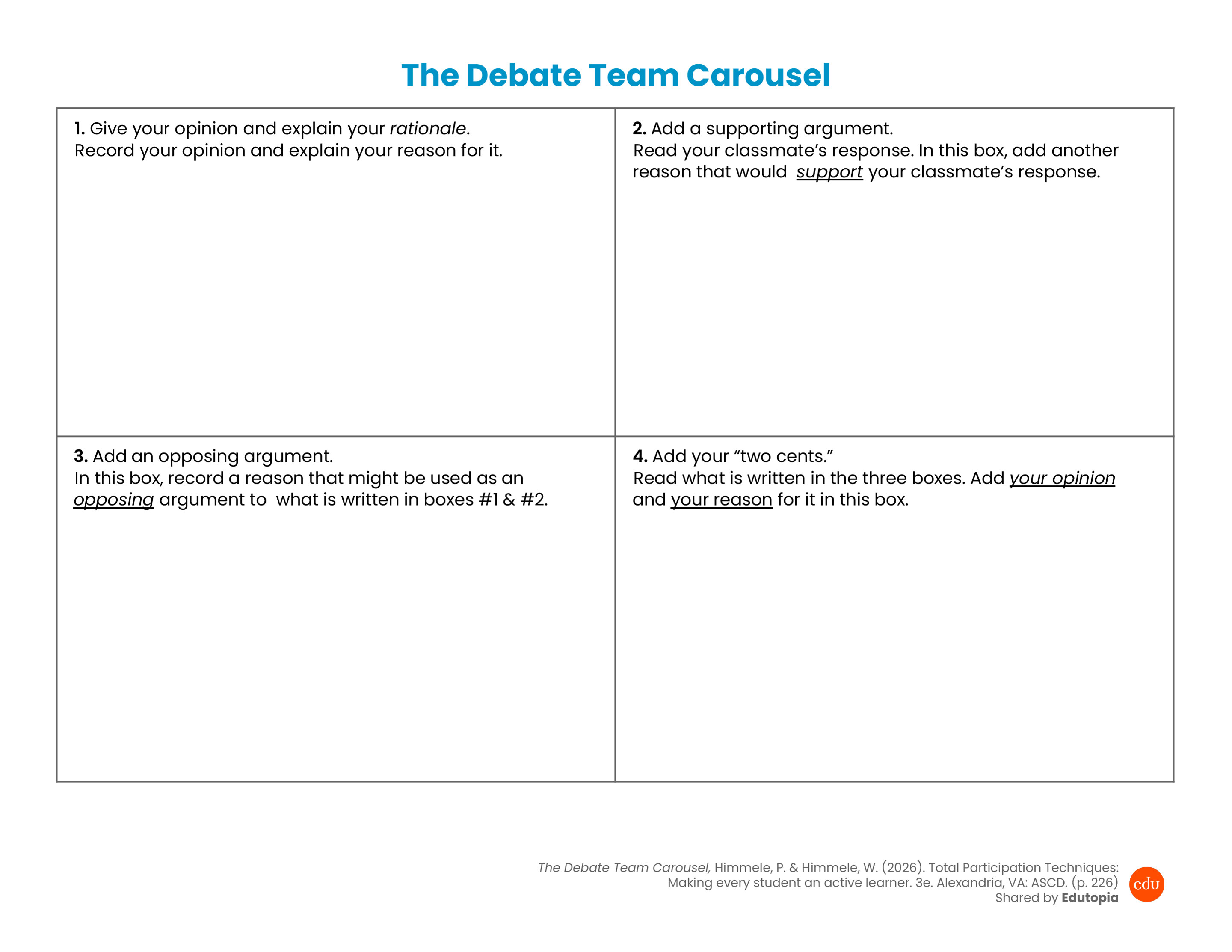
Step 1. Individual students record their agreement or disagreement with the statement, explaining their rationale.
Step 2. In small groups of four or more, each student passes their own paper to the person on their right. On the paper each student receives, they follow the prompt to respond to their peer in the second box. They repeat this process until all the boxes are filled and the papers are returned to their original owners.
Step 3. During the whole class debrief, students respond to these questions: What are your thoughts? What opposing arguments also held merit? Did you learn anything new?
Who Gets to Think?
Breaking habits that have been reinforced over decades is difficult. We understand this on a deeply personal level. Even after writing our book, we still found ourselves falling into the trap of asking, “Who can tell me?” Which is why we created a small poster to hang in our classroom and remind us to ripple all of our important question prompts.
Sustaining a commitment to total participation means continually examining your practice through the lens of engagement. As you plan your lessons, be intentional about looking for moments when only a few students are being invited to think and respond. Re-read your lesson plans with a simple question in mind: Who gets to think during this lesson?
When you find moments where participation is limited to a few volunteers, look for ways to redesign the experience so every student has an opportunity to process, respond, and contribute. After lessons, reflect on who participated, whose thinking remained invisible, and where participation structures could be strengthened. This ongoing cycle of planning, reflection, and refinement helps ensure that active participation is not an isolated strategy, but a mindset that shapes every instructional decision.
Each time we move from hearing one voice to hearing every voice, we gain a more accurate picture of student understanding. More importantly, students gain a stronger sense that their thinking matters.
The payoff is profound: more voices heard, more thinking revealed, and more explicit learning opportunities for every student.