Using Informational Texts to Support Skillful Writing
Reading nonfiction picture books can help upper elementary students understand and practice specific writing conventions.
Your content has been saved!
Go to My Saved Content.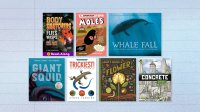
When teaching students how to read and write informational texts, teachers often focus on text features, text structures, and domain-specific vocabulary. Although they certainly help students understand what distinguishes informational from narrative writing, we argue that nonfiction offers another valuable teaching opportunity—exploring the intentional craft moves that authors make when using certain conventions. Investigating how nonfiction authors use different conventional tools can help student writers attend to the content of their writing and find new ways to create meaning and strengthen their voice.
Choose Mentor Texts Across 5 Types of Nonfiction
Melissa Stewart’s informative book 5 Kinds of Nonfiction presents teachers with a way to show students the different options for writing nonfiction. The following list of nonfiction mentor texts, by some of our favorite authors, demonstrate the five kinds of nonfiction, teach the reader about a particular topic, and overflow with language moves that students can easily emulate.
When choosing mentor texts for writing, we consider the sophistication of sentence structures that are appropriate for the grade levels we’re teaching, regardless of the age range suggested for that text. For example, a publisher may list a book for ages 4 through 6 for the enjoyment of reading aloud, but the sophistication of the sentence structures may be more appropriate for writing instruction in third and fourth grades. Therefore, we’ve added our grade-level recommendations for teaching writing with each mentor text listed below.
A convention focus and example sentences are included for each book to show the author’s intentional use of a specific punctuation mark for meaning and effect. By selecting carefully curated sentences from these mentor texts, teachers can show students how to move writing from sounding formulaic to prose filled with a distinct voice and intentional craft moves.
7 Nonfiction Picture Books for Teaching Writing Conventions
Concrete: From the Ground Up, written by Larissa Theule and illustrated by Steve Light (grades 3–4), provides the history of concrete. Theule creates a strong voice in this book with a variety of sentence structures and punctuation, and also adds speech bubbles to provide another perspective.
Convention focus: Use of colon to provide an example or clarification. Model sentence: Concrete has good compressive strength: You can put a lot of weight on concrete before it breaks.
What’s Inside a Flower? And Other Questions About Science and Nature, written and illustrated by Rachel Ignotofsky (grades 3–4), is packed with information about flowers and nature through beautiful illustrations and eye-catching text. Ignotofsky uses sentence structures and punctuation that invite young writers to try the same moves with confidence.
Convention focus: Use of serial comma. Model sentence: Flowers come in many colors, shapes, and sizes.
Trickiest! 19 Sneaky Animals, written and illustrated by Steve Jenkins (grades 3–5), is structured in a chapter-like book, focusing on 19 of the trickiest animals that exist. Jenkins uses em dashes for a multitude of reasons in this text: defining a content-specific term, adding internal thinking, and adding voice to a more traditional piece of nonfiction.
Convention focus: Em dash for varied purposes. Model sentences: The hairy angler dangles a lure—a glowing blue light on a blue stalk.
Body Snatchers: Flies, Wasps, and Other Creepy Crawly Zombie Makers, written by Joan Axelrod-Contrada (grades 4–5), is a highly engaging traditional nonfiction book. It includes all of the text features, structures, and vocabulary that we tend to associate with nonfiction and also uses a variety of punctuation marks to effectively organize information.
Convention focus: Commas to interject information or create transitions. Model sentences: The cockroach, normally feisty, becomes calm.
Whale Fall, written by Melissa Stewart, illustrated by Rob Dunlavey (grades 4–5), employs hyphens to create rich details that take Melissa Stewart’s writing to the next level for readers. She creates new adjectives and more precise nouns with hyphens, giving the reader a clearer and more engaging picture of her topic.
Convention focus: Use of hyphens to add depth and specificity to concepts being shared. Model sentences: But for a little-known community of deep-sea denizens, it’s a new beginning.
Giant Squid, written by Candace Fleming, illustrated by Eric Rohmann (grades 4–5), is filled with literary devices and intentional punctuation. Fleming uses ellipses in powerful ways throughout the entire text.
Convention focus: Use of ellipses to create tension and show the movement of time. Model sentences: In the murk... an eye!
The Superpower Field Guide: Moles, written by Rachel Poliquin and illustrated by Nicholas John Frith (grades 4–5), shows students how to use parentheses to share thoughts, feelings, and opinions about the information they present to readers. When teaching the concept of parentheses, we often tell students to think of them as a cue for readers to whisper something extra to their audience. (To physically act out the analogy, we often ask students to cup their hands around their mouth, mimicking the opening and closing parentheses symbols.)
Convention focus: Use of parentheses to show the writer’s internal thinking. Model sentences: Then she heaves the dirt up. (Egads. That’s hard work.)
As literacy consultants, we encourage educators to employ a variety of approaches to strengthen students’ reading skills. We reiterate that the Patterns of Power Process is an effective way to deepen students’ understanding of a grammar concept. Nonfiction picture books can be used in all classrooms to integrate content with writing instruction. By exploring these texts, students have authentic opportunities to apply a variety of writing conventions through the context of nonfiction. Ultimately, learners can gain a stronger understanding of grammatical concepts and meet the state standards at a deeper level.