How Battlefield Analysis Supports Strategic Thinking
Examining decisions made in wartime can help middle and high school students strengthen their critical thinking and collaboration skills.
Your content has been saved!
Go to My Saved Content.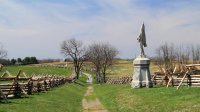
If you come from a family with a history buff or one that prioritized an annual summer road trip, there’s a half-decent chance that you ended up, either by choice or by force, on a tour of a piece of land that played host to a battle or conflict. As a history teacher, I’ve visited several sites myself and also toured them with students. They listened respectfully, but also made sure I was aware of the time so that we didn’t overstay our tour.
Some of the most famous battlefield parks that I’ve visited, like Gettysburg, Shiloh, and Vicksburg, weren’t initially preserved for the study of history or to reflect on the price of freedom. They were originally the property of the Department of Defense, which utilized them as open-air classrooms for training officers during outdoor lessons called “staff rides.” These sites helped prepare military personnel for combat by providing them with opportunities to analyze and critique command decisions and mission-critical skills like responsiveness to enemy movements and better utilization of terrain.
The training also developed skills such as critical thinking, collaboration, and complex communication, which aren’t just helpful to military leadership, but also key elements of student success in college, in career, and beyond.
Merging the Concept of Staff Rides with Your Instruction
Creating lessons and activities modeled after staff rides strategies can be beneficial because they allow students to more deeply understand skills used by historians and provide opportunities for students to practice collaborative learning. Military history can be a great way to engage students—especially the board game or video game enthusiasts in your room.
A battlefield-focused lesson follows a problem-based approach. You provide your learners with an open-ended question and a specific amount of time to come up with an answer that they must then defend with evidence. You can riff on this basic approach in a number of different ways, depending on the specific future-ready skill that you’re hoping to develop.
To target critical thinking: Make sure that students have to defend their decisions and explain why their idea is superior to any other option. Lessons like this teach critical thinking because they require students to consider alternative ideas, analyze and critique decisions, support claims or choices with evidence, and prioritize multiple solutions. In fact, this goes beyond critical thinking to strategic thinking—a higher form of thinking where students think three moves ahead by predicting outcomes based on different options, articulating the long-term effects of a battle’s aftermath, or the valuable lessons that we derive from it today. For example, have you ever heard the saying, “Don’t get involved in a land war in Russia”? Well, World War II Germany certainly didn’t.
If communication is your learning goal: Set up a discussion activity or a mock council of war where different student groups debate and respond to their peers’ solutions. You can use this structure to teach the importance of roles in discussions as well as respectful debate norms. You might utilize protocols designed to share perspectives, like Circle of Viewpoints or Feelings and Options, to ensure that students learn that discussion involves both speaking and listening. As students share the solutions or possible courses of action, provide them with sentence starters such as “Others might say…,” “Yes, and…,” or other accountable talk sentence starters that guide respectful disagreement and setting.
To have students practice collaboration: You can create a timed activity where students must choose roles and work together for about 20 minutes as a group to come to a consensus. Battlefield command decision problems are a great way to teach complex communication and persuasive writing. After students pick a course of action, they’ll essentially need to construct their best claim, evidence, reasoning response—a core history process skill. You can include primary source documents like letters, reports, and eyewitness testimonies as a way to teach source analysis.
Have students support and give feedback to their chosen presenter with resources like a presentation rubric. You can then add an engaging competitive angle to a collaborative exercise by turning it into a classwide game where groups compete for points to see who has the best solutions and speakers.
Depending on things like the age of your students and the subject you teach, you’ll want to consider how to best customize the design of your lesson.
Tools to Scaffold Strategic Thinking
Thinking like a general isn’t a skill that comes naturally to most students, but you can easily scaffold this kind of strategic thinking in multiple ways with a variety of digital tools to support student analysis:
- Create an engaging entry event, such as a short film or virtual tour of the site. Cyark’s Tapestry platform includes some that could capture students’ interest, like their Pearl Harbor tour.
- Provide students with an overview of what happened during the battle from start to finish, and ask them to identify the biggest mistake by the defeated side and the biggest success by the victorious one. Utilizing the American Battlefield Trust’s animated battlefield map library can help students visualize events and turning points. These videos can also be loaded into Edpuzzle as a way of allowing students to replay and highlight specific moments and turning points.
- Model the strategic process ahead of time by completing a similar assignment using an unrelated battle from another conflict or another region or theater of war. Provide a protocol or process that students can follow in a Google Doc, or use a collaborative discussion/brainstorming tool like Padlet so that they can self-manage their own discussion.
- Give students a premade list of three to five possible scenarios that present different strategies or command decisions that could be utilized, and have learners pick and defend the one they think is best. Tools that facilitate mindmapping like Canva or Lucid can help them formulate claim-evidence-reasoning arguments.
- For your students who are ready for more, you can really challenge them by offering a customized option in addition to those you create for the whole class.
Make a Trip to the Site
Of course, if you can visit in person, you should. Battlefields are a fantastic way to get students to understand or appreciate the impact of scale and place. If you visit the Tippecanoe Battlefield in Indiana, you can see physical markers and monuments that articulate the impact of the loss on the men, women, and children of the Indigenous nations who were defeated. If you stand in the middle of the Sunken Road at Antietam and look at the pictures of the battle’s aftermath, it engages students’ sense of empathy.
To have students reflect on the price of freedom, teachers can pair these excursions with writing activities. Are there causes or ideas that they feel so strongly about that they would be willing to risk their lives, or understand why others might be?