Encouraging Students to Be Open to Participating in Arts Classes
An elementary music teacher describes how she works with reluctant student performers to build risk resilience and increase engagement.
Your content has been saved!
Go to My Saved Content.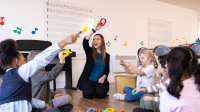
It’s easy to think of an elementary music class as all fun and games, but in every classroom there is at least one student who chooses not to participate in the movement activity or appears too afraid to take a turn during the singing game.
While some students thrive with the adventure of trying new things, others shy away from anything that doesn’t feel comfortable or familiar. In a music classroom, this sense of risk is amplified: Students are creating sounds and movements with their bodies, which can feel incredibly personal, and mistakes are often both visible and audible.
We’ve all experienced pushback to risk in our classrooms. The good news is that as teachers, we can build risk resiliency with our students. Through encouraging and scaffolding risk, developing trusting relationships, and normalizing productive struggle, we can honor our students’ fears and emotions while simultaneously strengthening their skills.
Encouraging Risk
As teachers, we can encourage students to take risks by inviting experimentation and offering opportunities for students to lead or volunteer. Students can do the following:
- Conduct a warm-up
- Be the leader in a call-and-response activity
- Sing or play a solo for the class on any song, phrase, or exercise they are learning
- Improvise patterns or make up songs (or a B section) for the class
- Use a spinner to select a mood or style, and have students play a song or phrase in that style (or have them make something up!)
Scaffolding Risk
When scaffolding risk, start with very low-risk activities such as rote learning, call-and-response, and full-group performance games, and then progress to higher-risk activities like performing a solo or leading a group activity, providing support along the way. Here are some examples of scaffolding risk:
Model everything: Model several examples of any performance or improvisation activity, then give students time to practice.
Imitate before create: Have students echo your patterns before having to come up with their own.
Group before individual: Practice any performance activity with the whole class before soliciting solo responses so that students have more certainty about what they are expected to do.
Reducing the Perception of Risk
You can easily reduce the feeling of risk by increasing the fun factor through games, offering choices for response, or reducing the group size through small groups.
Options for response: You might choose to have multiple response options for games, activities, or performances. When students feel like they have agency over their performance, they are more likely to push themselves and take bigger risks. Here are some examples:
- Options for different levels of challenge/degrees of difficulty
- Solo or with a partner
- Pizzicato or with the bow
Games: Everything feels better when it is part of a game! Solo performance games, guessing or detective games, Four Corners—all of these and more can be used to reinforce a skill or concept, as well as serve as an assessment strategy. Because the students are having fun, the risk level often feels lower than it might otherwise.
Small group work: For particularly risk-averse students, working in small groups can be very helpful. Simply reducing the number of people directly interacting with each other can immediately reduce the feeling of risk. Some easy examples include having small groups of students practice different song parts, pairing students on Orff instruments to create patterns together, or working in sectionals.
Normalizing Productive Struggle
Productive struggle involves clear goals, with effortful practice over time, along with feedback and support to help students grow.
Normalizing productive struggle begins with encouraging a growth mindset. At the beginning of each year, I show my beginning orchestra students an image of a mountain. I tell them that learning how to play an instrument is like climbing a mountain. We talk about how each of us will be climbing at different paces, and that is OK. We’re all working together toward the same goal and will support one another along the way.
I then show them successive images including various degrees of difficulty: a hiker joyfully walking along a babbling stream, a climber struggling through a snowstorm near the summit, a person rappelling off the edge. We talk about how the climbers in each of those images might feel, and that all of those feelings are expected and normal. Then I repeat our shared goal of helping each other up the mountain. I let them know that in our classroom, we will do hard things together and with support. As we go through the year, we regularly revisit those images, usually as a check-in to ask, “Which of these images demonstrates how you are feeling about ____ today?” to integrate that idea of productive and supported struggle.
Building Trusting Relationships
Teachers build trust over time with students by noticing them, listening to them, and believing that they want to learn. As students enter our classroom, I make a point to say good morning and call them each by name. During independent work time or while tuning instruments, I check in with them individually, asking about their weekend, commenting on their new haircut or outfit, etc. Acts like these let students know you notice them as people, not just students.
It is also important that we view our students as human beings with feelings. When a student chooses not to participate, I try to find out why without calling them out in front of the class. If they’ve left the room, I give the class a quick independent task and then check on the student individually. Often, what they are feeling has nothing to do with our class; they are simply having a bad day. Sometimes, students tell me that what we are doing is too hard for them or that they can’t complete the exercise or task we are performing. In these cases, I work to honor the students’ feelings and continue to build a sense of trust and compassion. I usually say something like, “I know you can do this, and I will help you. I hope you will join us when you are ready.”
This type of response shows students that you care about their learning and also about them as human beings with emotions. Students want to feel that we are there for them, and that our classroom is a place where they can be their full selves, without judgment.
Although we as teachers can’t eliminate all risk in our classroom—risk is how we learn—we can build a community where emotions are supported and mistakes are viewed as opportunities for learning.