
3 Ways to Make Your Secondary Classroom a Place Where Students Can Thrive
After asking, ‘How do I get this student to engage?’ teachers can go on to ask, ‘What kind of classroom would make them want to?’
Your content has been saved!
Go to My Saved Content.Walk into almost any school, and you’ll find a student who shows up every day without ever quite arriving. They sit in class but rarely talk or connect with the teacher. When asked to select partners, this kid seems to struggle to find anyone to work with. While this student participates in school, they never feel like they truly belong.
When we see that a student has disengaged, we tend to address the issue through a student-focused lens. We create interventions, track grades, communicate with parents, and develop plans for the student. While these approaches are helpful, we often don’t consider the bigger picture, the school community around them.
This bigger picture is precisely what psychologist Bruce Alexander began investigating back in the 1970s. In research on addiction, he used rats as subjects, usually housed in small cages without companions. Alexander wondered what might happen if he changed the cages.
He and his colleagues created a larger, more stimulating environment they called Rat Park, where rats could move around and interact. Across several experimental conditions, rats housed alone consumed considerably more of a drug solution than rats housed in Rat Park.
Rat Park didn’t prove that environment determines behavior. But it raised an interesting question: What if we paid as much attention to the environment as we did to the behavior of individuals happening inside it?
Alexander later called this psychosocial integration, people’s need to feel connected to the people and places around them. We need to feel known. We need to belong. And we need to believe we have something to contribute.
Now think about the student sitting quietly in the back of the classroom. Instead of only asking how to get that student to participate, we can also ask: What would need to change around this student for them to feel like they belong here?
That matters because school belonging has been linked to motivation, engagement, self-efficacy, achievement, attendance, and likelihood of dropping out.
We can’t control every environment our students inhabit. But we have tremendous influence over one of them: the classroom they enter every day. Here are three ways to make it a place where students are known, connected, and able to contribute.
1. Purposefully Make Sure Students Feel Known
Connection doesn’t require teachers to become counselors or find 20 extra minutes to talk with every student. More often, it grows through small interactions that repeatedly send the same message: I know who you are.
I see this with my 12th-grade English students. Seniors can be remarkably good at looking like they don’t need adults anymore. They drive, work, apply to colleges, and make decisions about what comes next. Then I ask, “What are you thinking about doing next year?” and get a glimpse of how much uncertainty can sit underneath all that independence.
One way I keep myself from missing students is through relationship mapping. Look at your roster and ask yourself: Who do I know well? Who do I know mostly as a student? Who do I barely know at all? Pay particular attention to that last group.
Then use moments already built into the school day to purposefully get to know the students your map shows you know the least. Stay curious. Ask low-stakes questions that build a bridge of connection. Follow up on the job interview they mentioned. Ask how the game went. Remember what they’re considering after graduation. Notice when someone who normally talks is unusually quiet.
The interactions don’t have to be profound. Relationships are built from dozens of small moments that eventually add up to something bigger.
A teacher can’t guarantee that every student will feel connected. But we can make it much harder for a student to spend an entire year in our classroom feeling invisible.
2. Purposefully Create Connections Between Students
Students don’t always make connections outside their usual circles on their own. If we want a tighter classroom community, we have to create opportunities for those connections to happen instead of just hoping they happen.
One strategy I use is Three Before Friday. Each week, students have meaningful academic interactions with three classmates they don’t normally work with. At the front of their journals, students have a class roster with checkboxes and space to record the date they worked with each person. I explain that the goal is to intentionally reach beyond their usual circles, and the roster helps them see who they haven’t connected with yet. These interactions might involve comparing ideas, giving feedback, solving a problem, or helping each other find evidence. Afterward, students record a one-sentence summary of what they discussed. I periodically check their lists to make sure they’re expanding their connections rather than returning to the same comfortable partners.
The interactions are built into what we’re already doing, so I don’t have to stop class three times a week to make them happen. Students know they’re expected to find three classmates to work with before Friday, and I give occasional reminders and create opportunities during lessons. After a difficult passage in Hamlet, for example, I might ask students to find someone they haven’t worked with that week and compare interpretations. One thinks Hamlet is genuinely conflicted. Another thinks he’s stalling. Now two students who rarely talk have something worth talking about.
The goal isn’t to force friendships. It’s to widen students’ circles a little at a time. Three people. Five days. As those small interactions accumulate, students know more people in the room, have more classmates they feel comfortable approaching, and begin to see themselves as part of a larger classroom community.
3. Give Students Something Meaningful to Contribute
There’s an important difference between being included and being needed.
Early in the year, I ask students a few questions in a Google Form called “What Do You Know That I Don‘t?”: What do you nerd out about? What could you teach someone else? The answers, collected in a Google Sheet, add up to a big list of student interests.
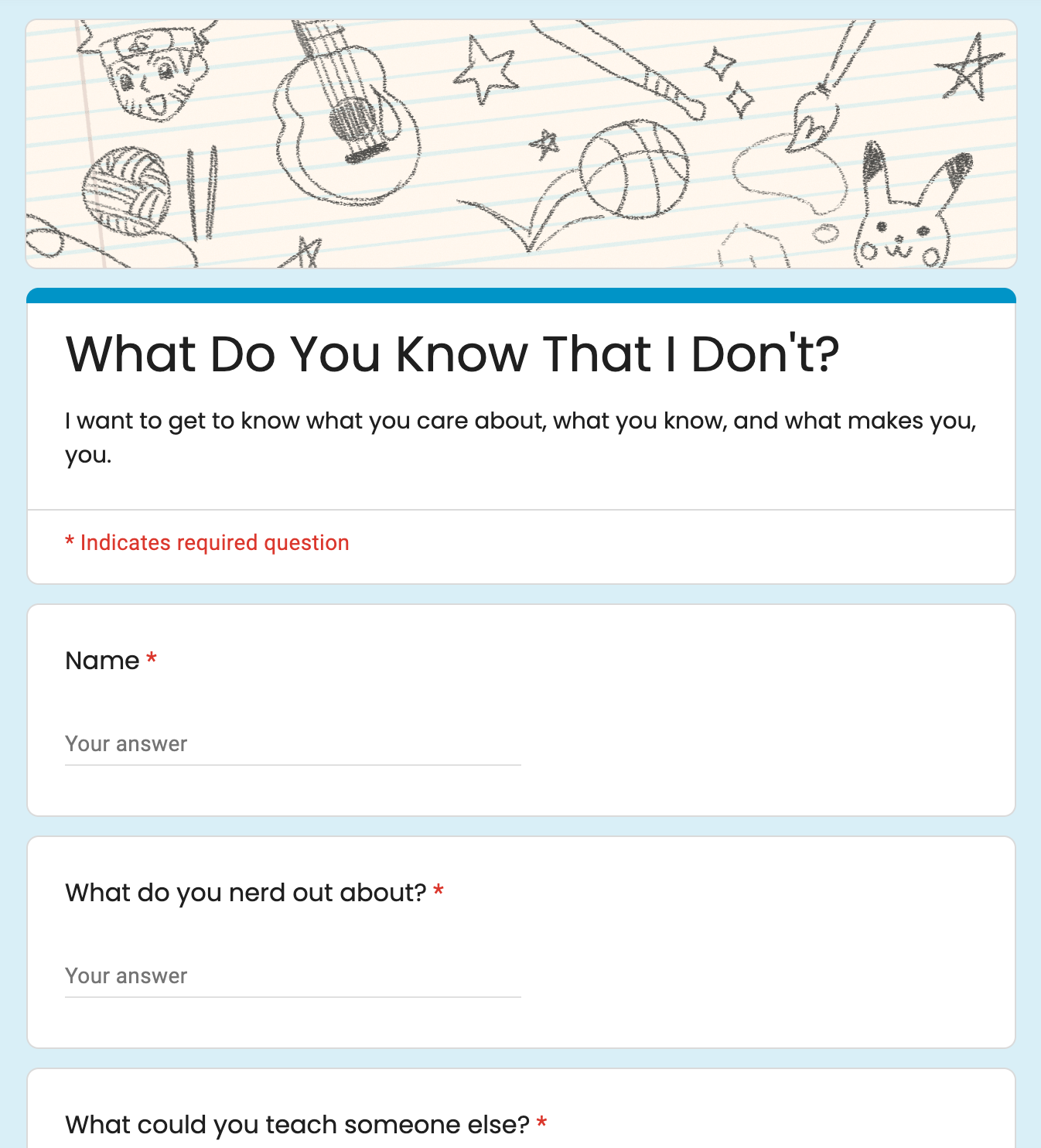
Their answers are often things I would never discover from an English assignment: cars, photography, weightlifting, anime, cooking, investing, horses, video games, military history.
When I’m planning, I use their answers to look for places where those interests could add something to a lesson. AI can make this surprisingly easy: You can give it your topic and copy and paste the list of student interests—without names or identifying information—and ask AI to find natural connections.
A math teacher working on distance and rate might invite a student who follows running to explain what happens during a marathon. During a Civil War unit, a student who collects coins might contribute what they know about period currency. In my English class, a student interested in psychology might notice something about Hamlet’s behavior that takes our discussion in a new direction.
Give students choices about how they contribute. One may want to teach for five minutes. Another might contribute from their seat. Someone else might send you an example, photograph, website, or video to use in the lesson. Students can contribute without becoming the center of attention.
I keep a simple checklist beside my roster and mark when students take these opportunities. It’s not for participation points. It’s there to catch my blind spots. If the same five confident students keep becoming the experts, I haven’t changed much.
The goal is to eventually reach every name. It takes some intentional effort, especially with students who are less comfortable speaking up. I use the checklist to see who hasn’t had a chance to connect yet, and I look for ways to bring their interests into lessons so they feel more confident engaging. Usually, by about nine weeks into the school year, I’ve reached every name. The challenge then becomes making sure those opportunities continue rather than being a onetime experience.
Being part of a classroom is different from having a place in it. Sometimes the evidence that a student has a place is remarkably small—it might be a teacher saying, “You know a lot about this. Can you help us?”
For that moment, the student isn’t someone we’re trying to engage; they’re someone the classroom needs.
Change Something Around the Student
Rat Park offers a useful reminder: Behavior doesn’t happen in a vacuum. When a student disengages, instead of only asking what’s happening inside the student, we can look around them:
- Does someone know them?
- Do they have people to connect with?
- Do they have something meaningful to contribute and an opportunity to do that?
We can’t control every environment our students enter, but when they walk into our classroom, we shape one of those environments, and sometimes changing what surrounds a student can change how they experience school.
After asking ourselves, “How do I get this student to engage?” we can go on to ask, “What kind of classroom would make them want to?”