Outdoor Learning Activities for Preschool That Work in Any Weather
There are plenty of opportunities for children to play and learn outside, even when the weather turns cold.
Your content has been saved!
Go to My Saved Content.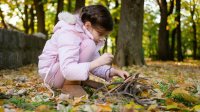
When the weather begins to turn colder, it can be tempting to bring all learning indoors. However, autumn and winter offer wonderful opportunities for young children to explore, investigate, and further develop their understanding of the world.
Outdoor learning is an essential part of early childhood education. Being outside encourages movement, develops coordination and balance, and offers unique opportunities for children to move freely, follow their own interests, and take manageable risks. Children can experiment with natural materials, explore changes in the weather, and develop their language and physical abilities.
4 Engaging Outdoor Activities
Creating faces using natural materials: This was a hit in our preschool class. We provided each child with a ball of air-dry clay and modeled how to form it into a pancake shape and stick it to a tree trunk. We then modeled how to use a variety of materials found on the ground to create faces. It was fantastic to see the children’s imaginations flourish and how they found different uses for acorns, leaves, and sticks.
After everyone was finished, we held an art walk around the trees so the children could explain what they had used to create their faces. The best part was how different each face was. This was an activity the children wanted to repeat many times.
Making hedgehogs from sticks and clay: Autumn is an ideal time to explore woodland animals and seasonal changes. Before this activity, we took the children on a “stick hunt,” which was a fantastic activity in itself. We observed children using mathematical language naturally as they compared sticks of different sizes and widths.
After the children were each given a ball of clay, they used their sticks to create mini-hedgehogs. As they did this, they developed their hand strength, coordination, and problem-solving skills. Once their hedgehogs were dry, the children enjoyed using them in their small world play. We left the leftover clay and sticks out, and children were inspired to create other animals and objects from their own imagination. We also used this approach to create stick people, after reading the picture book Stick Man, by Julia Donaldson and Axel Scheffler.
Writing names using sticks: Using the sticks we had left over from a previous stick hunt, we invited the children to use them to create marks and patterns in the sand pit and mud. For our older students, this extended to physically creating their names out of sticks. Our younger students who were not quite ready for name writing used the sticks to create different shapes and pictures. This playful approach supports early literacy, visual acuity, and an understanding that letters are made of different lines and shapes.
Building shelters for animals: For this activity, we needed a lot of large sticks. Those weren’t available to us in our environment, so we set up a “stick donation” box outside our classroom. We encouraged families to collect sticks during their weekends or after-school trips to the park. We ended up with so many sticks, of all sizes. The children loved that they were able to bring sticks from home, and it gave them a sense of ownership over the activities we did with them.
Before the den-building challenge, we explored various dens that animals make to live in. The children were split into groups of three or four and were given a small stuffed animal. We then challenged them to create and build a den for their animal to live in. It was amazing to observe how each group approached the task differently. Some children made dens in the style of a “teepee,” others stuck the sticks in the ground and then made a roof, and some children propped sticks against a tree, creating a sloped den. The children loved looking at each other’s dens and discussing their own approaches.
To take this challenge further for older students, you can challenge them to adapt their shelter so it protects their animal from wind, rain, or snow. Children can test their structure, notice what makes it stable, and change their design. This introduces early scientific thinking and engineering concepts.
Health and safety
Before each outdoor activity, you should check environments for hazards, such as broken glass, animal waste, or slippery surfaces. You should also check natural materials for suitability and remind children not to eat anything they find outside. Children need to be dressed appropriately for outdoor learning. (Teachers and parents should remember that there is no such thing as “bad weather,” just unsuitable clothing!) To ensure that children arrive to school appropriately dressed, remind parents of the benefits of outdoor learning in all weather. In our school, we require children to have rain clothes and sun hats at school at all times. This way, the children can make use of the outside environment no matter the weather.
One of the biggest misconceptions of outdoor learning is that you need a large outside area. In reality, the quality of children’s learning experiences matters far more than the size of the space. A few small planters or a few trees can inspire stories, artwork, and observations of seasonal changes.
Outdoor learning in the early years should be embedded in everyday practices. It offers endless opportunities for children’s development across the curriculum. And it doesn’t need to be complicated. It just needs to offer children opportunities to explore, discover, ask questions, and learn in a joyful way.