Transforming Your Hallways Into Learning Environments
Hallway walls can host communal experiences with familiar classroom activities like word searches and cryptograms.
Your content has been saved!
Go to My Saved Content.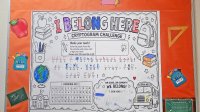
As a special education teacher, I am always looking for ways to make learning activities accessible to students with different abilities. This has also influenced how I approach schoolwide activities as part of my role as a lead teacher who organizes and facilitates events. I began exploring how familiar classroom activities such as word searches, cryptograms, and coloring pages could become interactive displays that invite students to contribute.
School hallways are often used to display student work or decorate for special occasions. Students pass these bulletin boards every day, but most of the time, they are simply there to look at. I asked myself, “What if we could turn these spaces into opportunities for students to participate, learn, and connect?”
Start With Something Simple
Creating a schoolwide learning experience does not always require an elaborate event or expensive materials. Sometimes, the activities we already use in our classrooms can serve a bigger purpose.
I started with familiar activities such as word searches, cryptograms, and coloring pages. Instead of giving students individual worksheets, I explored how these activities could become something students across the school could work on together.
For example, a word search that students would normally complete at their desks can become a large hallway puzzle. Students can stop by, find a word, and circle it. Some may find several words independently, while others may participate with help from a staff member.
Make the Activity Bigger
My brainstorming starts with identifying what our students need, whether it’s behavior management, inclusion, or an upcoming school event. I think about how to turn these needs into engaging activities while considering how students with different abilities can participate.
I often use familiar activities such as word searches, cryptograms, and collaborative coloring. I use Education.com for word searches and PuzzleGenio Cryptogram Maker for coded messages. In Canva, I customize puzzles, add graphics, or modify existing worksheet templates to fit my students’ needs.
Once the design is ready, I enlarge it across multiple printed pages and assemble them into a hallway display. Beyond size, I consider accessibility by using large, readable fonts; short instructions; and clear visuals. I also make sure the display is positioned where students can comfortably reach and participate.
Create Different Ways for Students to Participate
Working in special education has taught me that students do not always need to complete an activity in the same way to be meaningfully involved.
One example is an interactive hallway display I created called “I Belong Here: Cryptogram Challenge.” Students could decode a message about belonging using a number-and-letter key, but solving the puzzle was not the only way to participate. They could also write their names, draw, or color parts of the display. Students could bring their own supplies or use the markers and crayons I kept in a small pocket attached to the wall with Velcro.
I wanted students to have choices rather than feel that they had to complete the same task. As students added their answers, colors, and signatures, the display gradually became a shared piece of work.
When designing these activities, I keep instructions short and simple. A student who finds writing difficult might point to an answer or participate with staff assistance.
My goal is not for every student to complete the same task. It is to give students opportunities to contribute in ways that are accessible to them.
Connect the Activity to a Meaningful Purpose
Although these activities may look simple, I try to connect them to something students are learning or experiencing at school.
For example, at the beginning of the school year, I created a large interactive word search titled “Back to School: Be Your Best Self!” The puzzle included words such as “kindness,” “respect,” “patience,” “empathy,” and “self-control.” Students were invited to find and circle a word, then sign their name beside it on the word list. I also included simple visual reminders about making good choices, using kind words, and taking breaks. Through this activity, students could practice literacy skills while reinforcing positive behaviors and contributing to a shared schoolwide display.
I also adapt these activities for school celebrations and special events. To celebrate the 250th anniversary of American independence, I created a collaborative coloring display titled “I Love the USA!” Students could color sections, sign their names, draw, or write short messages. As they contributed, the display became a colorful collection of their work.
These activities can also encourage students to practice waiting for their turn, sharing materials, following directions, and respecting the contributions of others.
Let Students Complete the Display
One of my favorite parts of creating these activities is seeing how the displays change once students begin participating.
Before students contribute, I remind them to use appropriate words and drawings and respect the work of others. As they add their answers, colors, names, and messages, the display gradually becomes a shared piece of work. Some students participate independently, while others need encouragement or staff assistance.
To keep the activities manageable, I reuse familiar puzzle formats and adapt them to different student needs or school events rather than starting from scratch each time.
Small Activities, Meaningful Connections
Through these experiences, I have learned that schoolwide engagement does not always have to begin with a large event or complicated project.
Sometimes, it starts with a familiar worksheet, a few printed pages, and an empty bulletin board.
I have been able to implement these activities in a special education setting where students have different academic, communication, and support needs. This experience has shown me that interactive schoolwide activities can be designed to include students with a wide range of abilities. I believe the same approach can be adopted in other school settings, giving more students opportunities to participate, contribute, and feel connected to their school community.