5 Tips for ‘Soundtracking’ Your Classroom
The right music can help minimize distractions, improve students’ focus, and create a positive atmosphere for learning.
Your content has been saved!
Go to My Saved Content.While walking through my school, I smile at how many teachers are using music in their classrooms. Since I teach in a modified open-concept school, I can hear a lot. Some classrooms have soft piano or meditative sounds wafting through; others have classical or even upbeat music.
As a former music teacher and one who studied the benefits of music integration, it wasn’t until about 10 years ago that I started to look into the advantages of what I call “soundtracking” my classroom.
Actually, the first attempt to soundtrack my classroom back in 2017 was a bit of a failure. I did what I see many teachers do now: I chose some “nice classical music” from my CD collection and just pressed play. It wasn’t long before I noticed that approach was hurting more than helping my end goal, which, in that moment, was to calm and focus my students.
I had just given my students a written assignment, and they started working right away when—whoosh! A change in dynamics distracted about five kids. Then, without warning, there was a sudden rush of high-pitched notes that completely broke everyone’s concentration, including mine! The classical music I was playing did the opposite of what I was hoping for. It disrupted students’ focus more than it helped, leading me on a journey to discover the best way to soundtrack my classroom.
Here are some tried-and-true practices I’ve found to pick out the right music to soundtrack your classroom.
1. Choose Music that is Made for the Background
Often the go-to music for teachers is classical favorites or other beautiful music, but something we need to keep in mind is that this music was composed to be heard. Composers build in contrast to keep listeners’ attention. A moment of loud trumpets or a sudden trill of notes is not meant to keep you calm. This music is wonderful to integrate into your classroom as an active listening experience, but when we want to soundtrack our classroom, the music should lay over our classroom like a warm blanket.
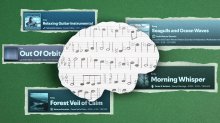
When choosing music for calm and focus, you want to find tracks that are the same volume throughout. Ambient tracks, meditation music, alpha-wave tracks, and gentle solo piano all work really well. You can find all kinds of options online. This is my go-to playlist on Spotify.
2. Skip the Lyrics
When there are lyrics in the music (even in a different language), our brains try to process them, which takes our attention away from the work at hand. This is especially distracting during reading and writing tasks. In a 2023 study, listening to music with lyrics hurt people’s verbal memory, visual memory, and reading comprehension.
Save songs with lyrics for other parts of your day. They work well for clean-up time, transitions, and celebrations.
3. Keep the Melody Simple or Skip It
In my own classroom experiences, I’ve noticed that a catchy melody is hard to ignore, even if it’s a soothing one. Many students’ ears want to follow the line of the melody, which is distracting when you are trying to think about something else. During focused work time, I reach for music with very little melody or rhythm, such as droning tracks that feel more like a calm atmosphere than a song. Another option is music that gets into a slow groove and repeats gently into the background. Lo-fi playlists are great at accomplishing this.
Another option is to use nature sounds. Wind, faint bird songs, ocean waves, and flowing water are all peaceful noises you can add into your classroom and are great to use during writing or silent reading time.
4. Turn it Down
Volume matters a lot when you want to soundtrack your classroom. A good rule of thumb is to keep the volume under your speaking voice and to think of it like this: You don’t want to completely drown out any noise that may be distracting your students, but rather it should provide a foundation of sound that can ground them.
Silence should also play a vital role in your classroom. Music doesn’t have to be for every moment. There are studies that show background music can be more of a distraction than a help when the task is cognitively demanding. So consider having quiet time during an important test or when students are learning something new and challenging for the first time. Sometimes the “sound of silence” can be just as impactful as your carefully curated playlist.
5. Match the Music to the Moment
Different parts of the day need different energy. So, consider the purpose of the background music you use to soundtrack your classroom:
- Upbeat or themed music, including music with lyrics, to greet your students or for celebrations
- Slow, droning music during lessons and work time to keep everything steady
- Calming nature sounds during silent reading
- Something with energy for clean-up time and transitions
Soundtracking has become a vital part of my classroom. Each year, I spend some time introducing the concept to my students and then practice how to use the music for calm and focus.
The first year I did this, we spent time building reading stamina during silent reading time. In just the first couple of days, we went from two minutes of sustained, silent reading as a class to 13 minutes with the music.
The students could feel the difference. Many students reflected on the experience, saying that it relaxed and helped them. One student called the music a “bubble of privacy” and a “force field.” A parent even mentioned to me that her daughter started doing her homework to gentle music and thanked me for introducing her to this incredible tool.
These experiences remind us that soundtracking, when used intentionally, can empower students by creating an environment where they feel more comfortable, focused, and ready to learn.