
Onboarding That Fosters Teachers’ Connection to Their School
By creating engaging modules that introduce the school’s culture and community, administrators can better prepare their new teachers for the year.
Your content has been saved!
Go to My Saved Content.
Schools can spend considerable time and resources recruiting the right educators, yet many still rely on a traditional onboarding approach built around reviewing various policy documents and sharing the school or district handbook. While these resources are important, they often do little to help new employees develop an early understanding of the school’s culture, community, and values.
At the International School Yangon in Myanmar, my team and I wanted to try to do something different. We wanted our new teachers to feel informed about and connected to the school before their first day even began.
Rather than overwhelming them during orientation, we introduced engaging pre-arrival onboarding modules. In these modules, teachers begin to see, understand, and experience the school before they ever step onto campus, transforming the all-important pre-arrival phase from a checklist of administrative tasks into the beginning of a meaningful relationship.
As we went through the process of creating these onboarding modules, we found a number of key steps and considerations that other leaders can apply to try the same thing out for their own school. Beyond the steps in this guide, it may be helpful to review a copy of the modules we currently use.
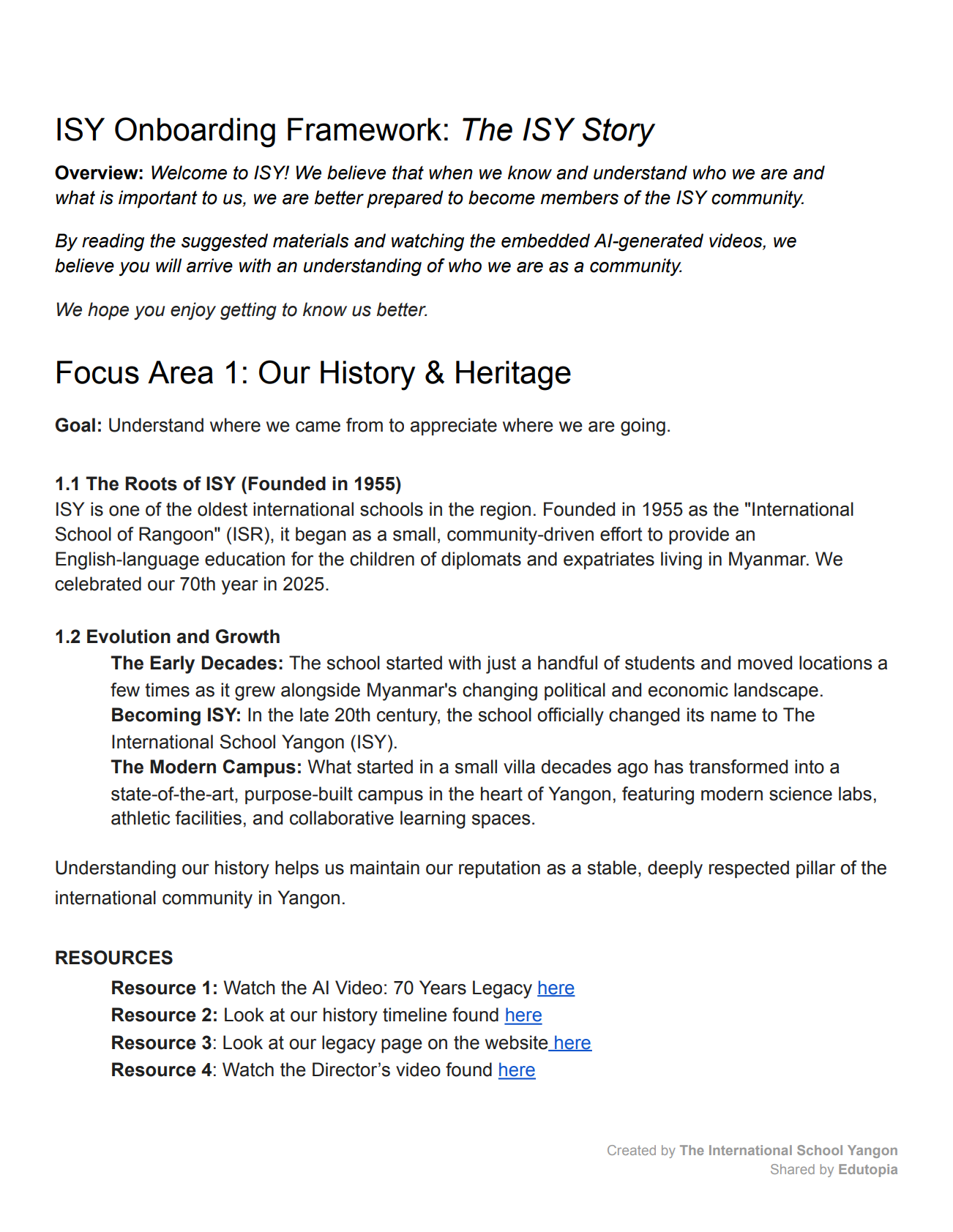
inviting teachers to engage with the modules
One of the first considerations is ensuring that pre-arrival onboarding feels welcoming rather than like additional work. Schools should be careful not to create the impression that teachers are expected to begin working before the contract officially commences.
The modules should therefore be presented as an invitation rather than a requirement:
- An invitation to connect: New employees receive access shortly after accepting their position, with a personal welcome message inviting them to learn more about their new school community.
- Strictly noncompulsory: They are encouraged to explore the modules at their own pace before arriving, with the understanding that this is voluntary.
- Designed to reduce stress: By providing information before arrival and allowing teachers to explore it at their own pace, rather than concentrating everything into orientation week, schools can help their new employees arrive feeling less overwhelmed by the start of the new year.
creating effective onboarding modules
The modules are not intended to be digital versions of the school handbook. Instead, they should be carefully designed experiences that clearly introduce new employees to the school’s culture through stories and authentic examples.
The development process for the modules begins by identifying what new employees genuinely need to know before arriving. Rather than relying solely on the human resources department, schools should include a range of voices in designing the content, including school leaders and both current and recently employed teachers.
Some of the most useful questions to ask when thinking about the content to cover are, “What do you wish you had known before your first day?” and “What is important to our school?”
Our school’s modules include the history and heritage of our school, stories that illustrate our school culture, our guiding statements, an overview of the school community, and information related to school safety.
Once the topics to cover have been identified, the information can be organized into a series of short, engaging modules:
Step 1. Identify the focus area. Each module should focus on one topic and include carefully selected resources, allowing the new employee to engage with the information at a comfortable pace rather than overwhelming them. For example, our first module focuses on the school’s guiding statements.
Step 2. Define the module goal. It is important to begin with a single clear learning objective that helps the new employee understand what the module covers. In our guiding statements modules, we explicitly state the goal as: “The goal of this learning module is to support your understanding of who we are as a school.”
Step 3. Break the content into smaller sections. Divide the content into small, easy-to-read sections that build understanding and present the information through storytelling rather than simply listing facts. In our guiding statements module, we broke the content down into a section on the mission and vision, a section on the history of the school slogan, and an explanation of how our mascot was chosen.
Step 4. Include resources. The content should be presented using different media to bring the school to life, combining storytelling, short videos, and practical resources that help new employees experience the school before they arrive.
Our guiding statements module includes links to the relevant parts on the school website, a video explaining the guiding statements, and written overviews of our history, slogan, and mascot.
The resources in a given module could include the following:
- Short welcome videos—e.g., from the head of school to introduce the new employees to the school community.
- Short videos showcasing the school’s history and legacy to help new employees understand the journey that has shaped it.
- An introduction to the school’s mission, values, and educational philosophy.
- An overview of crucial safeguarding expectations introduced early so boundaries and safety standards are clear from day one.
- Resources related to the school’s key initiatives and strategic priorities, such as inclusion, service learning, and exciting developments like a new school building project.
- An introduction to the school’s communication systems and technology platforms, including essential digital tools and online resources used daily.
- Any other helpful links and downloadable resources that new employees can refer to before and after they arrive, including the school website, section handbooks, and curriculum documents.
Our school’s technology team created a website for us to host our modules. New employees are given a link to the site, and the content remains available all year for reference. At the end of each onboarding cycle, we invite new employees to provide feedback about which modules were most valuable and what additional information would have helped them. This helps guide any changes needed for the next year.
By shifting our onboarding experience, we are better able to foster our new teachers’ sense of connection to the school, ensuring that they arrive on the first day ready to contribute to their new community.