Fostering Metacognition to Make Project-Based Learning Units More Meaningful
Middle school teachers can use a variety of prompts to support deep learning that students will be able to apply in new situations.
Your content has been saved!
Go to My Saved Content.
After presenting their project during our school’s Earth Week showcase, sixth graders Manu and Alice excitedly told me, “Mr. Pimentel, I loved teaching what I learned.”
Together, they designed an interactive cardboard poster with digital technologies and low-cost materials. The subject of the poster, which they chose themselves, was focused on conservation, sustainability, and protecting marine ecosystems.
This project is part of my sixth-grade design and modeling course at Graded—The American School of São Paulo. We explore three themes in my class: design process, or how to solve problems; technical understanding, which is learning about automation and programming; and conceptual thinking, which includes systems and interactions. A multipronged approach helps learners move beyond isolated examples and make connections that can transfer to new situations, an idea I picked up from author Julie Stern.
Metacognition strategies are a key part of my class project. Students move through different layers of learning: researching, sketching, documenting ideas, building prototypes, and reflecting on progress. I put a special emphasis on reflection. During different moments—setting goals, connecting with previous learnings, and checking progress—I also introduce prompts that lead to deeper discussions. Over time, these provocations become part of our classroom routine.
Below are the three phases of developing our Earth Week project, how each phase aligns with a variety of enriching metacognition routines, and how to incorporate daily metacognitive prompts.
Make Thinking Visible
I begin by discussing what empathy means within the context of a design thinking framework. I want students to consider how an audience, meaning other students and families, might eventually interact with their completed projects. We explore questions such as the following:
- What does it mean to empathize?
- How can we create awareness about a global issue?
- Can technology make an exhibit engaging and interesting?
To help answer these questions, we go on an intentional field trip to a museum in São Paulo, where students get to experience an interactive exhibit as visitors before they create their own showcase. I tell them to document what catches their attention, what makes them curious, and what makes an interaction memorable. Then, using an empathy map (there’s a free version on Canva), students connect their ideas with what they think the eventual audience will find interesting and important.
After we return to the classroom, I ask students to revisit their writings from the field trip. We go over how their observations could improve their own projects, which serves as a great opportunity to step back, reflect, and gradually turn toward design decisions.
Define Problems and Generate Ideas
After considering their audience and thinking about how exhibits can create engagement, my students move into the “define and ideate” phase. Their challenge is to transform a broad topic—a sustainable development goal—into an interactive learning experience.
I tell students to identify the specific message they want visitors to grasp and the action they hope to inspire. Then, I ask them to sketch possible solutions and think about the different parts, purposes, and complexities of the project. This type of thinking routine is supported by Harvard’s Project Zero.
Once they form their initial ideas, I introduce the “Eagle Pitch,” a mid-project sharing and feedback session that I created. This session is for groups to present and explain their ideas to the class and receive improvement suggestions. Before they pitch to one another, I teach the class how to give and receive solid feedback by being specific, respectful, and open to different perspectives.
At this point in the project, I bring the technical and conceptual strands together. Students look into programming concepts such as inputs and outputs and energy, while also thinking about ecosystems and human responsibility. Because they have a meaningful goal in mind, programming tends to be viewed as both a technical skill and a tool for bringing forth ideas about sustainability awareness.
Prototype, Test, and Iterate
The prototyping phase is often my students’ favorite part of the project, but it’s also where metacognition is most visible. I start by giving students 18 x 12 x 2-inch corrugated boxes, which provide a good structure for organizing the layout of the poster. They also use a GoGo Board, a low-cost microcontroller that works well as an introduction to automation. These are the only fixed requirements. From there, students can choose which sensors and actuators to use, how to organize circuits, and how to creatively communicate their message.
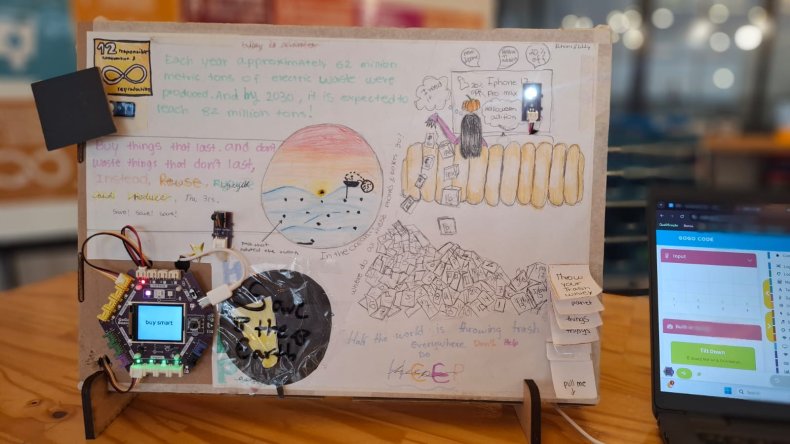
When they build their posters, students connect the microcontroller, sensors, and actuators. I eagerly watch as they realize that making a working prototype requires much more than technical knowledge. Ideas that seemed simple during brainstorming suddenly encounter real-world constraints: Materials don’t always work as intended, there might be a timing crunch, team members sometimes disagree, and there are often troubleshooting problems to address. These are healthy challenges that encourage teamwork and negotiation.
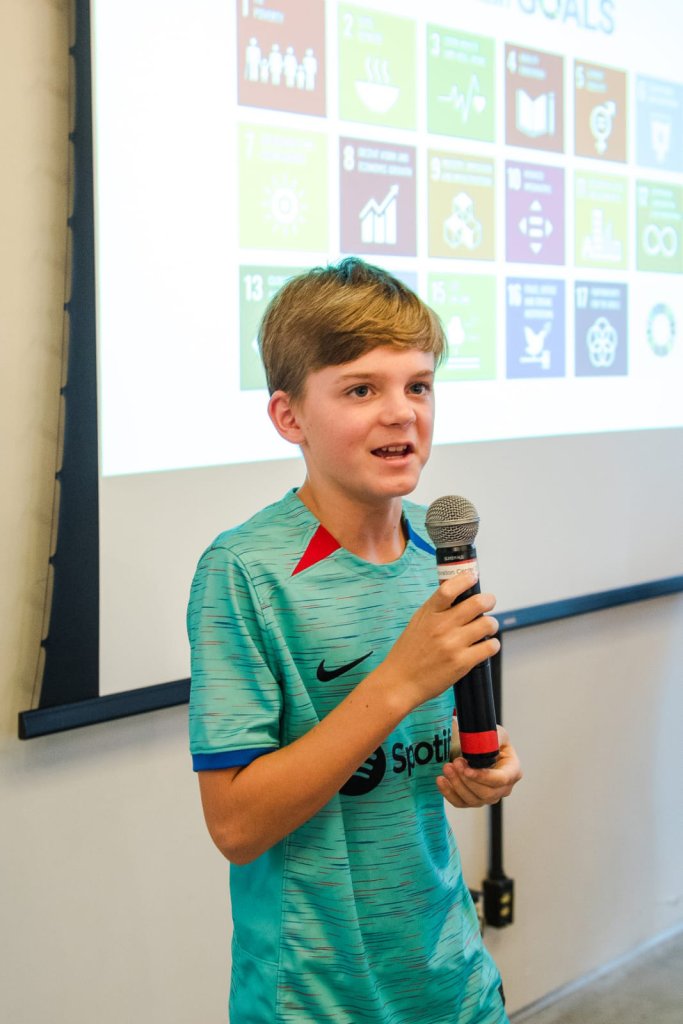
As the project wraps up, I ask students to record short video reflections about their experience on Screencastify, which allows them to share videos directly to my Google Drive. The project culminates in a showcase for the school community, where students demonstrate full ownership and present their research through an interactive exhibition. The exhibition is aligned with our school’s Earth Week celebration. Two volunteer students give their audience of families an overview of the entire project. They invite families to ask questions, and then each pair presents a three-minute pitch about their own interactive poster.
Bring In Consistent Metacognitive Prompts
Across the stages of the project, I repeatedly integrate a few prompts developed by my colleague and deeper learning specialist Jon Exall, adapting them to make metacognition a consistent part of the learning process.
At the beginning of each class, I provide whole-class and individual prompts. Whole-class reflections include the following:
- How does the learning described in today’s target(s) connect to our long-term targets?
- How does it connect to what we worked on yesterday?
- How does it connect to our larger efforts to learn about ___?
- Why does the learning described in today’s target(s) make sense as our next step?
- Which words or phrases in today’s target(s) seem particularly important? Why?
- Which words or phrases in today’s target(s) are new to us and require some explanation?
Individual reflections at the beginning of class include the following:
- What previous experience do you bring to today’s target(s)?
- What might be challenging for you about the learning described in today’s target(s)?
- What tools (or resources or strategies) will help you successfully meet today’s target(s)?
- How might you help your peers be successful in meeting today’s target(s)?
In the middle of class, I offer metacognition questions like these:
- What tools, resources, or strategies have been useful today?
- Are you on track to successfully meet today’s target(s)?
- What do you need to do differently in order to meet today’s target(s)?
- What do you need to continue doing in order to successfully meet today’s target(s)?
And at the end of class, I present one more round of metacognition prompts:
- Whose efforts do you want to celebrate or thank today?
- Which tools, resources, or strategies supported your progress in meeting today’s target(s)?
- How close were you to meeting today’s target(s)? What helped you meet today’s target(s)? What held you back?
- What would be a good step in our next class in order to build on today’s progress?