
The Endless Pile: How to Mitigate Grading Woes
By reserving grades for work that truly measures progress and using feedback for everything else, teachers can reduce stress and give students clear guidance for growth.
Your content has been saved!
Go to My Saved Content.Several years ago, I worked with a talented teacher who decided to leave the profession after six years. Her decision had nothing to do with usual suspects like low pay, demoralization, or burnout. She loved her students and deeply enjoyed the creativity of her work. However, the same qualities that made her so inventive in the classroom also wound up being her undoing—she assigned so many projects that papers piled up endlessly on her desk, increasing her level of anxiety to such heights that she eventually decided grading was a dealbreaker for her.
While this story might represent an extreme case, most teachers can agree that grading is one of the worst parts of the job. But the thing is, we have the power to make decisions about how we grade, by using tried-and-true strategies for managing the workload, for example. We can also determine the true purpose of each assignment and whether each one needs to be graded; and of course we have the ability to do a little bit less grading while still providing students with valuable feedback for their growth.
Unlearning Beliefs
“But if I don’t grade their work, they won’t do it.” I often hear this objection to the idea that not everything needs to be graded, a belief rooted in the notion that student work depends as much on compliance as it does on learning. Teachers also point to student expectations, noting that the pressure to grade everything can feel too ingrained to challenge.
These concerns are not insignificant, but they also reveal how deeply our grading habits are tied to mindset. Consider a teacher who collects and grades student journals every day, believing it to be the only way to ensure participation. When the workload becomes unsustainable, she shifts her approach: Instead of grading each entry, she skims responses during class, highlights a few ideas for discussion, and asks students to select one entry per week to receive feedback.
What she discovers is that engagement does not drop; it improves. Students take more risks without the pressure of numbers being put in the grade book each time they do something, and the teacher gains clearer insight into their thinking without carrying stacks of notebooks home. Letting go of the belief that grading drives effort (the “more is more” belief that everything must go into a grade book) is not just a logistical shift; it is a mindset change that is essential if we want to eliminate the vicious cycle of endless work that grading can create.
What Does a Grade Mean?
When teachers assign a grade too soon, they inadvertently stymie students’ ability to self-assess. If teachers delay the grading process and are cautious about what they evaluate, students have more time to understand what makes their work successful. Furthermore, research indicates that grades are often an inaccurate measure of student learning, which means that teachers not only grade too many assignments but also grade the wrong ones.
Consider a middle school writing unit in which students are crafting personal narratives. Over the course of a week, students might generate ideas, identify conflicts, experiment with dialogue, and revise for clarity. If each of these steps receives a grade, the final score becomes a murky representation of effort, early attempts, and partially developed skills. A student who struggled to write a strong story idea on Monday but produced a compelling, polished narrative by Friday may still carry the weight of those early missteps in their grade.
If the teacher instead provides feedback throughout the process—noting students’ progress toward the criteria for success, sharing suggestions for dialogue, and setting up quick conferences to discuss structure—and reserves grading, aligned to clear criteria, until the final piece, that grade communicates something far more precise. It reflects the student’s ability to craft a complete narrative, not their initial attempts at getting there. In this way, the grade becomes a meaningful indicator of learning rather than a record of the journey’s rough drafts.
Feedback ≠ Grades
I can’t count the times I’ve been so intimidated by a stack of ungraded papers that I wrapped them in a rubber band and shoved them into a closet. However, out of sight is never out of mind, especially when students keep asking when they will get their work back. Beyond the stress this situation creates for teachers, it also delays the information students need to improve.
Students benefit from frequent feedback, but that doesn’t mean they need grades on everything they do. Backward design expert Grant Wiggins differentiates grading, which is evaluative, from feedback, defining feedback as information about how we are doing in relation to a goal. In other words, feedback moves learning forward, while grades simply judge where it stands.
Consider a fourth-grade science class designing shelters for Lego figures using simple materials like Popsicle sticks, pipe cleaners, or straws. Students test their designs against “wind” (a fan) and revise their initial attempts based on specific criteria, such as using multiple materials or keeping the structure standing. Instead of assigning a grade at this stage, the teacher can quickly indicate which criteria have been met and which haven’t, giving students clear direction for improvement before any final evaluation takes place.
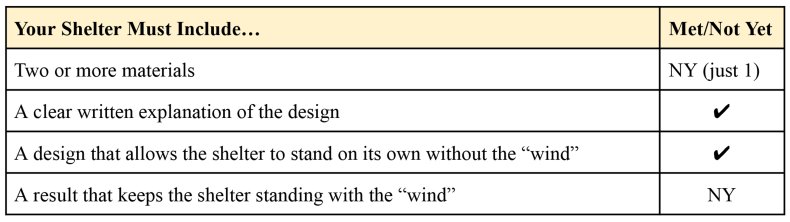
With this approach, feedback is quick, targeted, and immediate, preventing work from piling up. Because the goal is for the shelter to ultimately withstand the “wind,” this stage does not need a grade; it needs information that students can use to improve. The grade comes later, once learning has taken shape, making it a clearer and more meaningful measure of what students can actually do.
Assigning Less
When we fall into the habit of collecting assignments every day, the resulting pile becomes difficult to manage. Grading too much work not only increases stress but also can lead to unintended consequences, such as limiting teacher creativity and confusing students about what truly matters in their learning.
One of the most challenging aspects of teaching is setting priorities. We cannot do everything well, and that includes grading every piece of student work. Effective lesson planning requires deciding not only what students will learn, but also how that learning will be measured that day, even if the measurement is informal. A teacher has a key decision to make: Does this need to be a graded assignment, or is there a quicker way to gauge understanding?
Strategies like dipsticking offer an efficient alternative to grading while still measuring what each student in the room knows. A single, well-crafted question at the end of class (answered on whiteboards or collected quickly) can provide immediate insight into student understanding. By gathering real-time information from every student without creating additional grading, teachers can make informed instructional decisions while keeping the workload manageable.
Ultimately, the endless pile makes a welcome exit from teacher life when everything we grade is carefully selected, purposeful, and closely connected to learning goals. By reserving grades for the work that truly measures progress and using feedback for everything else, we reduce stress, give students clearer guidance, and turn assessment into a tool that actually moves learning forward.