Setting Up a House System as a Classroom Management Strategy
Organizing elementary students in yearlong groups is an effective way to guide them to manage their behavior and rely on each other.
Your content has been saved!
Go to My Saved Content.
Most people are familiar with the house system in the Harry Potter series, where students who attended Hogwarts were divided into one of four houses. Each house developed its own identity and earned points with the intention of winning the coveted House Cup at the end of the year. I wanted to see if I could use something similar in my fifth-grade classroom to manage behavior while also getting students to rely more on each other.
House Sorting
I divided my class of 24 students into four houses:
- Busara: Swahili for “intelligent”
- Fidèle: French for “loyal”
- Valeroso: Spanish for “brave”
- Waibu: Chinese for “caring”
Each house had its own color, crest, animal, and chant. Coming up with the animals was the easiest part, as I tried to match the animal to the adjective of each house. For example, an owl is typically associated with being wise. I decided on the colors by just walking down the back-to-school aisle at Walmart and seeing which four colors appeared the most on school supplies.
The crests, which incorporate each house’s color and animal, were then created by a friend of mine. One of my students from the first year of teaching wrote the chants, and they were passed down to new students each year. Every morning, the four houses each stood and said their chants.
Before school started, I talked with my school’s amazing counselor and tried to create groups with different academic abilities, personalities, and behaviors. I didn’t want one house filled with students who were academically strong or another with several students who struggled behaviorally. If your school has more than one counselor, find out which ones worked with your new students to create a well-rounded house.
House Arrangements
Students’ desks were arranged in groups of six for the entire year, with the house crest hanging from the ceiling on a colored cardboard sign above them. Each house also had shirts featuring its crest and color. Shirts were created by a friend of mine, given within the first month of school, and worn every Friday as a way to show house unity.
House leaders were appointed by their members. For the first three weeks of school, I asked students to pay attention to the people in their house. Who helped someone without being asked? Who encouraged people? Who listened? After those three weeks, the students selected their own leader based on what they had observed.
That was important because the best leader wasn’t necessarily the smartest. I had students who were academically strong but didn’t always have the best social skills. Other students might struggle academically but were good at getting someone to participate or helping a frustrated classmate. Over time, students began to figure out what each person brought to the group.
The house leaders had responsibilities beyond earning points. They became the mediator in group disagreements and served as the voice of their group. I also taught students about decision-making models and showed them several examples. The most common decision-making models that students used were pros/cons and the DECIDE model. This has students do the following:
- Define the problem
- Establish criteria
- Consider alternatives
- Identify the best alternative
- Develop a plan
- Evaluate the decision
Each house then created its own model for making important decisions. If there was a disagreement within a house—house arguments, a decision that the house felt may not have been fair, a leader not listening to their members—the leader could call a house meeting. I served as the mediator, but the leader was expected to explain the problem, listen to the other members, and try to find a solution. If they couldn’t resolve it, I stepped in.
Earning Points
Throughout the day, houses could earn points, which were already clearly established on a bulletin board I created, for teamwork, cooperation, smooth transitions, and praise they received from other teachers. Houses could also lose points, but only by risking them. An example of a risk could be trying to solve an “Impossible Math Problem.” If the answer was worth 50 points and they chose to risk it and got the problem wrong, they would lose 50 points instead of gaining. I entered the points using a Google Form connected to a Google Slide, so students could follow the standings during the day.
The system changed some of the conversations I was having with students. Instead of constantly correcting individual behaviors, I could recognize what a group was doing well and add points. Students also started noticing that what they did affected the other five people sitting with them.
At the end of each week, the house with the most points was offered a mystery envelope that they didn’t have to take. If they passed, it went to the house with the second-highest point total. The twist was that the envelope could contain either something they wanted—or something they definitely didn’t.
For example, one envelope might require the entire house to sing “Baby Shark” in front of the class. The winning house had to decide whether the mystery envelope was worth the risk instead of automatically receiving a prize every Friday.
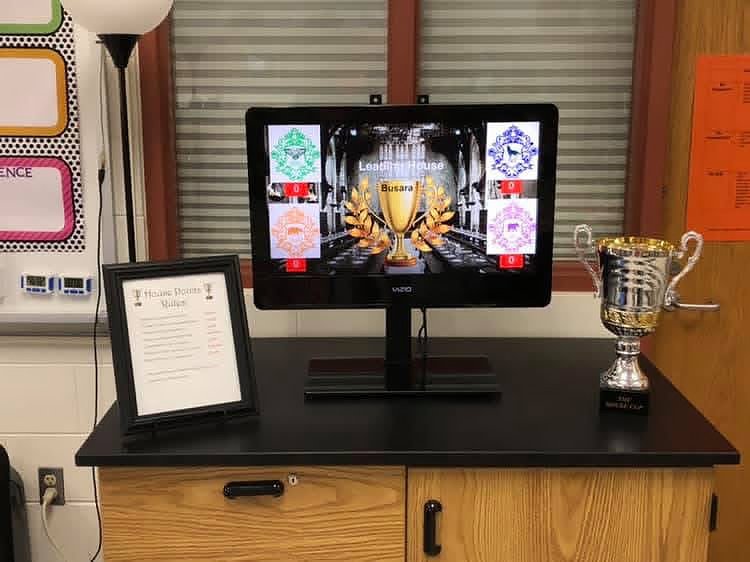
During the final month of each marking period, I stopped displaying the standings. The reason for this was simple: I wanted to keep the students in suspense. Students continued earning points, but nobody knew which house was ahead. At the end of the marking period, I announced the winner of the House Cup, which was an actual trophy that stayed at their table until the next marking period.
House Legacy
What surprised me after using the system for several years was how much the houses continued beyond the students who were currently sitting in my classroom. Former students would stop by, check the scoreboard, encourage the current members of their old house, and sometimes join them in saying the chant. A student who had left my classroom several years earlier could still walk through the door and immediately know where they belonged.
I used the house system for eight years, which meant each new group inherited parts of it from students they had never met. At the end of every school year, the four house leaders wrote letters to the students who would eventually take their places, offering advice on leading the house and working with different personalities.
When I have explained the house system to others, I often get asked if I ever had to remove someone from a house. I never did. That may be surprising, but with the same six kids staying together all year, they had to learn to get along with different personalities and resolve differences.