There’s Still a Place for Memorization
When students have a rich store of readily retrievable knowledge, they’re able to more efficiently approach new content.
Your content has been saved!
Go to My Saved Content.
As an educator, you’ve probably had students ask why they had to memorize something. It’s easy for students to want to skip the memorization and just rely on external tools to get information that helps them solve a larger problem. But when a student’s foundational knowledge isn’t automatic, they have to spend more time and mental energy just to get the information before they can even really begin to work through it.
Instead, when a student has memorized key foundational information, they free up their working memory to tackle high-order thinking.
HELPING STUDENTS BUILD THEIR AUTOMATIC KNOWLEDGE
When thinking about how to help students memorize important information so that it can become automatic, I prioritize the following memory-building strategies.
1. Creating your own flash cards. Your students, and probably even you, have likely used flash cards to try to memorize information at some point. Whether it is a vocabulary definition or labeling a diagram, flash cards can help students get a lot of quick reps with the content.
But when students are just using flash cards they’ve been given, they aren’t getting the most out of this exercise. Instead, I challenge students to create their own materials to work from, as the act of creating the resources can greatly impact memory.
I recommend giving students time during class to create their own flash cards to represent the information you have identified as a class as the most important foundational knowledge for the unit.
2. Organizing and representing new information. When students actively think about how different pieces of information fit together, they are better able to commit those pieces of information to memory and use them to answer questions.
To help my students organize information, I encourage them to think about ways in which their teachers have presented information to them in the past and use what has been most helpful.
For example, some of my students have identified Venn diagrams as the most helpful way for them to organize new information in the context of what they already know—they actively identify similarities and differences between topics.
I give my students time during class to create representations of important information, which not only helps them commit content to memory as they organize it, but also gives them a resource to review later on.
3. Connecting new information to prior learning. Just as organizing new information can help students commit it to memory, connecting that information to things they already know can help too.
To help students connect information effectively, I introduce a three-column table in which students put the new concept on the left, a connection to something they’ve learned previously in class in the middle column, and a connection to something outside of school in the rightmost column.
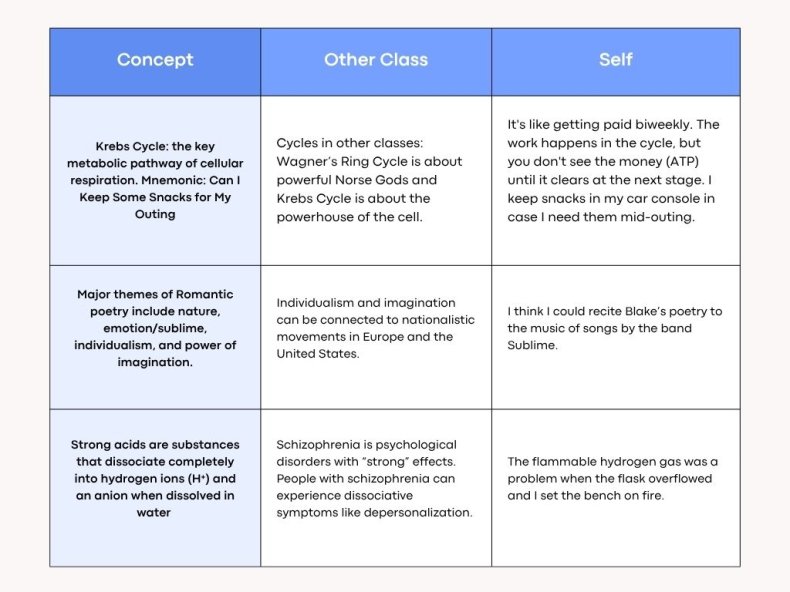
Sometimes, my students will say that they can’t think of any connections, but this is rarely if ever true. I often show them my own creative examples to help demonstrate that the connection doesn’t have to be something that makes sense or is obvious to everyone, it just has to make sense to them. The goal is to make the information memorable, so making a less obvious connection can often be more effective.
Designing Instruction with Students’ Memory in Mind
Knowing that it is important to help students commit certain information to memory, and having strategies to do that, still leaves the question of what that information that is worth memorizing actually is.
Students today have access to so much information, and it can feel easy to just allow them to outsource the storing of information to online resources. But, when students have to rely on external sources for foundational knowledge, they take time and mental energy away from being able to more deeply engage with the content in front of them.
So, how can you decide what information students should commit to memory? I rely on the most high-utility information for my students in my specific course. For example, as a psychology teacher, my students need to be able to locate and label the regions of the cerebral cortex—this is information we will use in pretty much every unit we cover. Because this is something my students will need consistently throughout the year, it is information worth memorizing.
Once this information is automatic for my students, I don’t need to take time to reexplain it in each lesson, nor do my students miss out on the opportunity to explore new information because they are stuck trying to figure out what I’m talking about as I mention a region.
Depending on your specific course, the foundational information a student should commit to memory will change. I recommend thinking about the information your students will need consistently throughout the year, as well as the information that they will need to know in order to understand the next major topic. For example, you have to know the characteristics of a major literary or historical movement if you are going to understand reactions against it in the next movement—those characteristics would therefore be worthy of committing to memory.
When students have a rich store of retrievable knowledge, they have more to be curious about, more material to combine in new ways, and more capacity to make connections to new information in a meaningful way.