A Project to Combat End-of-Year Disengagement in Social Studies
A low-stakes assignment culminating in an investigative paper has worked wonders in this teacher’s AP World History classroom.
Your content has been saved!
Go to My Saved Content.
As the school year winds down, high school students often struggle with engagement and motivation. Some are anxious about upcoming AP exams, while others are simply exhausted from their demanding coursework.
In my AP World History class, I’ve found that students lose focus after all of the major content has been covered. I still offer review packets and drill sessions, but students have told me that these practices—and other traditional practices provided by AP teachers—can feel repetitive.
To combat disengagement, reinforce AP World History skills, and keep things interesting, I like to assign an investigative paper that provides rigorous preparation for end-of-year exams. The paper is the culmination of a four-week student-led, teacher-guided learning activity that occurs alongside normal coursework and reviews.
The payoff of the four-week activity is real: My students are able to synthesize the course holistically, rather than seeing units in isolation. They recognize and interconnect broader historical themes, and as a result, their AP World History scores improve.
How the Activity Works
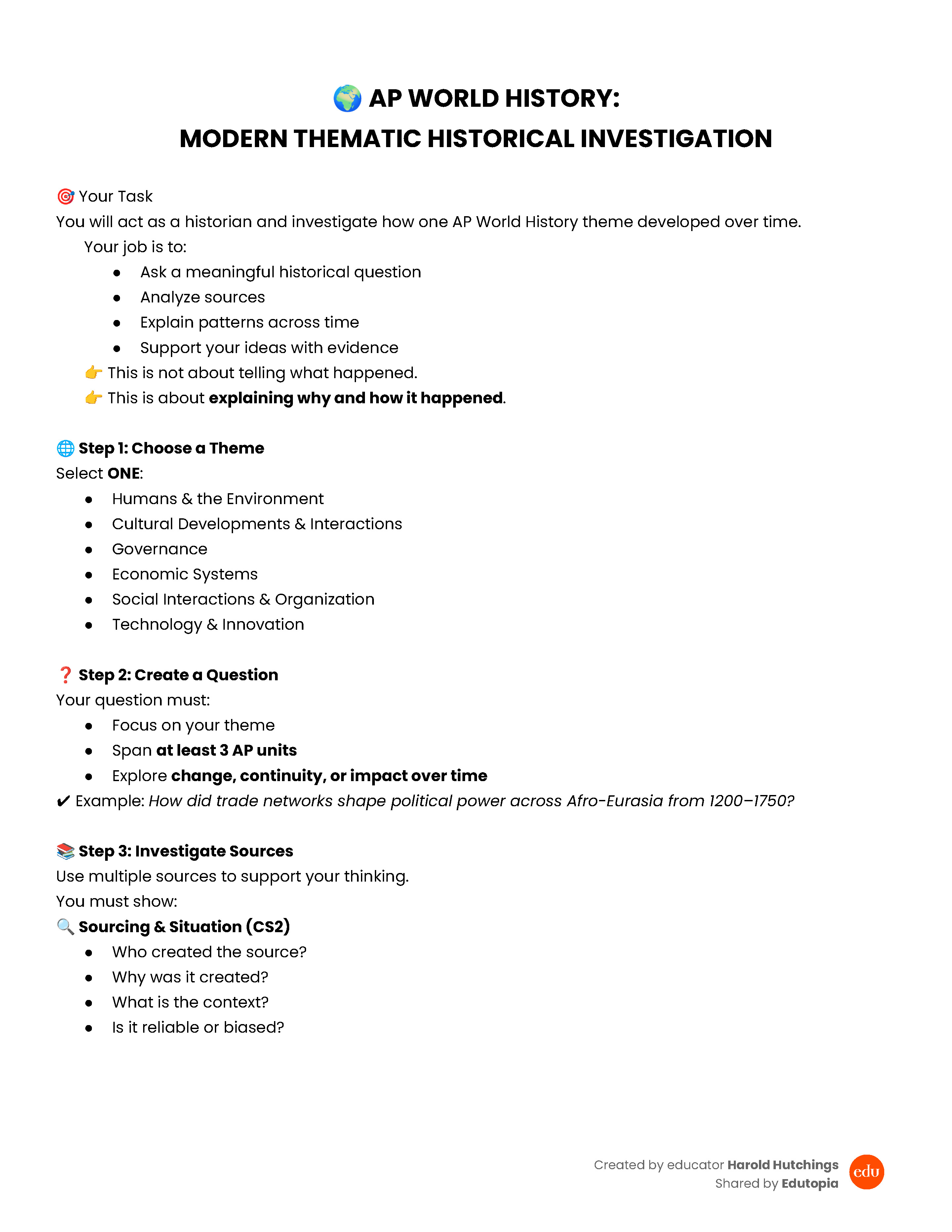
To make the process for the activity as clear as possible, I give students a structured task sheet, which breaks the investigation into manageable steps. The activity asks students to do each of the following.
Choose one AP World History theme: Examples include governance, economic systems, and cultural developments.
Create a historical research question: The research question ties back to students’ chosen theme and evolves based on the sources that students find. The question must span at least three of the nine AP World History units. To ensure good preparation for the exam, I ask that students choose from one of the first three units, one of units 4 through 6, and one of units 7 through 9. This pushes students to think across time, not just within one chapter or unit. Here are two example research questions:
- Governance: How did empires use religion, bureaucracy, and military power to maintain authority from 1200 to 1900? (Incorporates units 1, 3, 4, 6.)
- Economic systems: How did global trade networks change labor systems from 1450 to 1900? (Incorporates units 4, 5, 6.)
Analyze and incorporate multiple sources: Source investigation begins with books from the school and/or classroom library. Students identify author perspective, purpose, context, and reliability. They gather claims and use the evidence to support an argument. Six sources are required in all, two of which are evaluated in the paper like a document-based question (DBQ).
Develop a clear thesis: Students should be able to explain how and why a theme changes over time. In other words, they demonstrate their historical thinking with a defensible thesis. Here are two example thesis statements:
- Although empires used different methods of control, many states from 1200 to 1900 maintained authority by combining religious legitimacy, bureaucratic administration, and military force.
- Global trade networks changed labor systems from 1450 to 1900 by expanding forced labor, encouraging migration, and linking local economies more directly to global economic demands.
Make connections and reflect: Students successfully incorporate causation, comparison, and continuity—and also consider how thinking develops over the course of the activity. This mirrors the long essay question–style of reasoning and further connects the assignment to the AP World History exam. The final paper is usually 1,200 to 1,500 words, divided into a short question-and-source analysis section, a longer thematic investigation, and a brief reflection.
Providing Scaffolds
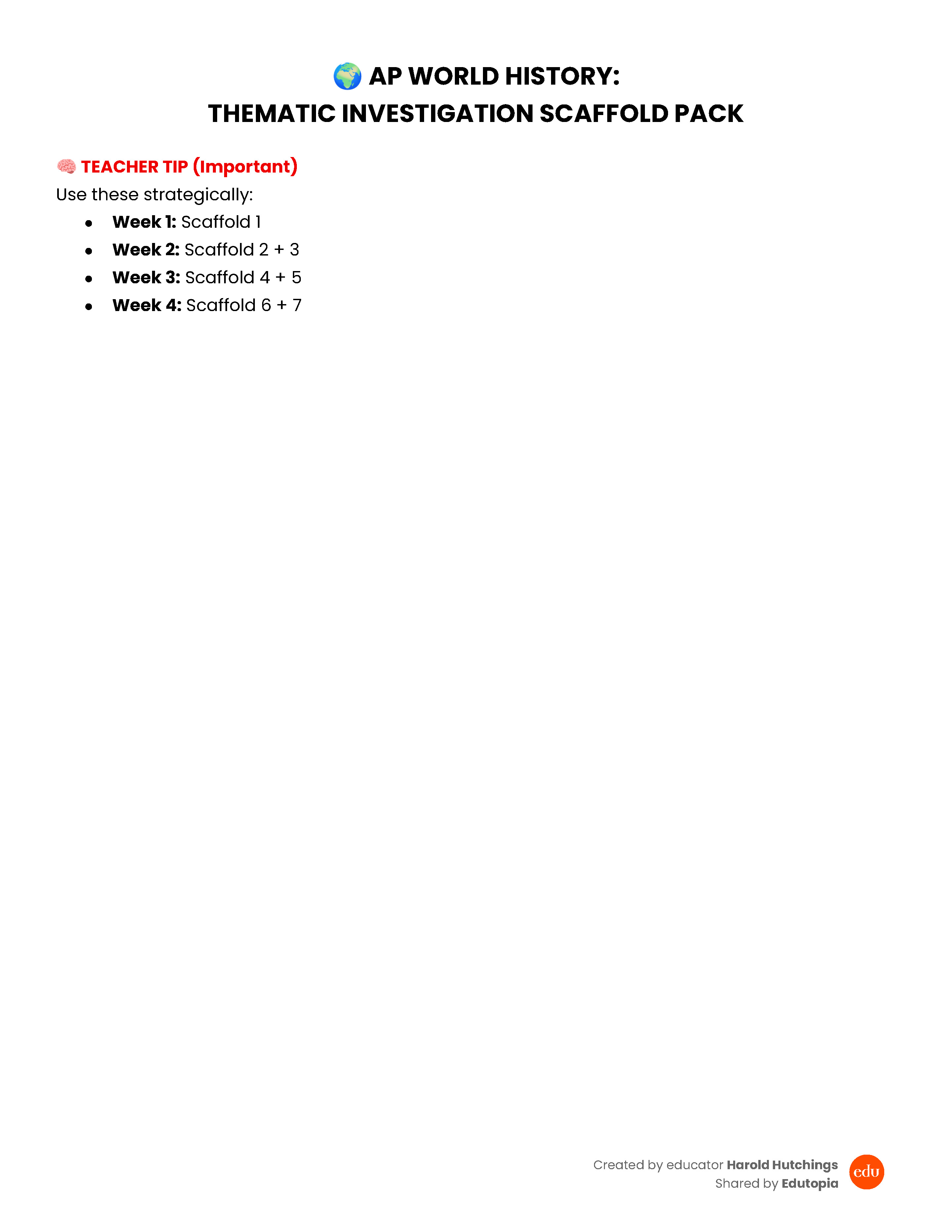
Students are not left on their own for four weeks. I scaffold the activity so that each stage builds toward a final investigation.
- The week one scaffold guides students on how to design their own question.
- The week two scaffold pushes students to analyze their sources and judge the value of their evidence.
- The week three scaffold asks students to revise their thesis and focus on the sources they’ve determined to be most useful. This scaffold also helps students craft their reasoning, which in turn shapes their essay.
- The week four scaffold encourages students to reflect on their learning process: how they’ve incorporated teacher feedback and how their thinking has evolved. Before students submit their assignment, they complete a checklist to confirm that they followed all the necessary steps.
I also include clear AI guidelines for students. I’ve found that a simple color system is most effective. “Green” uses are allowed, and include tasks like finding sources, organizing ideas, and checking grammar. “Yellow” uses like brainstorming and interpreting sources require caution, because students must verify accuracy and ensure that the thinking is their own. “Red” uses are not allowed; these uses include asking AI to write paragraphs or generate a thesis for submission, or submitting AI-generated work as their own. In general, the AI guidelines make it clear that AI can support learning, but it cannot replace historical thinking.
I grade the investigation as a low-stakes, process-based assignment, not as a traditional high-stakes research paper. I lightly grade the scaffolded checkpoints to encourage steady progress. The final paper is not weighted more heavily—it simply has multiple rubrics in the style of standards-based-grading.
Why The Activity Works
The philosophy behind the assignment is that students are more engaged when they have ownership of their learning. Instead of passively reviewing teacher-selected materials, students investigate a topic and theme of their choosing. The work becomes inquiry-based rather than compliance-based. I want my students to feel more like historians than worksheet completers.
A highly structured, highly scaffolded task leads to better-quality outcomes and makes the process predictable for everyone involved. The scaffolds are weekly checkpoints to keep the young historians on track. I provide a question design sheet, source analysis organizer, thesis builder, and writing organizer, all of which prevents students from feeling overwhelmed and minimizes procrastination. “Free-form chaos” is avoided, and that reduces the minutiae of my workload.
Even better: Because of this activity, students ask more thoughtful questions and engage in better discussions during class. Crucially, I observe reduced apathy during the spring months. Students have told me that the activity helps them see how the units connect instead of treating each unit separately. Other students have said that evaluating sources makes DBQ practice feel less mechanical. The most encouraging shift is that students begin asking better questions: “Does this source actually help prove my argument?” or “Can I compare this example to another unit?” My advice for teachers: Adopt this activity for your AP US History, AP US Government, and standard world history courses.