How K–8 Libraries Can Be Hubs of Student Well‑Being
School librarians can play a key role in ensuring that students feel that they belong, matter, and have value.
Your content has been saved!
Go to My Saved Content.
As education systems become more aware of how intricately well-being and academic progress are interwoven, we are witnessing how student needs are amplifying, especially in mental health.
The Ontario, Canada, 2022–23 People for Education Annual School Survey reported that “91 percent of schools reported needing some or a lot of support for students’ mental health and well-being.” As a 25-year veteran teacher, I entered my first year as teacher-librarian with the belief that the library space and program can be at the heart of this evolution into a mentally healthy environment for all students.
Transforming the Space
Space is abundant in the library I have the privilege to teach in, which has been both a blessing and a challenge. The space allows for movement, flexibility, and change, but how do I make it a purposeful location where all learners can thrive? Considering the essence of a mentally healthy school and the research into the well-being value of play, creativity, connection, and meaningful breaks, I created library micro-environments that catered to students’ varied strengths and needs.
My first step was permitting spaces to have more than one purpose. For example, I transformed the primary reader section, which had been used as a home for teacher-led storybook reading and picture books, into browsing shelves and a hands-on makerspace. When I added tables where four or five students could collaborate and create, as well as shifting some of the shelving from books to bins of creative tools (Legos, straws and connectors, loose parts, and materials from nature), the space provided opportunities to explore literature concepts through visual, kinesthetic, and tactile experiences.
The Learning
Teacher-librarians on Instagram showed me that the traditional school model of library instruction being “read or check in/out a book” is shifting to inquiry and experiential learning opportunities. I set out to establish a space for this learning.
The library’s Learning Lab was born with flexible seating options and tables/desks of various shapes and sizes, as well as a central location for the projection of lesson materials. All classes use this space for teacher-librarian lessons and inquiry investigation portions of the library experience. The setup in a horseshoe configuration encourages collaboration and participation, allowing students who are leaders to shine, the collaborators to work together, and the independent workers to have a space for solitary learning.
Creating a Micro-Environment
A micro-environment I created was the Reading Nest. A soft chair, rocking chair, and couch surround a circular carpet, and the direct fluorescent lights in this area are always off to promote calm. Accessed when their class comes or through a library pass, this space is for students to read, talk together, draw or color, or find a quiet space.
An example of how this space is used was for a student whose religion prohibits participation in music lessons. During her designated music class, she came to read and draw in the library’s reading nest. At the end of the school year, she wrote me a note saying the library was her favorite place, as she always felt she belonged there.
Library Access
Ensuring that the library was accessible to every student was an important goal to foster a sense of belonging. With clear, purposeful spaces established, my attention shifted to how students could engage with and use the space beyond their designated classroom time.
The value of intentional brain breaks for students is well researched. For most students, these breaks can be done meaningfully in the classroom, but some students benefit from having a different environment and an activity.
Each teacher received two library passes, pictured below. The intended structure of the program was that when students needed a break, they brought the pass to the library, turned on a five-to-10-minute timer, and did the designated activity. As my schedule was full each day with class visits, students needed to be able to do this routine independently.
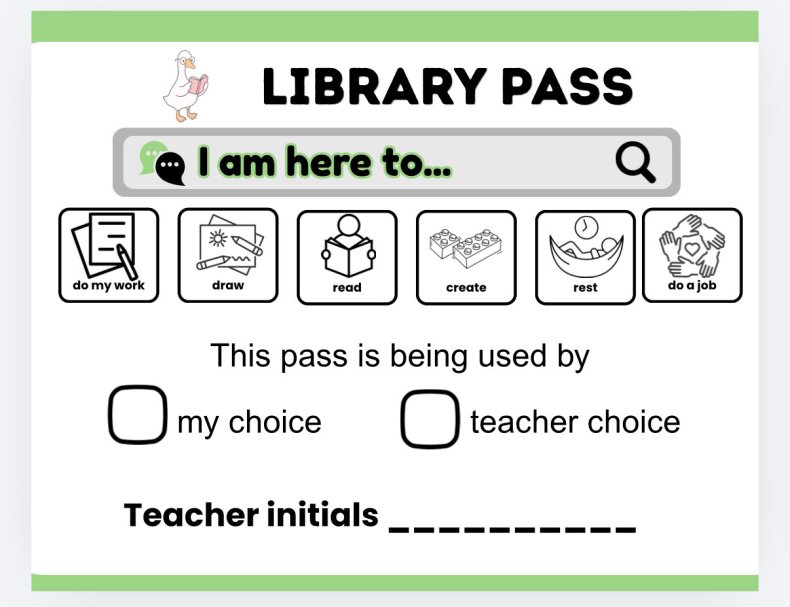
As with any program, there were bumps along the way. An important consideration for planning was ensuring that students used the pass with intention and not to escape learning in the classroom or as a way to have peer social interactions. I proactively did the following:
- Created student “library videos,” which were inserted into our weekly digital announcement slides to teach and review library pass expectations
- Had teachers use their professional judgment in handing out passes to students who they believed could perform the routines independently
- Communicated regularly with teachers about how students were using the pass so we could identify patterns and make adjustments when needed
If students misused the pass, we reviewed the process together, treating this as an opportunity to reteach expectations rather than a reason to discontinue the program. These discussions would also sometimes reveal the “why” behind the pass misuse, and a collaborative program consisting of student, teacher, librarian, parent, and administration input was designed for students to use a library pass with an individualized schedule. This communication was a key piece in shaping a successful program.
As with any educational program, the library pass was not perfect. While unfavorable situations did arise, the benefits outweighed the challenges. Students reported that the library was a place where they felt safe and belonged. Teachers told me that with a space to send students for purposeful breaks, they could address those students’ individual needs while supporting the whole classroom’s success. At the end of the year, I received several thank-you cards from parents for establishing a place where their child wanted to be.
The Costs
I am often asked about the cost of materials and resources. Here are ways I tried to keep spending low:
- Makerspace: Asked for donations from families through the school newsletter; thrifted items; asked educators if they had extras in their classrooms.
- Learning Lab: Checked the school storage for tables and chairs and did not worry if they all matched; got carpet remnants from stores as a seating option.
- Reading Lab: Gathered items that had been in school storage or donations from staff when they upgraded their own furniture.
For a school to be mentally healthy, all students need to feel that they belong, and the library is at the heart of creating this feeling. When the school library engages students in varied learning modalities through creative use of space and learning opportunities—as well as allows for connection, joy, and well-being to flourish—students feel that they belong, matter, and have value.