4 High-Quality Math Enrichment Tasks
These low-floor, high-ceiling problems support differentiation, challenging all students by encouraging flexible thinking and allowing for multiple solution paths.
Your content has been saved!
Go to My Saved Content.
Does this sound familiar? You are 45 minutes into your 70-minute math class. One of your high-achieving students—let’s call him Marcus—finishes his math practice before anyone else. On most days, he works quickly through his problems and is often done before you are able to give support to one of your other students. With a room full of students who need support, you sometimes ask Marcus to walk around and help classmates. On other days, instead of helping peers, you have him try more challenging word problems or let him go on a math computer program.
Marcus’s experience is very real for many high-achieving math students. Differentiation is one of the hardest parts of teaching, and finding or creating tasks that are suited for high-achieving students can be the most difficult of all. When we plan lessons, most of our time is spent thinking about how to support students who are struggling, especially when those struggles show up as frustration. Our highest-performing students can often receive the least-intentional planning. They finish early, wait, tutor others, or complete more of the same work.
As a mathematical supervisor for grades K–12, I am always analyzing data. Last year, after reviewing state-released performance data, we noticed that our highest-achieving students were growing the least. When I looked at the local and state data, I noticed this trend was not unique to our school. The same pattern showed up at the district and state levels. Instead of responding by giving these students more work, my administration and I focused on giving them better work. Our goal was to find tasks that required them to slow down, think differently, and truly grapple with their mathematical reasoning.
Rethinking What ‘Enrichment’ Should Be
When enriching tasks are done correctly, they should be easy to access for students but difficult to solve. Strong enrichment tasks do not need to be complicated to explain or time-consuming to prepare. The most difficult part will be finding the balance of subtle support without creating learned helplessness.
Using the right enrichment tasks allows teachers to continue supporting students who are still working toward mastery while knowing that students who are ready for more are being challenged appropriately. In our classrooms, we have seen fewer behavior issues from advanced students because they are no longer bored or disengaged by work they have already mastered.
These tasks challenge students’ sense and use of numbers. They should experience productive struggle and be able to work through these challenging problems independently without being given the answer right away. This is an opportunity that high-achieving learners rarely encounter if they are above grade level. We need to move past “This is too easy” and intentionally plan experiences that push our strongest mathematicians to think more deeply.
4 High-Quality Enrichment Tasks
Teachers do not need to create these low-floor, high-ceiling tasks from scratch. There are several free, high-quality resources that offer rigorous enrichment, encourage flexible thinking, and contain multiple solution paths.
Logic puzzles. Consider logic puzzles such as Sudoku for older students or 2x2 Yohaku puzzles for younger students.
Yohaku are logic-based puzzles where students place numbers in a grid so row and column totals match, requiring strategic reasoning and perseverance.
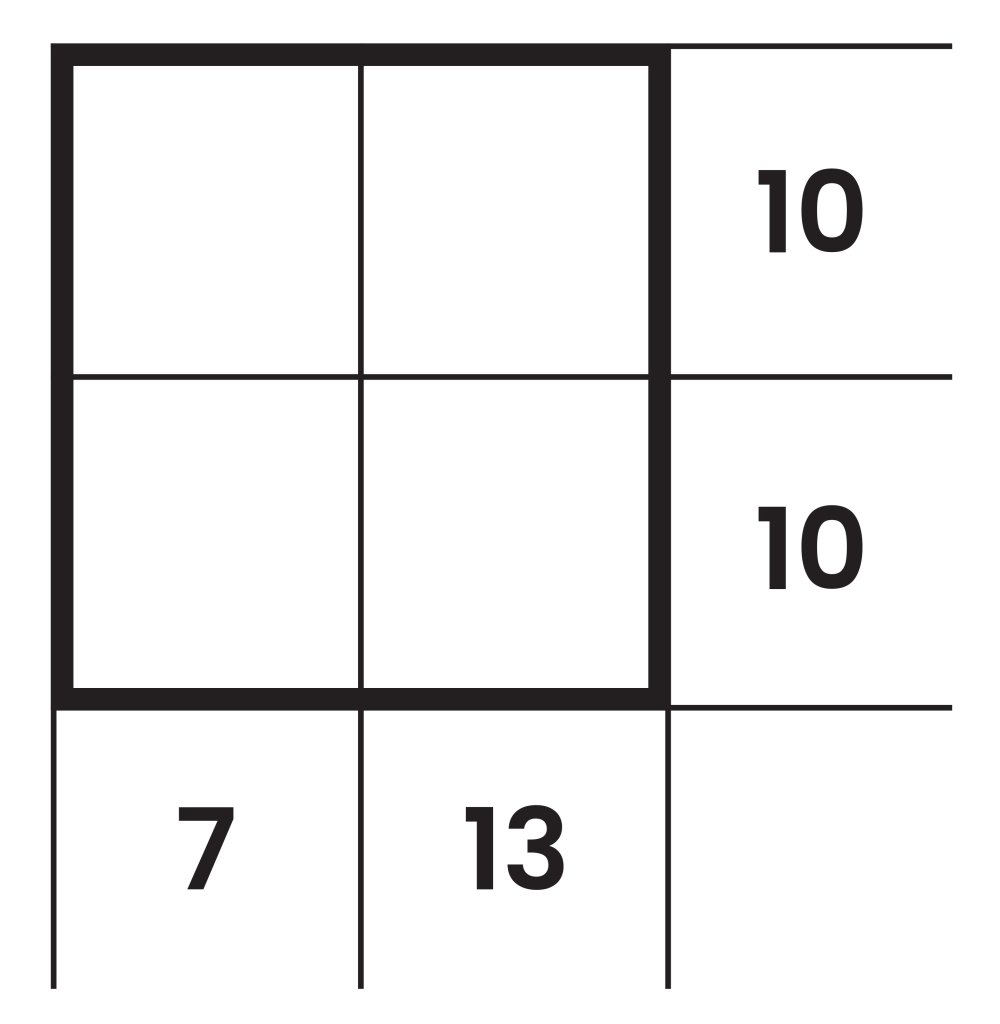
Elementary students who have mastered one-digit addition can jump right in because they already have the operational knowledge they need. The challenge lies in finding combinations of numbers that satisfy every row and column—for example, placing 5 and 5 across the top, with 2 and 8 on the bottom, so all totals work correctly. You can make the problem more difficult for older students, for example by swapping for numbers with decimals. This puzzle requires reasoning, trial and error, creativity, and persistence.
Teachers can model one puzzle in under a minute and then step back. Students naturally push themselves to try the next one. These tasks do not require students to come over to you while you are working with a small group because the directions are clear and the structure is simple. What is challenging is the thinking, not understanding what to do.
Open Middle problems. Students can also be challenged through mathematical problems that can have more than one answer. For example, take this problem from the Open Middle website: “Using the digits 0 to 9 at most one time each, place a digit in each box to create an inequality with a solution of x < 4 x + __ < ___.”
There are multiple answers that can match this equation. We push our students to think by seeing if they can find more than just one answer by using their number sense. Here are some possible answers for teachers who want to give this a try in their classroom: x + 0 < 4, x + 1 < 5, x + 2 < 6, x + 3 < 7, x + 4 < 8, x + 5 < 9.
Menu Math. Nat Banting’s Menu Math provides tasks that push students to think flexibly within constraints and to justify their thinking. For example, students might be asked to build a series of mathematical expressions that meet a set of constraints. Constraints can include things like “Contains only the numbers 2, 3, 4, and 5,” and “Only uses double-digit numbers,” and “Evaluates to -4.”
Students are asked to consider questions like “Which constraints pair nicely?” and “Which constraints cannot be paired?”
Who Am I? puzzles. These puzzles present mathematical clues about a mystery number or shape, building logical reasoning and number sense. In this example, elementary students must apply their number sense of two-digit numbers given three clues to make this puzzle correct:
- All of my digits are even.
- The sum of my digits is equal to 10.
- My tens digit is equal to six more than my units digit.
These tasks are easy to introduce with a quick example and then allow students to work independently while teachers focus on small groups. All of these platforms are user-friendly and allow teachers to go to the topic or grade level and find a task. These resources have helped many of my teachers support those high-achieving students who need that extra push.