Advantages of a Discussion-Centered Math Classroom
Before offering direct instruction, teachers can have students work together on a problem to help deepen their conceptual understanding and mathematical reasoning.
Your content has been saved!
Go to My Saved Content.
A few years ago, I was coaching a fourth-grade teacher as she was preparing a lesson on subtracting multidigit numbers. She planned to begin by explaining the standard subtraction algorithm, working through several examples with the class, and then having students practice independently. If there was enough time, students would attempt a few word problems in groups. As she told me the plan, I proposed a question: “What if the lesson started with the word problems?”
Flipping the Format Fosters Discussion
Instead of beginning with a procedure, students from third grade through high school could begin with a situation they needed to make sense of, an approach that can deepen students’ conceptual understanding and mathematical reasoning.
Students work together and test strategies before anyone has shown them an algorithm. As the teacher circulates, they ask guiding questions, monitor the approaches students are using, and deliberately select a sequence of solutions that students could share. Rather than telling students whether an approach is correct, the teacher might ask, “How did you get started?” “Can you show me what this number represents?” or “Can you solve it another way?” Only after the students wrestle with the problem does the teacher connect their ideas, codify an efficient method, and provide additional practice.
In a discussion-centered classroom, the teacher doesn’t stop teaching; rather, the work of teaching changes. The teacher chooses problems worth discussing, anticipates student approaches, asks questions, connects representations, and helps students make meaning from one another’s ideas (Anticipate, Monitor, Select, Sequence, Connect). An algorithm introduced after discussion is no longer an abstract series of steps, but connected to a problem or problems that students have already attempted to solve.
A discussion-based classroom takes more time, since problem-solving and idea generation take patience, require the willingness to make mistakes, and involve students sharing their thinking. A lesson that might take 40 minutes in a traditional “I do, we do, you do” format may take 50 to 60 minutes when students are generating ideas and discussing approaches. Teachers often worry about covering less content, but in my experience, students may need less reteaching later because the methods are connected to problems and strategies they have already worked through.
For example, a 50-minute lesson might begin with a word problem and several minutes of individual think time. Students then compare strategies with a partner while the teacher circulates. The teacher selects two or three student strategies that reveal important mathematical ideas. Students explain and compare the approaches, and the teacher connects their reasoning to the lesson’s standard algorithm. The final portion of the lesson is devoted to practice, now with students able to connect the procedure to strategies they have already used.
Students may also sit in discomfort for a little while as they uncover new mathematical skills. Some expect the teacher to show them exactly what to do, and productive struggle can feel like they are not learning. Research on active learning has also found that students feel as if they learn more from a polished lecture even when they perform better after feeling actively engaged and primed for the material.
This discomfort is one reason discussion-centered teaching requires careful preparation rather than simply placing students in groups and telling them to talk to each other. When students become genuinely stuck or begin an unproductive approach, it is time for the teacher to intervene with a simpler case or a new representation rather than simply providing a solution. The goal is meaningful cognitive demand that moves learning forward.
Preparing Rich Discussion
During the opening weeks of school, I treat discussion routines like any other content I expect students to learn. We establish norms together, practice what active listening looks like, discuss how to disagree respectfully, and develop expectations for presenting ideas clearly enough that classmates can understand and build on them. These routines matter because students cannot participate productively in mathematical discussion simply because we put them in groups. They need practice listening for reasoning, asking questions, and responding to ideas rather than evaluating whether an answer is right or wrong.
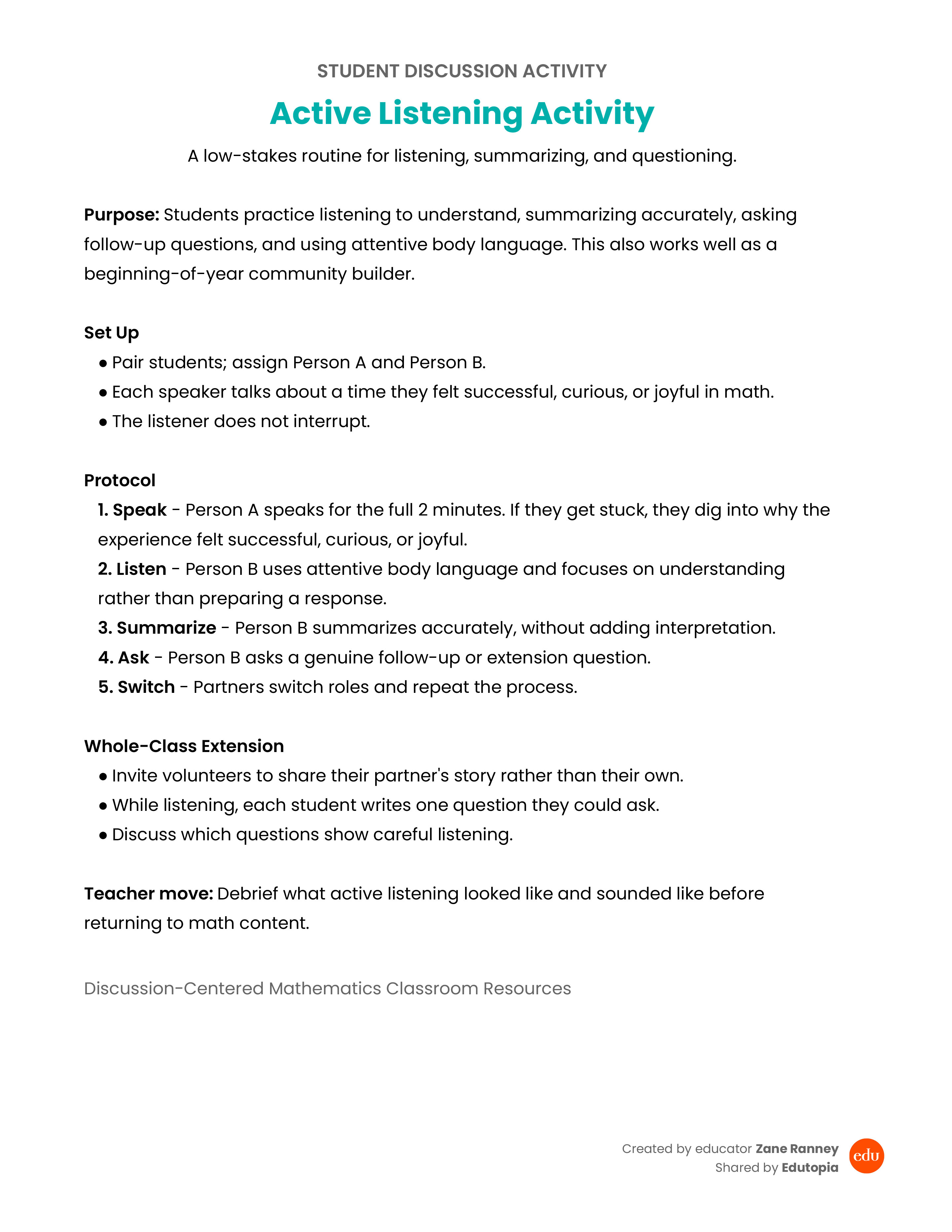
In one active listening activity, partners listen to each other describe a positive mathematical experience, summarize what they’ve heard, and ask a follow-up question. In another, I intentionally model several weak and strong whiteboard presentations, and students use a presentation checklist to critique my communication. Students also respond to agree-or-disagree prompts such as, “A good math problem is one you do not immediately know how to solve.” After explaining their own positions, students may be asked to switch sides and argue the opposite perspective. This teaches them that disagreement is not personal and that understanding an idea is different from agreeing with it.
These activities are provided here:
Choosing Math Tasks Worth Discussing
In tandem with developing these discussion habits, I provide rich mathematical tasks that give students authentic opportunities to use them. A routine exercise with one predetermined method or procedure often produces one-way, shallow interactions (“What answer did you get?”). A rich task allows students to enter in different ways, use multiple representations, and encounter ideas worth comparing.
A common problem I like to employ early on in the school year that gives students a low-stakes environment to practice these skills is one without a definitive solution, from Phillips Exeter Academy’s open-source Math 1 textbook: “How long would it take to count from 1 to a billion?” Students quickly realize they need to simplify the problem, collect data from a smaller case, and extrapolate. Because different groups make different assumptions, meaningful discussion naturally emerges.
Starting the year with low-floor, high-ceiling tasks invites every student into the conversation. Excellent examples can be found through collections such as NRICH, Illustrative Mathematics, YouCubed, and Open Middle, all of which are designed to support exploration and multiple approaches.
Making Discussion a Daily Practice
As students get further into content throughout the course, I first pose open-ended problems that invite them to share their thinking, and only after students discuss the problems together are ideas and strategies codified. One approach is to assign the more challenging questions for homework, problems that students may struggle with, and have them bring their partial solutions to class to collaborate and present to their peers, then narrow in on effective solutions and practice in class together. Because discussion is a part of their everyday routine, students get a chance to practice these skills until it becomes a habit and stop looking solely to me for validation as they learn that the most valuable resource is each other.