
Should Students File an AI Transparency Survey With Completed Work?
Envisioned as a tool for accountability and self-reflection, an AI transparency survey asks students to acknowledge how they used it and reflect on whether it helps or harms their learning.
Your content has been saved!
Go to My Saved Content.Pat Yongpradit, general manager of global education at Microsoft, recently compared artificial intelligence in education to a marathon, reminding us that even the leaders and innovators are only “at the half-mile mark.” What if we envision ourselves running this marathon alongside our students, as fellow learners?
Even in schools that have not invited AI into classroom instruction, many student writers are using this technology at home. Some may not even realize that tools they have already embedded into their writing process, like Microsoft Word’s Editor or Google Docs’s Help Me Write tool, are AI hiding in plain sight. But to imagine that the only use student writers want to find for AI is cheating, evading all intellectual engagement, demeans and underestimates them.
In my high school English classroom, I am centering curiosity. In order for that curiosity about AI to be fruitful (instead of harmful), my students and I must be honest with each other. Creating a classroom environment rooted in transparency—through open conversations, consistent reflection, and tools like transparency surveys—helps students map the ever-changing landscape of AI use while building the discernment to navigate it thoughtfully.
Creating a Solid Foundation for Transparency
Class discussions are at the heart of AI transparency. I’ve found that demonstrating a curious but cautious approach communicates that I’m happy to navigate AI’s complexities together while building trust. Our conversations about when and how students might use AI in their writing process revolve around two basic principles:
- Not all generative AI “use” is the same.
- An acceptable AI interaction should push our thinking rather than replace it.
Prior to and during class discussions about AI, consider:
- What do your students think about AI?
- How do you/your students use AI for nonacademic purposes outside of school?
- What do students need to know about AI to reason on their decisions responsibly and develop discernment?
Before even introducing transparency surveys for students, there are several things you can do to model transparency and reflection:
- Explain your own use and/or non-use: Be specific about when and why you use AI (or why not) for certain tasks. Model transparency when you use AI to help create anything student-facing.
- Listen, listen, listen: Ask students about their experiences and reasoning. Treat their insights as valuable and welcomed, even when they differ from your own.
- “I’m still learning”: Be honest about the fact that you are learning alongside them and that your thoughts and feelings are in-progress, incomplete, and evolving.
Is It Cheating?
Early in our course, I use a lesson called “Is It Cheating?”—one of many lessons in my new book, Artful AI in Writing Instruction: A Human-Centered Approach to Using Artificial Intelligence in Grades 6–12—to build reasoning skills around when and whether AI is pushing or replacing our thinking.
I take a retired essay assignment (something analogous to the project we are working on but not quite the same) and demonstrate various prompts a student might use to invite AI into their process on a large screen.
In one prompt, I ask Microsoft Copilot to create a list of ideas I can write about; in the next, I brainstorm ideas first before asking Copilot to identify gaps in my thinking. I then model a prompt that asks for the first two paragraphs of an essay, followed by one that asks for organizational strategy suggestions based on a thesis statement I composed.
For each use, we consider the prompt, the output, and then the question, “Is it cheating?” We also consider the fact that AI will almost always offer to do even more than we prompt it to at first: “Would you like me to write that for you?”
These are ongoing conversations, not just one-and-done, often paired with some short reflective writing in paper notebooks to more deeply engage our brains.
The consensus we reach in class discussions inspires me every time: Students know when interactions cross boundaries of academic integrity and they can articulate why.
Transparency Surveys
Transparency surveys are not a substitute for quality writing instruction. For example, all of my major writing assignments begin with some thinking on paper, as well as lesson plans on how to organize our thinking and craft strong sentences. Check-ins along the way communicate the idea that learning to write is about developing a process, not just a product. So an AI transparency survey on the back of the rubric is part of a broader message that writing takes time, attention, iteration, and voice.
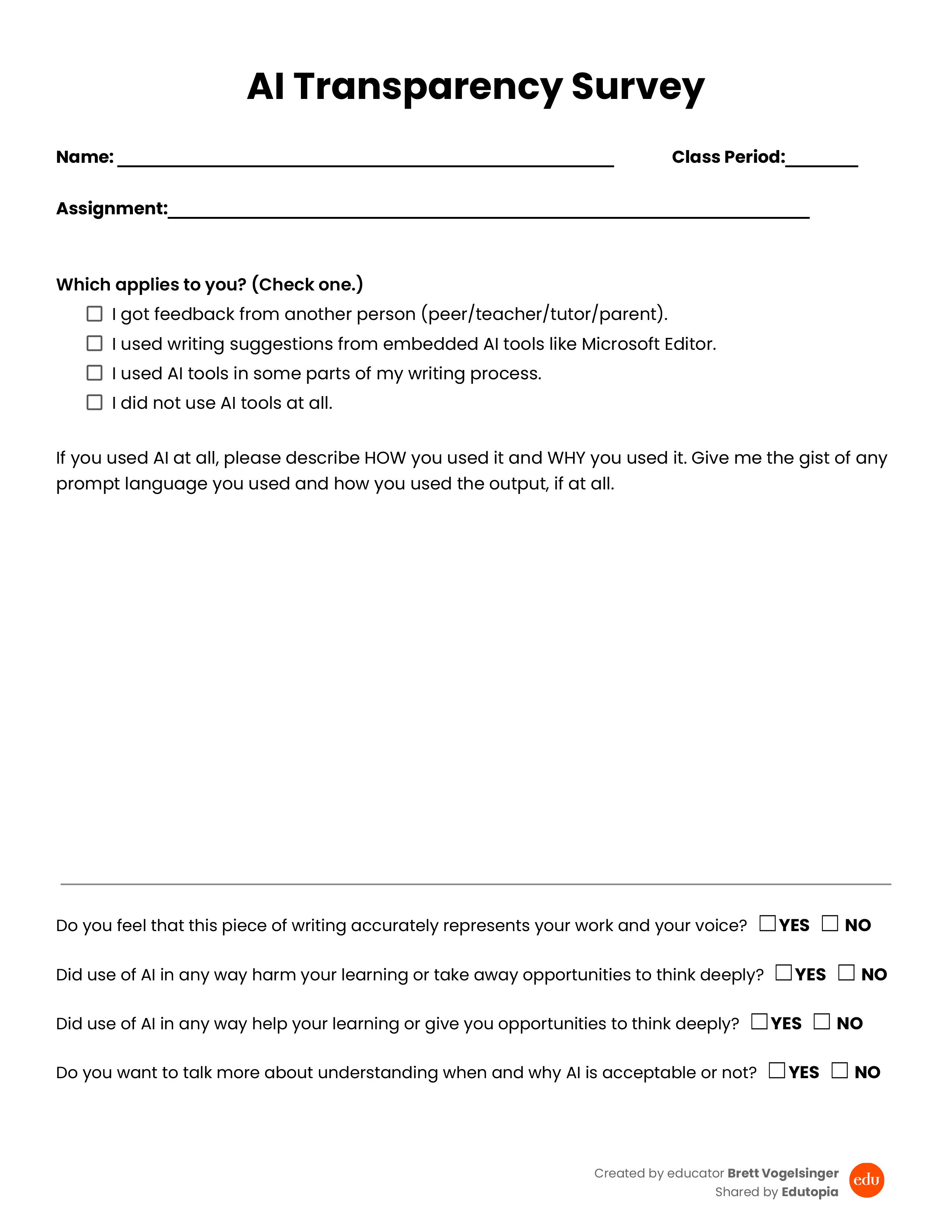
Students already know that prompting AI to write a finished essay for them is off the table. But by giving them the opportunity to reflect on the potential (and perils) of inviting AI into their process in limited, judicious ways, we explore and define boundaries together.
The opening question on the survey positions assistance from an AI tool within a spectrum of available supports:
- I got feedback from another person (peer/teacher/tutor/parent).
- I used writing suggestions from embedded AI tools like Microsoft Editor (built-in writing tools).
- I used AI tools in some parts of my writing process.
- I did not use AI tools at all.
Next, a more open-ended question gives students the chance to tell the story of their learning and provide a window into their reasoning: “If you used AI at all, please describe HOW you used it and WHY you used it. Give me the gist of any prompt language you used and how you used the output, if at all.” This gives me enough information to ask more questions during a conference, if needed. I am careful to craft this question so that students understand they do not need to be using AI to complete an assignment well, and some do choose to avoid it entirely. Encouraging those who choose to use AI to describe how they used it helps me more accurately diagnose how an overstep happened when it occurs.
I close with yes/no questions that get at the crux of what students need to self-evaluate as writers:
- Do you feel that this piece of writing accurately represents your work and your voice?
- Did use of AI in any way harm your learning or take away opportunities to think deeply?
- Did use of AI in any way help your learning or give you opportunities to think deeply?;
- Do you want to talk more about understanding when and why AI is acceptable or not?
Since I have, from the beginning of the course, cast myself as a curious learner about AI, a candid dabbler, and a person who values their reasoning, when students turn in a transparency survey with a major assignment, I usually get honest replies, fostering trust between us.
What Students Say
Student responses consistently broaden my perspective.
A good number of student writers choose to abstain from AI: Cassie writes that she feels using AI would be “cheating myself out of my learning,” and Olivia does not want to “depersonalize” her writing.
Others are open to using AI but do not feel it will benefit them on a particular assignment: Reflecting on his essay about why volleyball deserves more respect as a sport, Max explains, “Other than Editor in [Microsoft] Word to clean it up a little bit, I didn’t use AI in any other way because this is a topic I know well and love a lot.”
Still others identified specific reasons for inviting artificial intelligence into their process.
Callen riffed off one of our demonstrations in the “Is It Cheating?” lesson: “I didn’t like how one of my sentences sounded, so I asked AI if it could make it sound smoother in three different ways. I looked at the ways it gave me and combined them, overall making the sentence sound better, while still letting me learn and think deeply.”
Perry even used AI to clarify my written feedback on his draft: “I asked ChatGPT, ‘What did Mr. Vogelsinger mean in this feedback?’… so that I could understand it better and apply his feedback into my final copy of my essay.”
‘Ruthlessly Reflective’
My friend and colleague Marcus Luther once described my approach to AI as “ruthlessly reflective,” and that’s exactly the type of mindset I’d like my students to cultivate as they write. Transparency is a foundational step to impactful reflection in a world where AI is at our fingertips.
I expect that transparency surveys will be adaptable as I modify them to respond to the new curiosities, responsibilities, and choices that emerge for writers as technology evolves.
Writing builds relationships and helps us clarify our thoughts. These human pursuits are not going anywhere, and with ongoing conversations with our students and frequent opportunities for transparency, we can help high school writers to thrive in this new terrain.
AI Transparency Statement for This Article: This piece is human crafted. I used some grammar suggestions built into Microsoft Word and the assistance of Microsoft Copilot in rewording a sentence in the opening section, much like what my student Callen describes later in the article.