
6 Routines to Get Students Unstuck
When students are grasping at straws, these self-directed strategies help them to pause, make a plan, and pivot more effectively.
Your content has been saved!
Go to My Saved Content.For students, getting stuck is an inevitability—a key part of the messy, effortful work of learning. In fact, researcher Manu Kapur insists, if students aren’t regularly feeling frustrated and struggling, they’re probably not learning at all.
The experience of frustration, however, can elicit a range of responses from the students inside your classroom. Some children naturally develop the skills to navigate this discomfort with ease, while others spin their emotional wheels before gaining traction. A handful sink under the weight of their own confusion and give up.
“When assignments, projects, and academic tasks feel overwhelming, this can create anxiety, frustration, angry outbursts, or a shutdown in behavior where assignments are not even attempted,” explains Lori Desautels, an assistant professor of educational neuroscience at Butler University.
It can be tempting for educators to rush in and rescue, but as students encounter increasingly complex problems, it’s important that they develop the habits of mind to pause, take stock, and recover their composure—and learn to reach for a toolbelt of academic strategies they can use to improve their problem-solving.
Below are six strategies students can use to help get themselves unstuck. While the tips can help students reclaim a sense of composure and calm—and provide concrete steps to recover their academic momentum—students won’t make them habits without some modeling and frequent reminders. For kids who are consistently stuck, consider short, informal check-ins to bridge the gap between awareness of the tools and putting them into practice when they're needed. “During these meetings, ask them to create a plan for what they will do differently when tackling a similar type of learning challenge in the future,” writes educational consultant Zaretta Hammond for Cult of Pedagogy.
What Would Your Friend Do?: When a student is barely treading water, they’re often too deep in the emotional weeds to see a path forward. Shifting to an outsider’s perspective allows them to zoom out and look at the problem more objectively, says the neuroscientist and professor of psychology Ethan Kross, who refers to the approach as “distanced self-talk.”
“We know that it’s a lot easier for people to give advice to others than it is to take that advice ourselves,” Kross explains, as reported by Liz Greene for Nautilus. “Language provides us with a tool for coaching ourselves through our problems like we were talking to another person.” Students can create some psychological distance from what ails them by asking themselves, “If my best friend were stuck on this exact same thing, what advice would I give them?” Or they can pivot to third-person: “What is Jenny missing here?” After generating a few useful ideas, they’re more likely to take the advice and run with it.
A brief teacher think-aloud, modeling how to narrate and work through your confusion, gives students a clear example to follow. From there, students can choose an approach that feels natural: writing a quick note to a friend explaining how to regain their footing, or pausing for a silent moment of perspective-taking.
Getting Back on the Road: In a moment of exasperation, a student who’s stuck might throw their hands up and conclude that they’re the problem: I’m just bad at math! Giving kids a handy way to classify their situation helps them imagine a way out.
School counselor Laura Wheeler uses the language of driving—speed bumps, detours, and parking spaces—to give students the vocabulary to “recognize stuck thinking and shift their mindset to a more flexible place.”
- I’ve hit a speed bump: Students sometimes hit a snag, and slowing down can help them think things through. In these moments, students can remind themselves to pause and take a moment to assess the problem they’re facing: what they know, what’s unclear, and what is a reasonable next step to take.
- I need to take a detour: Occasionally the original plan students plot for themselves just isn’t working, and trying to force progress only deepens their frustration. Wheeler encourages students to recognize these moments as a signal to pivot, identifying a new approach and dropping what isn’t working.
- I’m parked: Everyday stressors can compound and overwhelm students, transforming a task they can normally navigate easily into quicksand. Taking some time to emotionally regulate—some stretching to shake out the tension or a quick check-in with a trusted adult—allows them to decompress before returning refreshed and refocused.
Wheeler asks students to brainstorm examples of speed bumps, detours, and parking spaces that they might encounter—along with a few strategies they’d use to help themselves move forward. She often models this thinking herself in real time: “‘We’ve got a detour on our hands! Our reading worksheets aren’t available due to the copier being broken. Does anyone have any ideas for a detour to our plan?’”
Chunking It Out: Once a student has recovered their emotional balance, they need to deploy the right academic strategies. Big or challenging assignments can feel unwieldy, for example, “especially for students still building confidence in their abilities,” writes educator Michelle Singh. Breaking complex tasks into more easily digestible chunks can reduce the cognitive load and create a clearer roadmap for getting started.
A “scan and plan“ approach provides students with a handy framework to reduce cognitive load and develop a plan of action: Identify the main components, what the finished product will look like, and when the assignment is due. From there, students can read and carefully annotate the directions—numbering each step in the process—or visualize working on the assignment from start to finish. “For example, if students are writing a research paper, they may envision themselves creating a research question, looking for articles, reading the articles, annotating their reading, etc.,” writes education specialist Sarah Kesty. Each action they visualize becomes a smaller step to add to their checklist.
Making the First Move: Oftentimes students know exactly what they need to do and how to do it, whether it’s finishing a packet of math problems or studying for an upcoming quiz. But as they look over their to-do list, the sheer volume of work that awaits them feels insurmountable.
Students can break the spell and kickstart their momentum by identifying and completing a single small action, like re-reading the instructions, reading one page instead of a whole chapter, or completing one practice problem instead of the entire set.
It might seem silly, but teachers should consider celebrating even these small victories with struggling students, writes high school English teacher Cathleen Beachboard: “Celebrate every bit of progress, no matter how small. It’s all about helping students feel good about moving forward.”
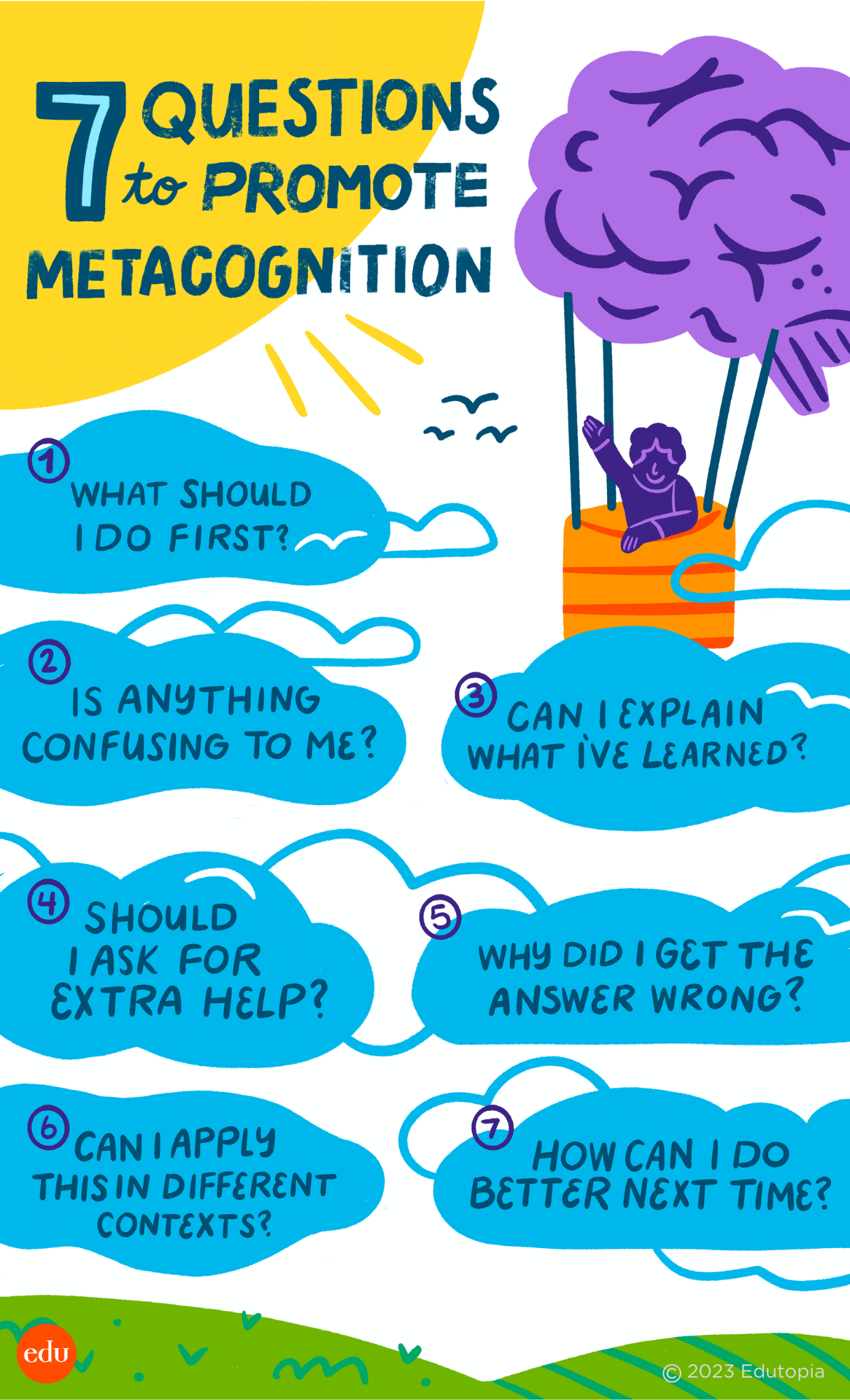
Getting Metacognitive: When students sense they’re reaching a cognitive standstill, the right self-directed metacognitive questions can help shift them from a passive place of inflexible thinking to a more active, problem-solving mindset.
A question like “What should I do first?” focuses students’ attention on choosing an entry point. “Is anything confusing to me?” can surface misconceptions about what students think they know that may be blocking their progress. Asking “Why did I get this answer wrong?” or “How can I do better next time?” turns a small setback into a productive feedback loop where students start to develop better strategies to use in the future rather than dwelling on their missteps. Posting these questions in prominent areas of the classroom can foster more independent problem-solving.
For many students, “asking for help feels like admitting defeat,” Beachboard says. But learning when the answer to the question “Should I ask for help?” is actually “yes, I should” is a valuable skill for getting unstuck. With practice, students will learn to acknowledge when they’ve reached the edge of what they can do alone, find the right resource, then keep moving.
Taking a Breather: By the time a student feels stuck, they’ve likely already invested a good chunk of brainpower into what they’re working on. At that point, pushing through the frustration can feel like the only option to maintain momentum.
But the research suggests that short breaks from a challenging task can provide the brain some much-needed respite before diving back in. Encourage students to briefly hit the pause button when they need to refresh their thinking. They can take a few deep breaths or a short teacher-approved break in the hallway to decompress. Remind them that “a regulated and calm brain is a brain that is ready to deeply learn,” Desautels says, so taking five to reset isn’t time wasted.