Why Teachers Should Be on LinkedIn
The social platform can help educators network and grow their experience to better serve their students.
Your content has been saved!
Go to My Saved Content.
Back in college, I stumbled upon LinkedIn. I had it for a few weeks before discarding it as just one more thing I didn’t want to keep track of. Hearing no one speak of it since, I honestly thought it had crashed and burned, a failed venture. Imagine my surprise when I found out LinkedIn was not only still very much alive but also thriving—popular with tech CEOs and politicians, but also with education-specific people and companies, such as curriculum developers, edtech leaders, and school and district leaders as well.
My colleague laughed at me initially when I told her I had created an account—she said it wasn’t for teachers. Just a short time later, she became a convert. There are many reasons LinkedIn is very much a place for teachers, a few of which I’ll dive into deeply here.
WHY TEACHERS SHOULD BE ON LINKEDIN
Networking. There are few things I find more invigorating than going to some form of professional development outside of my own district. You hear from other educators from other places with new and diverse perspectives, breaking free of the silo you often find yourself in when enclosed within your classroom. Imagine if you could get that all the time, instead of just once or twice a year.
When I first began utilizing LinkedIn, I started small, with professionals I knew from our local STEM hubs, former college instructors and mentors of mine, and local leaders from our Department of Education.
Slowly, I started expanding, adding in curriculum professionals of the products we use in my school, authors of professional development books, national leaders in education, and others across the country (and world) who work in fields of similar interest to me. This allowed me to connect with others and see what amazing projects they were working on, and it opened the door for collaboration on new endeavors.
And speaking of conferences, LinkedIn allows me to follow all of my favorite conferences and organizations. Not only do I always know the dates and locations of upcoming professional development events, but also I see the additional opportunities available—the chance to submit my own conference proposal or to review proposals that others submit (something the National Science Teaching Association always offers).
Career opportunities outside the classroom. I have been a teacher in the same school for eight years—the same school I started at after graduating from my teaching program. You would think that would mean my résumé was pretty short, but it isn’t. Education can be very different from other careers, as we often aren’t going through regular promotions or new job positions. This can feel limiting, but since establishing myself on LinkedIn, I have been able to find and take advantage of opportunities that help me build my résumé without permanently taking me out of my classroom.
For example, the National Council of Teachers of English, as well as the National Council of Teachers of Mathematics, offer opportunities to write for their journals, become an editor for one of their many publications, or submit a proposal for their joint conference, among other things. Recently, the National Science Teaching Association also posted opportunities to apply for positions on several different boards and committees they have.
One opportunity I stumbled across on LinkedIn was for my state Department of Education. They had a post announcing open director seats on a council called the Educator Advancement Council. One of the open seats was for an active elementary educator. I applied and am now serving a two-year term as a director. It has been an amazing experience to become more connected with state leaders and education policy, our state’s education service districts, and teachers.
I feel this is a position where I can really make a difference in the experiences, opportunities, and policies affecting active teachers, and I never would have known this opportunity existed if I wasn’t on LinkedIn.
Professional development. In my teacher preparation program, I was constantly handed reading assignments on the latest research in education. At the time, it felt like a little too much, but once I left that program, I quickly forgot that those resources existed and how helpful they could be. Luckily, LinkedIn filled the gap to keep me up-to-date with the latest research in the world of education.
By following different pages, such as those of the International Literacy Association or the National Association for the Education of Young Children, I am always seeing the latest research, just by passively scrolling my home feed. I do this on my phone, from the comfort of my couch. This has created a really positive climate of learning between my colleague and me, as we are constantly sending each other different articles and deciding on things we want to try next in our own spaces. You can follow people and companies in key areas of education such as STEM, English for Speakers of Other Languages, literacy, math, and more.
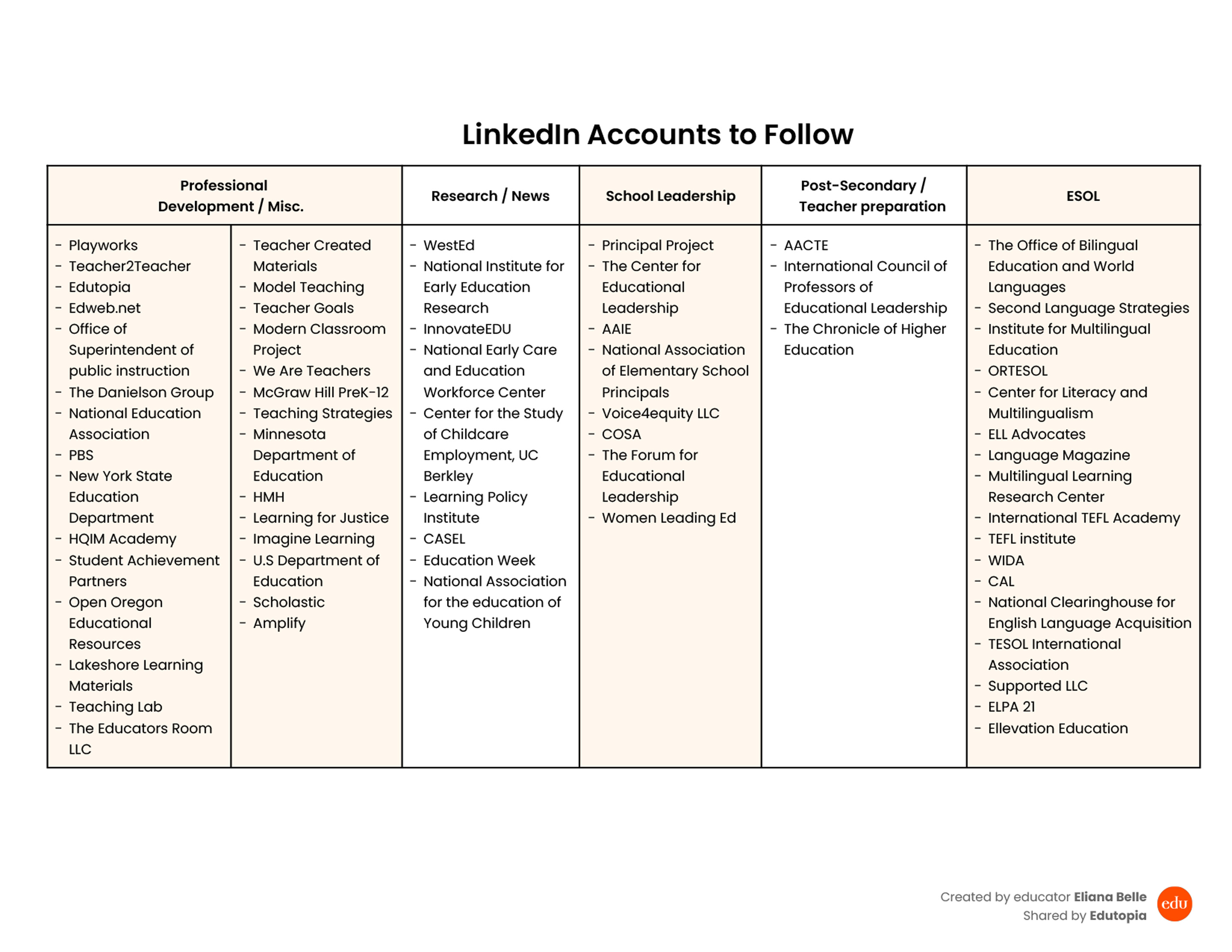
MAKE THE MOST OF YOUR POSTS
Up to this point, I’ve talked a lot about what LinkedIn can do for you. Now, let’s talk about what you can do for the LinkedIn community. This is your space for the work-related content you love, so make sure you’re sharing your experiences, projects, ideas, and contributions here as well. You can self-publish articles, post links to articles or journals you’ve written for, promote a session you’re presenting at a conference, and so much more.
LinkedIn can help you be a leader in the education space and share your knowledge and creativity with other educators who are looking for new, creative, and innovative ideas.