
How Learning Conferences Can Save Teachers Time and Enhance Feedback for Students
Here’s one teacher’s process for talking one-on-one with students during the school day instead of spending hours at home writing feedback on their work.
Your content has been saved!
Go to My Saved Content.Here’s a familiar scene: A weeknight. A pile of papers. Hours of feedback, written in the belief that all this work is going to dramatically improve student learning.
And then the deflated feeling of writing the same feedback for the same student the next time and wondering why in the world you’re doing this.
I can’t explain how many times I found myself trapped in this vicious cycle: knowing that feedback is important but feeling like the amount of time I was spending outside of contract hours trying to ensure that students received good feedback really just wasn’t having the benefit I expected.
I don’t even think it was the added work that really had me questioning if the process was worth it—it was the fact that it didn’t seem to be helping students learn.
Then I tried learning conferences, initially in an attempt to make the grading process a conversation in which students had a role. It also turned out to be an effective method to check on the originality of student work in the age of generative AI. I was able to have conversations with students that revealed whether or not they produced their work themselves, and the in-person element allowed me to explain to them why I wanted their work to come from their own brain.
However, I discovered that the real value of learning conferences was that they allowed me to give more meaningful feedback. As a bonus, doing them during class time meant that I wasn’t spending hours outside of school time writing feedback.
So how do I make them work?
Learning Conference Logistics
Whenever I talk to someone about learning conferences, the first question is always, “When do you find time for that?”
Most people are surprised to find that the answer is already built into the way their classrooms run. Whenever you assign independent work, that is time you can use for learning conferences because other students are engaged in the activity.
You may think students aren’t independent enough for that. Trust me, I know that feeling. I teach middle school ELA, and I can promise you that with a little training on the process, students can do it.
The next question I often hear is, “Where do you even hold them?”
The answer will vary quite a bit depending on your room setup, but essentially my answer is anywhere that the student doesn’t feel like they are in front of everyone but where I can still see everyone.
In my current setup, I can do conferences at one of my center tables while students are facing outward and working independently. I’ve previously set things up so that the student is at a desk just outside the door, with my chair positioned so that I can see into the classroom while we talk.
Prepping for Conferences
The success of a learning conference lies in what happens before and after it; that’s more important, in my opinion, than the actual conference because students do a lot of mental work to prepare and then to process and use the feedback.
Beforehand, I will identify the specific learning focus for the conference and have students identify pieces of their work that show a good example of that learning focus. For example, if I say that we’re going to focus on transitions and how we lead into our evidence in writing, I give students some time to pull their best examples of those from their piece of writing for us to talk about.
While I would love to sit and read through student writing with them, the reality is that we don’t have enough time for that. Using a targeted approach to their writing allows us to have a focused, productive conversation. In addition to the learning focus I discuss with everyone, it’s helpful to have students identify something specific that they need help with.
Another key aspect of preparing is making sure I give students a rubric or learning progression. This helps ground the conversation and ensures that students are able to effectively reflect on what they already know and what they can work on next.
I also ensure that I pre-teach some of the expected behaviors for the learning conferences—behaviors of both the student attending and the other students working. This conversation is a chance to explain why the conferences are important and how we can all make sure they’re helpful for everyone.
Running the Conferences
During each conference, my goal is to start by remembering this is a relationship and that the effectiveness of feedback is often dependent on the degree of trust in that relationship. Even when I’m pressed for time, I like to start by checking in with the student, asking how their game was the other day, etc. This continues building the relationship and helps the student relax a bit for the conversation.
Then we jump in. I will use the rubric or learning progression to guide the conversation, but the student gets to decide where to take it while sticking with the learning focus previously established so that we use our time well. I like to simply ask, “Where are you growing? What are you stuck on?”
Once the student has identified those areas, I provide a small amount of feedback using the learning progression or rubric and guided by what the student said they are stuck on. I really want to emphasize: I give a small amount of feedback. I’ve found less is better in this scenario.
I ensure that the student records the feedback somewhere. While they can write directly on the assignment, I prefer having them record using something like the feedback portfolio sheet below. This way it becomes a running record, and the student has access to previous feedback easily when they approach their next piece of writing—which can help relieve the problem of giving the same feedback over and over.
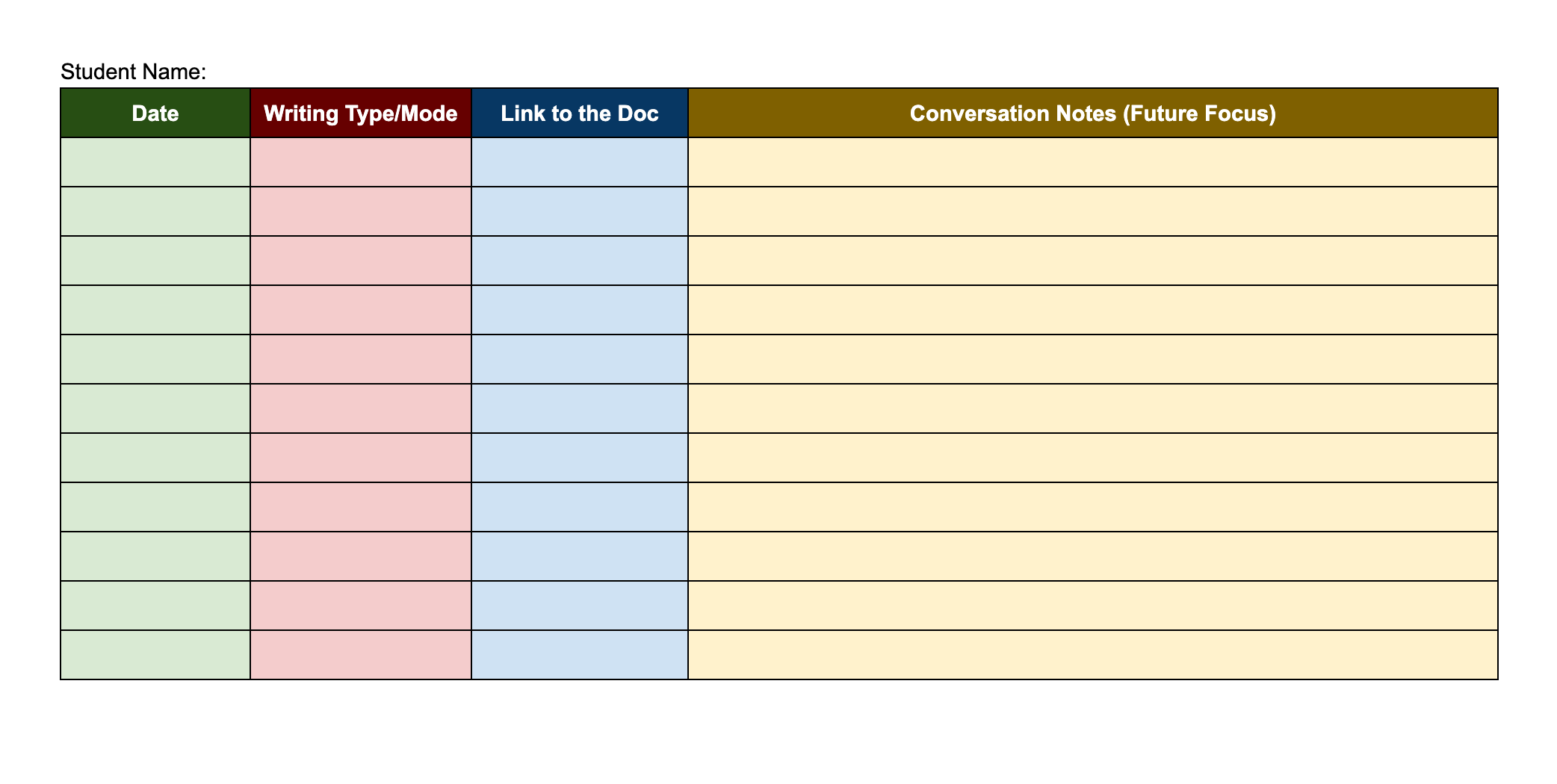
Each conversation usually is around three minutes—a bit longer when I can manage. In a 56-minute class period, I can usually get to about eight to 10 students; there is transition time between students, plus moments when I need to pop back into the class for redirection or support.
What Happens Afterward
As I noted at the outset, feedback that goes unused is a waste of time and effort for both teacher and student. With learning conferences, I’m intentional about how feedback will be used immediately. There are two ways I like to do this.
Whenever I have learning conferences—really, whenever I provide students with feedback on any assignment—my goal is to have some digital resources lined up and ready to go for some of the more common elements I might address in the feedback. If we’re focused on transitions and lead-ins for evidence, I might just have a couple videos for transitions between paragraphs, transitions within paragraphs, punctuation with evidence, and how to introduce a piece of evidence.
When the student leaves the conference, I can have them pick which resource would be a good next step for them and have them engage with that resource when they return to their seat. I’ve found it helpful to have them record their additional learning from the resource in the same feedback portfolio mentioned above to help capture it before it slips away.
The second way I ensure the feedback is used is to, well, have them use it. This might mean they apply the feedback on their next piece of writing, or, if we discussed a test in the conference, they can just do test corrections. Immediately applying the feedback has been helpful in guiding them to improve the current piece of work and helping the feedback stick in their memory better so they can apply it next time.
A Few Final Notes
Yes, if I were to spend the entire time monitoring the class and redirecting behaviors when students are working independently, they might be more productive. That’s true, and I won’t deny it, but that just goes to show how much value I see in these learning conferences. I can accept that the group may be slightly less productive because the individual conferences and feedback truly result in meaningful learning.
Learning conferences don’t really save me time giving feedback—they simply ensure that the time is part of my regular work day. I’m not spending hours of my own time leaving feedback on papers that may or may not be used; instead I’m having good conversations with students as part of the learning process and doing so with the time that is built into my day.
After shifting to this in-person and interactive approach to feedback, it feels nearly impossible for me to go back to those stacks of papers and late nights at the kitchen table writing comments I wasn’t sure would ever be read or used.