Giving Teachers Ownership Over Their Professional Learning
The best kind of professional learning is the kind that teachers actually care about—involving the things they engage with every day.
Your content has been saved!
Go to My Saved Content.
“Check this out!”
“Can I do this?”
“I thought of you when I watched this!”
“Have you seen this?”
These messages from teachers show that real curiosity and authentic enthusiasm can produce more professional learning opportunities than could ever be fully curated by a professional learning team.
We knew our teachers were on to something big, and we needed to capture it. At Greenville Elementary in Virginia, we designed our approach to professional learning by introducing a personalized plan that gives ownership to the teacher—and tracks the kind of learning that can sometimes be invisible.
Making It Meaningful
As a current principal and former district supervisor of professional learning, I know how important it is to continually learn and improve, but it can seem overwhelming to determine how to maximize both learning and the joy and energy that come from meaningful experiences.
As district leaders, we can provide access to structured professional learning, but it is not always valued. Teachers complete required hours, attend sessions, and document participation, yet these routines do not consistently translate into sustained changes in practice. Over the last few years, I noticed a change in the conversation about professional learning. Our teachers were excited to try new ideas they found on social media, in podcasts, and on educational sites like this one. But much of this learning—the kind that teachers engage in every day—was going unnoticed.
This learning often leads to reading books, following experts on social media platforms, asking to attend conferences and workshops, and enrolling in graduate courses and programs. Behind these requests was something undeniably energizing. Teachers were engaging in learning that was sparking a newfound energy. As a school leader who loves to learn and improve, I am renewed and energized when I see those around me bristling with curiosity. I know that questions are soon followed by collaborative thought partnerships. This sets the foundation for the social conditions that are needed for improvement and innovation within classrooms and the school.
When teachers and leaders are given permission and encouragement not only to have autonomy with their learning, but in their daily practice, this is when real learning and innovation begins to take hold. It has been clear to our administrative team that creating conditions for teacher agency in learning directly impacts student growth.
Research on relational trust shows that teachers are more likely to engage in risk-taking and sustained learning when systems are experienced as credible, respectful, and growth-oriented. And studies on professional learning emphasize that agency matters for impact when teachers have ownership over their learning.
Knowing Where to Start
At our school, we begin with a simple question: “What are you interested in learning more about this year?” At the beginning of the year, teachers identify professional goals and learning activities: peer observation, application of social media ideas, podcasts, self-selected classes, conferences, workshops, book studies, coaching cycles, action-based implementation cycles, and any other way they can deepen their knowledge base. They track their progress over time. These goals may align with their SMART (Specific, Measurable, Achievable, Relevant, Time-bound) goals or be standalone learning goals that connect to their annual evaluation. The learning can evolve over the course of the year.
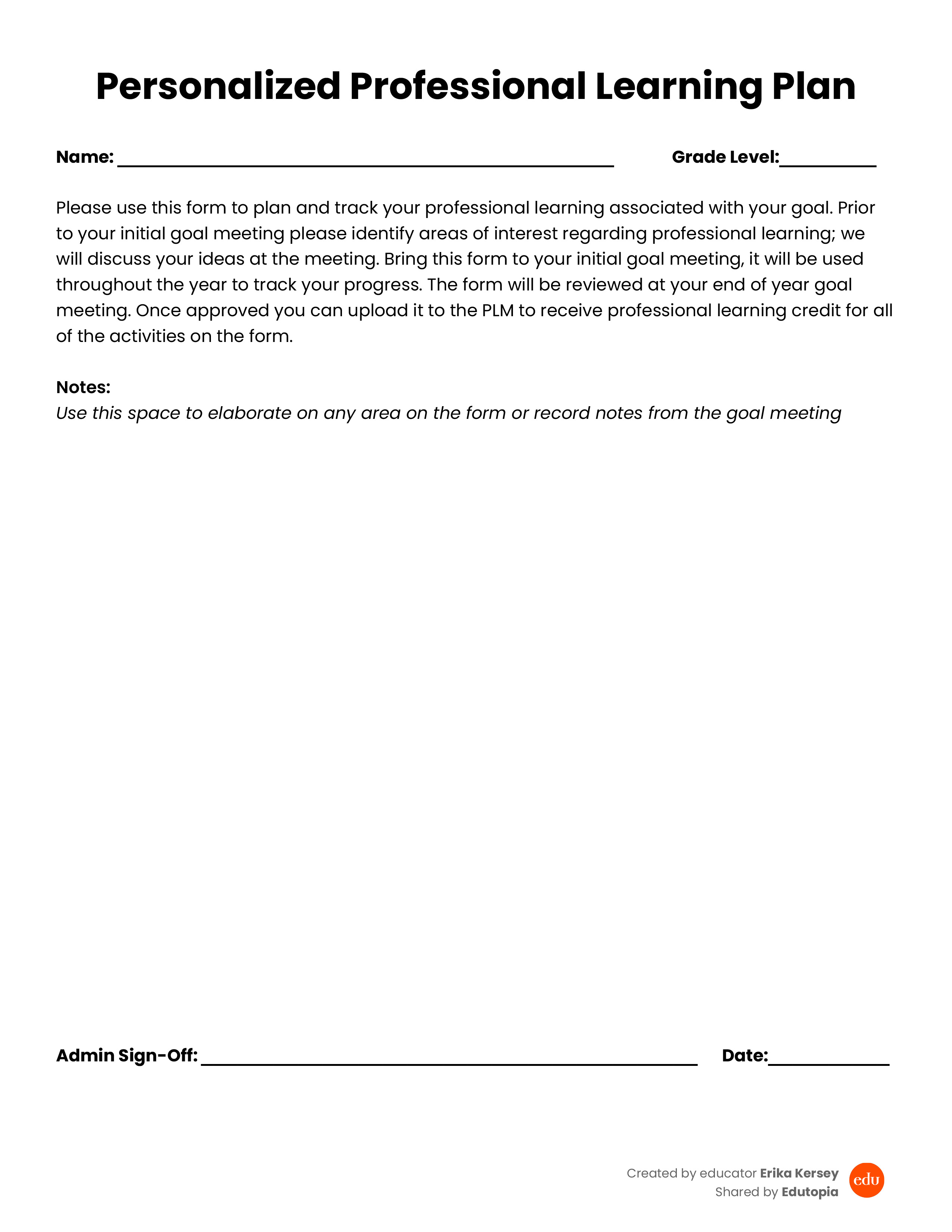
A great example is a cohort of teachers at our school who, sparked by their own learning, wanted to innovate their instructional practices. As conversations continued, I offered a book and expert suggestions, and they jumped right in—even sending me photos of book quotes. Their pursuit led to them being awarded a grant to attend a national conference.
The structure maintains accountability through goal alignment and administrative feedback, while creating flexibility in how teachers engage in growth. It provides professional development credits for state licensure and local requirements that directly tie to annual evaluations. For example, when a group of teachers was interested in learning more about AI, we created a cohort that attended an AI workshop at a state university. In addition, our Instructional Technology Resource teacher planned a series of monthly collaborative learning sessions around AI. Teachers then were able to engage both as a group in planned learning and on their own.
Tracking Progress
We worked with our division's office of professional learning to build a simple system. Teachers self-record on a personalized professional learning form, which I approve at the end of the year. This is attached to their annual evaluation, and the teachers are awarded credit from the office of professional learning for their local and state PD hours.
We purposely chose to embed this within evaluation, as it strengthens the professionalism our teachers show and is an existing structure that naturally allows time for conversations with each teacher. By aligning personalized professional learning with instructional goals and, when appropriate, with teachers’ SMART goals, we create a clear connection between what teachers are asked to do and how they grow. Professional learning becomes less about documenting compliance and more about making learning visible. Teachers engage in self-directed learning and apply it in their classrooms.
Over time, we have learned that professional learning feels most worth teachers’ time when it is connected to their daily work, chosen with purpose, and reinforced through meaningful feedback rather than isolated requirements.
Teacher-driven learning has strengthened trust, increased engagement, and supported instructional change across our school. Teachers are more motivated when they are valued for taking ownership of their growth rather than being participants in a system to be completed. Honoring teacher expertise and making learning feel personally meaningful allows for sustained professional growth. These conditions form the foundation for the kind of professional learning that not only energizes teachers but ultimately improves student outcomes.