The Benefits of Giving Students a Big Goal
A yearlong project to build a scale model of their school and surrounding community helped students connect classroom concepts to real-world applications.
Your content has been saved!
Go to My Saved Content.It was the first week of ninth-grade Geometry in a new high school in Jersey City and time for students to review measurement. Students were broken into pairs, each pair given a ball of yarn, a pair of scissors, and a yardstick. With no instructions on how to use these tools, I gave them 30 minutes to find the length, width, and diagonal length of a small park across the street from our school. Most pairs unraveled several yards of yarn, assuming that the task required them to use all materials provided. Some students, however, took a different approach.
When we regrouped, one group shared that they didn’t use the yarn at all. They measured a single tile and counted the number of tiles along each edge of the park. Several students responded with frustration, “They didn’t use the yarn!” to which I responded, “I never said you had to.” One student then timidly shared that his group used the measuring app on his phone. While that wasn’t my preference, I appreciated that they considered all tools at hand to accomplish the task.
The measurement task was the first in a series that served as a spine for purposeful learning throughout the year. Now more than ever, students have reason to question the purpose of each learning experience, so why not beat them to it? What are your course’s objectives, and why are they important? Instead of telling students why something is important, consider connecting to the purpose.
After I explored a few ideas with my class, they were enthusiastic about the possibility of creating a scale model of our school and its surrounding community.
Phase 1: Carefully Crafted Learning Experiences
To begin, the Design teacher and I created a prototype, logging each academic skill used throughout the process. After confirming that all the skills needed were covered in our courses, we created a timeline, ensuring that students would be able to call upon content as needed and that there was no redundancy. Once the timeline was in place, we focused on framing individual learning experiences in context to help students make future connections.
Determining the footprint of a building: Instead of participating in a typical lesson on perimeter, students internalized why this skill might be important through the measurement task assigned during the first week. The problem-solving, movement, and discussion built into this task made it memorable. Months later, when students needed to determine the footprint of their building, this skill did not need to be retaught.
Determining and using scale: Because the concept of scale would come up several times, it was important that students develop a deep understanding. During that unit, the class did an investigation requiring a comparison of the size of Liberty State Park to Central Park. Students were surprised to find that our local state park was bigger than the most famous park in the region! In disbelief, many were motivated to carefully check and recheck their work.
Determining the height of the building: While teaching Geometry in previous years, I asked students to calculate the heights of buildings in the neighborhood using content from our Trigonometry unit. Though they usually enjoyed the task, I often asked myself, “Why should students be motivated to find the heights of these buildings? Was it just to satisfy our curiosity?”
Now, with a larger goal at hand, this assignment was framed to serve a true purpose, becoming the heart of our diorama project. Each group created a clinometer, a device with a straw attached to the base of a protractor and a weighted string used to determine an angle of elevation. They would determine the height of their assigned building, not because they were told to, but because they needed it for a larger goal.
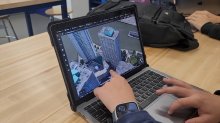
Creating a 3D model in Tinkercad: Creating 3D models was a foundational part of students’ Design and Fabrication course experience, so my partnership with the teacher for that course was essential. As the school year progressed, students’ projects became increasingly sophisticated, and by the time they needed to create their models, they had the experience to do so with little to no guidance.
With carefully planned experiences in place, pursuing this project didn’t take away from valuable class time. Instead, it pulled everything together for a visible purpose.
Phase 2: Bringing it All Together
By late winter, not only were my students ready to build their models, but other students in the school had heard about the project and wanted to participate.
The Design teacher and I reconvened to consider the following questions.
How do we meaningfully include students with varying skills? Using student performance on Phase 1 assignments, we strategically formed teams of two or three, ensuring that at least one person from each team had demonstrated each skill needed for both math and design. Additionally, Algebra I students were not required to complete the Trigonometry portion of the task.
How will students be assigned their buildings? Once in their teams, students submitted three choices along with their rationales. We had two constraints in the approval process: All buildings had to be within the designated boundaries, and no building could be modeled twice. Most groups got their first choice, and in the rare case when that was not possible, a team of teachers selected based on the more compelling rationale. In one case, a student was assigned their home. In another case, students who demonstrated the stronger ability and desire to elevate their design and fabrication skills were assigned the more complex building.
What is the appropriate balance between giving students agency and providing clear guidelines? We provided students with clear guidelines that didn’t compromise their agency. Instructions included linked video lessons, walk-throughs with screenshots, a timeline explicitly outlining when each portion of the task should be complete, and a clear rubric detailing how grades would be determined.
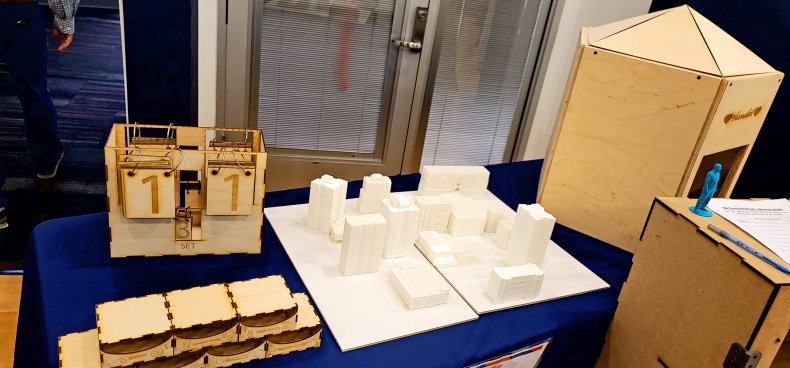
Driven by their desire to accomplish our shared goal, students’ engagement remained high throughout the year, and the outcome was excellent. Though not every team’s model was a flawless replica of their building, most were impressively close.
But the benefits of this approach were not limited to our school’s resulting diorama. Compared with previous years of teaching the course, I was surprised to find that we accomplished more in less time through careful planning. Additionally, I saw a noticeable difference in students’ performance across assessments, including cumulative tests.
Engaging students by connecting to a greater purpose can both enhance our curricula and deepen learning.