All the Reasons for Seating Students in Groups of 3
This desk arrangement facilitates peer discussions and supports effective collaborative and independent work. And students prefer it.
Your content has been saved!
Go to My Saved Content.
In more than 17 years of setting up classrooms, I have tried rows, pairs, and groups of four. But I am now in my second year of arranging desks in groups of three, and I can honestly say it is the most effective arrangement I have ever used.
Recently, I was surprised to read a social media post claiming that only rows should be used because students in groups cannot see the board or stay engaged. I disagree. With clear expectations, students know when to work collaboratively or independently, and groups of three make peer discussions much easier. This arrangement creates a spacious classroom environment and allows for quick redirection if students get off-task. Even on the first day, students sense that discussion is encouraged based on how the desks are arranged.
According to the Partnership for 21st Century Skills, the “four Cs”—critical thinking, communication, collaboration, and creativity—are essential skills for education and the workplace. Seating students in groups is the best way to develop these skills and allow them to be practiced.
Forming Groups
When forming groups, consider diversity and skill level, and ensure that all students can see the board. However, students do not need to face a traditional front of the classroom. Students need access to the board for note-taking, but teachers should be able to move freely throughout the room and instruct or guide from anywhere. Grouping desks into threes makes it practical to work with small groups while circulating.
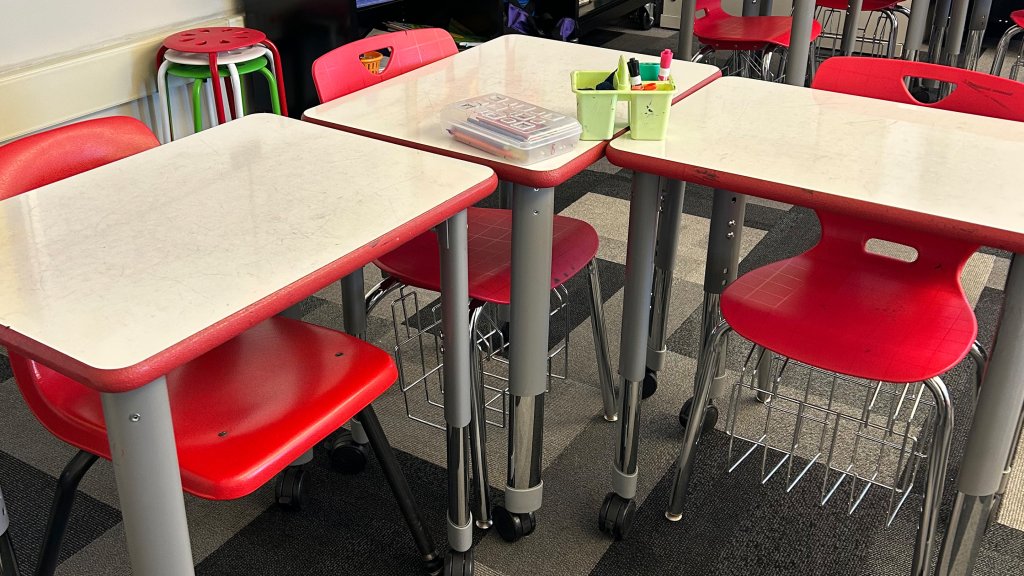
Don’t underestimate the importance of being able to pull up a chair to support a group. With groups of three, it is easier to see everyone’s work, provide targeted instruction, and comfortably engage with students. Larger groups make this more difficult.
According to research about creating more engaging learning environments, “de-fronting” the classroom is key to effective group work. Groups of three are intimate without being isolating, and off-task conversations occur less frequently. Students are more likely to engage in meaningful discussions when their peers are easily accessible. Part of my classroom setup includes vertical non-permanent surfaces, and whether students are working on whiteboards or doing a gallery walk, groups of three are ideal. These groupings feel natural since they are already seated this way and accustomed to working in this group size. Groups of four are too large and often result in one student becoming off-task or disengaged.
Copying from the board is not the same as learning, and a strong classroom is not a quiet one, but rather one filled with discussion and varied perspectives. Student voice is essential to learning. Additionally, middle school students must transfer learning to long-term memory, and strategies such as turn-and-talk, manipulatives, number talks, and thinking tasks support this process.
Research shows that groups of at least three are necessary to promote diverse thinking and meaningful collaboration. According to the Center for Teaching and Learning, students engaged in group work show increased individual achievement compared with those working alone. Furthermore, student group work strengthens communication and other professional skills.
Dos and Don’ts
Here are some best practices for arranging desks in threes.
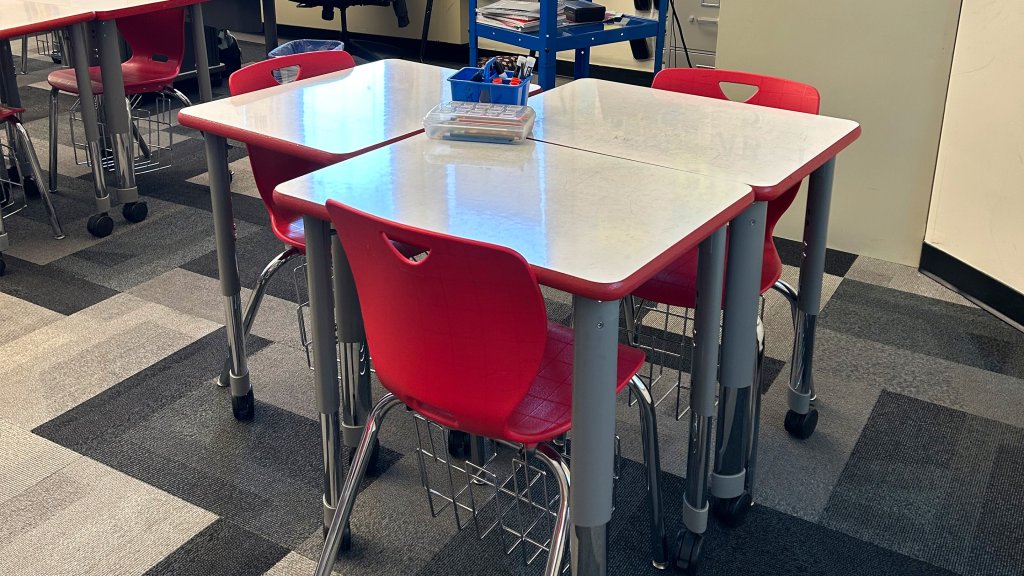
- Group desks in an L shape or a pod with two desks facing each other. Don’t have any students with their backs to any board that is used for taking notes.
- Instead of having students get up for each supply they need, have supplies (such as markers, protractors, and glue sticks) in a small caddy for all three to share. Pre-stock the caddy depending on the lesson.
- Have one student be in charge of handing in papers for their group, instead of having each student hand things in individually.
- Model expectations for how to act and work, and what collaborating sounds like within the group. Don’t expect students to know how to work collaboratively just because they are sitting together.
- Encourage conversations—don’t insist that students work quietly.
- Circulate around the classroom—students will keep conversations on topic when they know you are listening. Proximity to students matters. But don’t stay too long at one table of students. Give each group time to think so they can struggle productively.
Groups of three provide ample space and a free-flow environment even with a large number of students (I have 26 this year). Pairs don’t allow much walking room, and rows don’t allow for any type of discussion. And based on an anonymous survey I gave last year, students prefer groups of three.
Ask yourself: When you walk into a professional development session with seats in rows, what do you expect the session to be like? If the same session had desks in groups of three, how would that change your feeling about it?
I strongly encourage you to try this seating arrangement for your students—you will not be disappointed.