Embrace the Blank Page
Research supports regularly asking students to recall information from memory, and to do that you don’t need a worksheet—just a plain piece of paper works great.
Your content has been saved!
Go to My Saved Content.
I’ve spent a lot of time thinking about this quote from Pooja Agarwal: “When we think about learning, we typically focus on getting information into students’ heads. What if, instead, we focus on getting information out of students’ heads?”
Traditionally, teachers get information out of students’ heads during a unit assessment. Students either show that they know the content or show that they don’t. Agarwal’s work reveals that consistently spending more time getting information out of students’ heads during the learning process pays off in terms of their overall learning and memory retention. This mindset shift has been transformative for me as I work with students and teachers to facilitate active learning.
The science of learning advocates that activities like retrieval practice (also known as active recall), spaced learning, the testing effect, and interleaving work best for successful learning. Still, many teachers struggle to plan for these types of activities, especially if they’re not part of their typical planning rotation. This is when I suggest that they embrace the blank page.
What is the Blank Page Approach?
The blank piece of paper approach asks students to show what they know, in their own way, on a blank page. This is a place for them to create a physical page of their understanding and knowledge. The blank page could be a flash card, Post-it, lined page, or piece of scratch paper. The emptiness of the page is an opportunity for note-making as opposed to note-taking. It’s a place for students to get the information out of their heads and reflect it back to them, their classmates, and their teacher. It’s a place for student choice and creativity.
The possibilities here are endless, and there’s a lot of beauty in that because it allows for a variety of responses in a variety of ways. It’s worth noting, though, that this kind of creative freedom can be a roadblock for many students who may feel overwhelmed or don’t know where to even begin, so that’s where teachers need to weigh in with explicit instruction, modeling, and feedback.
Find Opportunities to Model the Approach for Your Students
Explicit teaching is needed for students to have the initial information, of course. Explicit teaching is also needed to illustrate ways to note-make rather than simply note-take, which, although necessary, can be a passive activity. Teachers can and should embrace the blank page themselves to model for students how this can be done. The teachers must, over the course of time, give students ideas for ways to create, connect, compose, elaborate, and illustrate their understanding. This can easily be done during a lesson or even just as bell work or an exit ticket. You don’t even need to make copies and handouts
You could teach a word, idea, or event in a class period, and during the same class or even the following day, you could illustrate a few ways to do something with that information outside of simply rereading those notes. You could illustrate the concept or create a flash card or a magnet summary. Elaborate on it by writing to learn, or think aloud and model a brain dump, a 20-word summary, a content-web. The list goes on.
The Blank Page Approach Puts Learning In Students’ Hands
These note-making moments are essential for students to take ownership of their learning. I often hear students say that they can’t start studying because their teacher hasn’t provided the study guide yet. Or that they don’t know what to do with their notes beyond rereading them or “reviewing them.” These are all big no-no’s in my classrooms due to their passivity.
When this happens, I suggest that students embrace the blank page by showing me (and themselves) what they do know based on an essential question, key terms, chapter titles, etc. I remind students that they don’t need to wait for a worksheet to complete or homework to be assigned, but rather, they can and should create something representative of their learning.
Examples of This Activity in Practice
I provide students with several examples of how they can demonstrate their learning.
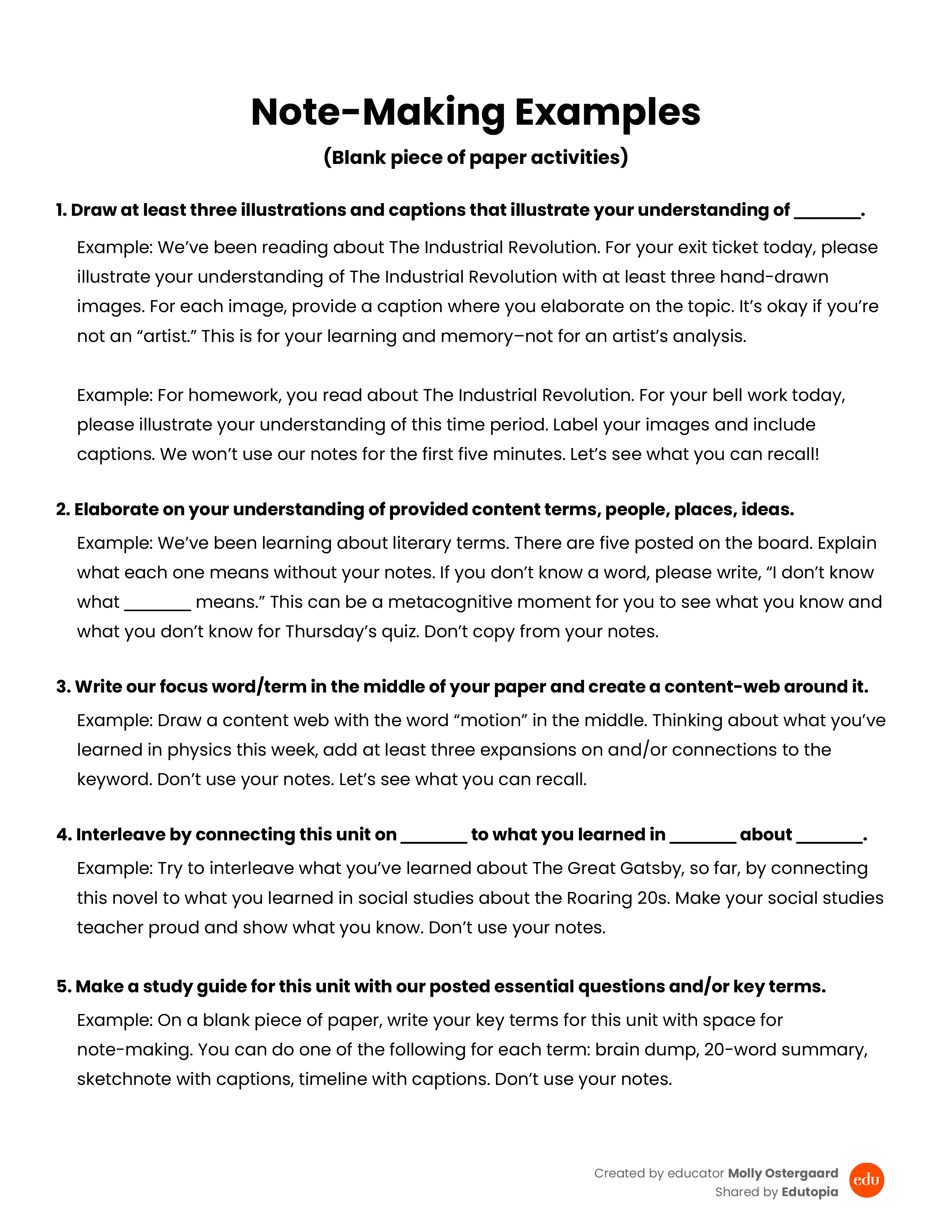
I’ve asked them to complete a brain dump with required keywords, key events, key people, etc. I’ve had them create a concept map of unit terms where they connect words within their content and write summaries. Other options include illustrating a sketchnote of a lesson or unit or coming up with clever ways to remember the information they need to know. Of course, students need to see examples of this type of work; this is why it’s important for teachers to teach and model various ways to make meaning rather than create worksheets and study guides for their students to merely fill in.
If students are given explicit instruction of ways to fill the blank page, and those are modeled for them regularly, they’ll eventually get the hang of this type of meaning-making. It can be really beautiful to see the ways in which students make connections, make meaning, and expand upon or construct their thinking. In my experience, their interpretations and explanations can also be further utilized to reteach or help others review concepts.
Students’ work can be used as exemplars and for teachable moments—even in error-making (after all, errors should be embraced in the learning process). Students can also begin with a meaning-making activity at the start of a unit, and they can build upon it over the course of several class periods, like running notes, but rather, running note-making.
This strategy is adaptable and can be implemented in various ways over the course of learning. In time, students get the hang of it, and teachers get to see what works for their classes and their students.