Classroom Routines That Support Mathematical Thinking
Elementary teachers can create opportunities throughout the day for students to strengthen their math knowledge.
Your content has been saved!
Go to My Saved Content.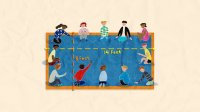
The more we think about math instruction, the more we see math in nearly every moment of every day. We want students to see the many ways that math can show up in their lives, especially beyond their math classroom. When we weave math into other aspects of our day, we can strengthen students’ mathematical vocabulary, confidence, and retention. Here are some high-impact, low-prep suggestions that support you and your mathematicians without taking time away from Tier 1 math instruction.
Build Math Language Through 5 Daily Routines
Consider these simple routines that elevate math language throughout the day:
- Use area and perimeter when gathering on the rug. Ask students to sit along the perimeter of the carpet or to fill the area inside it. These repeated visual and spatial references will help students attach meaning to the vocabulary.
- Line up using number relationships. Assign each student in your classroom a number. Students can organize least to greatest, greatest to least, by odds/evens, or even by multiples.
- Find collaborators using math concepts. Give students cards and encourage them to find their mathematical match for group or partner work. For example, students who are holding quadrilaterals find students holding other quadrilaterals, or expressions with the same answers.
- Name classroom groups with math vocabulary. Label tables or groups with mathematical ideas such as shapes (square, rectangle, trapezoid) or equivalent expressions that match a number (3x4, 6+6, 24÷2). As students move to their spaces throughout the day, they repeatedly encounter and use mathematical language in a meaningful context.
- Build estimation into transitions. Pose quick estimation prompts on the go, such as: “How many steps will it take us to reach the library?” “How many floor tiles are there between this door and the water fountain?” “How many students are already in the lunch line?”
Supporting Math Confidence Through Reflection
Math concepts can be overwhelming for many students. Because of that, it’s important to incorporate tasks that focus on emotional check-ins, which are beneficial in increasing student confidence. Math manipulatives can serve as a great way for students to participate in a social and emotional check-in.
One idea that we always incorporate in our classroom is a dice check-in. Students share how they’re feeling on a scale of one through six. They turn to that number on the die and share with their partner about how their day is going or how they’re feeling at the start of math class. Through our observations as educators, it’s a great “soft start” to math, and students enjoy the routine utilizing the math dice. Overall, this is a short, two-minute transition activity that helps reset students’ minds before they start a math lesson.
Reflection is also an important part of a social and emotional check-in. Another idea for teachers would be to utilize the Standards for Mathematical Practices as a reflective tool. Reflective tools can remind students about the effective practices that they’re engaging in as mathematicians. These practices include the following:
- Making sense of problems and persevering in solving them
- Reasoning abstractly and quantitatively
- Constructing viable arguments and critiquing the reasoning of others
- Modeling with mathematics
- Using appropriate tools strategically
- Attending to precision
- Looking for and making use of structure
- Looking for and expressing regularity in repeated reasoning
You can write the practices on cards, put them on a binder ring, and encourage students to flip to the practice that they felt the most proud of using during the math lesson. Next, students can turn and talk to their partner and share how they used that practice.
In a conversation we observed, we noticed that a student flipped to the practice that stated, “I modeled with mathematics.” Then she shared with her partner that she was proud that she used her manipulatives to support her thinking. This task boosts the student’s confidence while allowing them to reflect on their behavior as a mathematician.
Students need to be reminded that they can still be an amazing mathematician even if they don’t grasp the content immediately. This routine takes less than five minutes and could be done during the middle of the lesson or at the end of the lesson to support reflection, serve as an emotional check-in with a peer, and increase math confidence.
Keep Math Concepts Fresh with Spiral Review
There are also math routines that can support math spiral review. Many teachers feel the pressure of fitting in Tier 1 instruction and not having enough time for spiral review. A morning meeting provides a transition routine that supports spiral review. Post a problem on the board that connects to a past math topic, and have students record their answer in their notebooks. Then they can share their answer with a friend they’re sitting next to during the morning meeting.
You can also incorporate spiral review through energizers. For example, students can walk the distance around a shape, measure the area of objects around the classroom, or jump out the answer to a math fact. Spiral reviews don’t always have to be lengthy worksheets. If educators embed short routines including past topics, it won’t feel overwhelming at the end of the year. The routines mentioned above support all learners and are a great way for teachers to continue to expose students to previous topics.
You’ll notice that making these small math moments count will help your students use math language better, feel confident with math concepts, and remember the math they’ve learned. Whether your students are estimating steps while walking in the hallway or finding a partner with a matching expression, these routines create opportunities for math thinking across the day. Try starting with just one small routine and see how it changes the way your students talk about and engage with math.