Using Tinkering to Build Problem-Solving Skills in Young Learners
Open-ended tinkering in pre-K and kindergarten allows students to experiment with different solutions through repeated trial and error.
Your content has been saved!
Go to My Saved Content.Whenever I bring my wind tunnel into the classroom, there are squeals of joy. “What’s the challenge of the day?” an excited student asked, eager to get started with building and testing. The wind tunnel—a plastic tube attached to a fan or purchasable from various retailers—reliably guarantees fun, hands-on learning.
“Today we’re going to use these materials to build something that will fly through the wind tunnel. And then we’re going to use these same materials to build something that won’t go through the wind tunnel,” I announced.
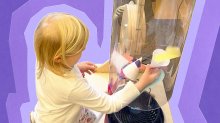
The students were visibly excited. The first time we used the wind tunnel, the challenge was to combine at least four items to make something that could fly through; we’d never tried making something that wouldn't go through, though. I put the bins of materials out: a bunch of small recyclables (lids, small pieces of cardboard, pieces of bubble wrap and foam, etc.) and many pieces of pre-ripped masking tape. The students dove into the bins, ready to build and test their first iterations.
This kind of tinkering project is an invitation to try and test solutions and then, based on results, try again with modified solutions. Here are some reasons why these types of activities are beneficial for young minds.
How to Introduce a Tinkering Challenge
Introducing a tinkering challenge is an opportunity to intrigue students with the problem they will get to solve. I like to demonstrate ways they might solve the challenge without giving too many ideas.
For example, for this challenge, I made a creation to try out in the wind tunnel in advance. I held up my creation made of several Popsicle sticks taped together and asked, “Do you think this will make it through the tunnel?” Students offered their opinions, and then I put the creation into the wind tunnel. When it didn’t fly through, students immediately began suggesting ways we might alter the object so it could fly through, such as using fewer Popsicle sticks or adding feathers. I encouraged them to try their ideas themselves.
The Benefits of Tinkering
Tinkering activities are playful, hands-on learning opportunities for young children that offer a scaffold to scientific concepts students will encounter as they grow. Young children may not know concepts like lift, gravity, or surface area, but I believe they will be more likely to understand those concepts when they encounter them in the future.
In my mind, there are two main benefits to this kind of open-ended tinkering challenge. The first is that these types of activities engage children in solving problems through iterative design. Young children do many activities that require following directions carefully, and there is much value in learning to follow directions. But tinkering challenges are different, as they have many possible solutions. As children try to come up with solutions, they grow their capacity for handling productive struggle.
Being exposed to open-ended tinkering challenges can help young children think of themselves as capable problem solvers even when they don’t immediately find a solution. How incredible to emerge from your early childhood years thinking of yourself as a person who takes on challenges!
The second big benefit of a project like this is its emphasis on a process instead of a product. What kids ultimately make is often the least interesting part of the project. Focusing on the learning process is freeing for children. Even young children can be very concerned about getting the “right” answer, and process-oriented challenges like this one remove that product-oriented goal.
Even so, students do love taking home the “product” they make from weird taped-together recyclables, and I am confident that when their parents encounter a creation without knowing the context, they might think it is junk. That’s why I always send a brief explanation of the project and how its emphasis was iterative design and process-oriented learning. I include a paragraph about our tinkering projects in the weekly newsletters sent home by email each Friday. I also include many pictures!
This particular challenge is delightful because whatever happens to a student’s creation in the wind tunnel, the child still gets helpful information. If a creation doesn’t fly all the way through, then you now know how to make a creation that doesn’t go through—how cool!
Other Types of Challenges
Offering weekly tinkering challenges for students allows their tinkering skills to develop over time. Here is one formula you can use to generate tinkering challenges: Build an X that can Y using Z. X is an object, Y is a function, and Z is the materials students can use. An example: Recently, a colleague and I challenged a group of first graders to create a bird feeder that was impossible for squirrels to penetrate using recycled materials and lots of tape. One student started by making a tree.
“Ms. Baggett!” she called. “I’m using the big idea!” I had no idea what she meant, and upon asking her, she said, “Remember in pre-K when we learned that triangles are the strongest shape after building those bridges? That’s the big idea I’m using to make my base stable!”
I love it when ideas—big, small, and otherwise—come back in any way. Getting to see young students’ spongy brains learning about and applying new ideas right before our very eyes is magical.
We want to grow students who are joyful, resilient, and also good at solving problems. Tinkering challenges touch on so many aspects of child development, like executive function skills, social and emotional skills, and academic skills.
For example, at my school, one of the most beloved projects for first graders is the Invention Convention. Students work for months to iterate on an idea they have for an invention that can solve a real-world problem. We have seen improvements in students’ ability to recover when their initial ideas are not successful, with increased ability to tolerate frustration. We see students who are willing to initiate tasks more quickly with less hesitation and less concern about being perfect.
Tinkering is powerful! I believe tinkering challenges for young students help build good people who will lead us with wonder and thoughtfulness into the future.