A Field Trip Focused on Art and Poetry
Going outdoors can inspire elementary students to tap into their creativity and produce poems with a visual twist.
Your content has been saved!
Go to My Saved Content.
Toward the end of this school year, my third-grade teaching colleagues and I planned a field trip. We found a way to combine three perspectives into a multidimensional learning experience for our students. My colleague Matty planned for us to visit the excellent downtown theater. In Portland, Oregon, we are lucky to have a lovely city center park that parallels the path of the Deschutes River as it heads south. Given that we were also starting our final literacy unit about water, it also seemed like a perfect opportunity to expose my students to my favorite art form: poetry. And my colleague Karen has the same feelings about her love for the visual arts. The stage was set for a great field trip.
Use a Sensory-Based Approach to Inspire Poetic Thinking
I had already scouted out a location in the city park: an extended grassy area with a lot of shade and views of the river. Just around the corner from some ponderosa pine trees was an amphitheater: a perfect place for my colleague to host her art lesson. Karen’s clever art project was to draw (on one side of a piece of a card) with pencil and pastels the view of the river as it slowed into what is known as Mirror Pond. By folding the card in half and rubbing vigorously, a fun “mirror” print was made.
For poetry, the goal was to focus on using our senses to gather ideas, impressions, and observations about the park and the water in front of us. I created a planning sheet that we used to record our experience.
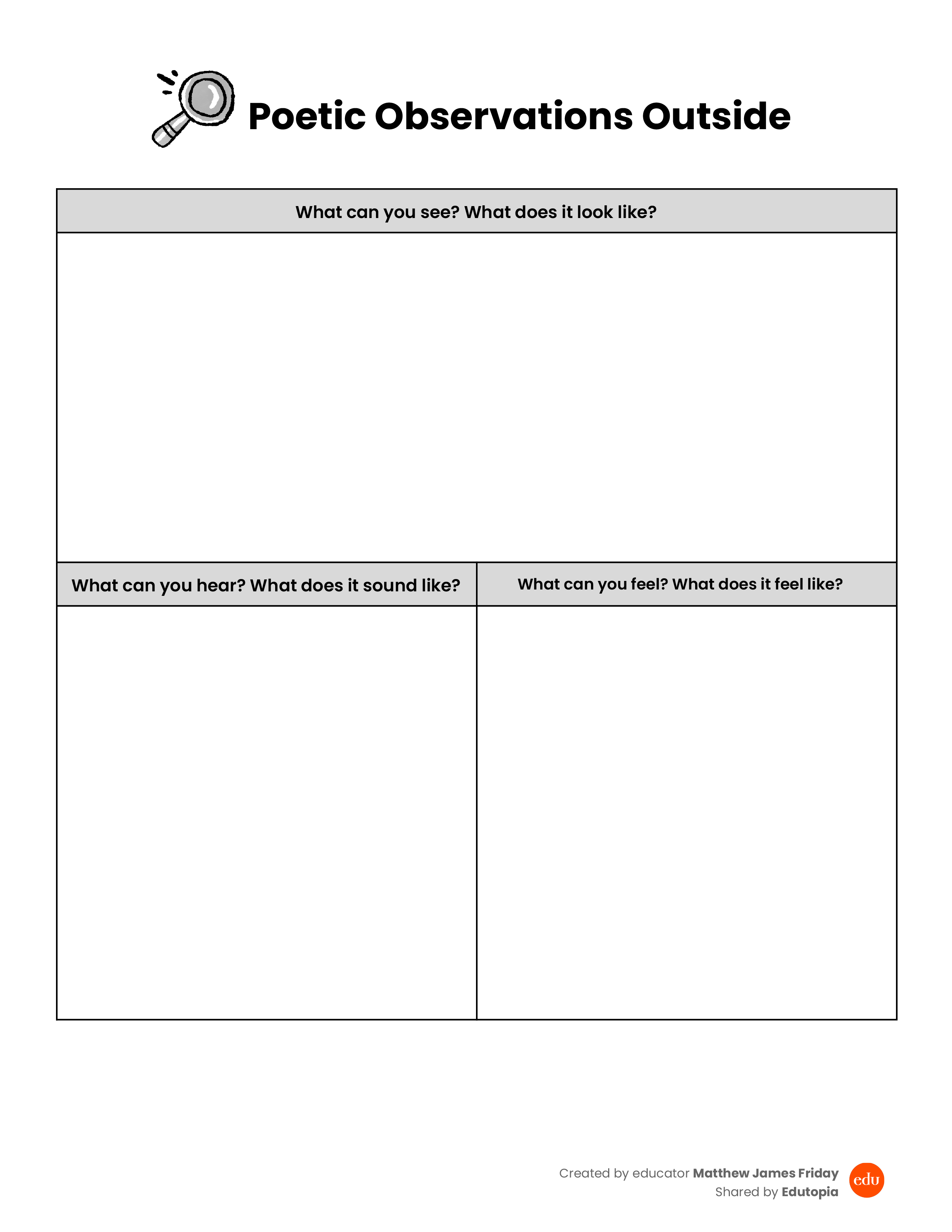
Start with “What can you see?” The visual medium is the easiest one to use for gathering ideas. I modeled the process by thinking aloud and writing my own notes. The goal here was for the students to observe the literal world around them (the trees, the water, the grass, the clouds, etc.) but write similes while doing it. For example: the tree looks like a giant hand; the cloud looks like a fluttering feather. We did this for about 10 minutes.
Use the other senses. Next, I then moved on to what we could hear and physically and/or emotionally feel around us. This was a natural place to add in personification (when we embody inanimate objects with human qualities), such as: the wind is whispering in my ear; the grass is tickling my legs.
Sharing ideas is key. Another goal was to develop the students’ spoken figurative language skills and especially their confidence in doing this. At first, many students found this challenging, as it’s not something they have much opportunity to do, especially with our literacy curriculum so focused on nonfiction writing. However, by inviting students to share their ideas, we all listened and gained ideas. Hesitant students had more time to build up their courage, so that within 10 minutes most students wanted to share what they had written.
“Be poetic.” This means observing the world around you and using your best language to express it. This is being a poet. There was no pressure to write a complete poem in the park. Students were welcome to record whole sentences or descriptive fragments. The more ideas the better. By the end, I even invited some less confident writers to use drawings and labels to record their ideas.
Apply Visual Elements to Support Poetic Expression
Back in class, I pondered how to develop the poems further. With the school’s annual art night occurring the following week, I wanted a way to develop the poetic lines in a more visually artistic manner. After some thought, I settled on the idea of developing “shape” or “concrete” poetry. These are poems whose form and shape on the page directly represents the topic of the writing.
First, we worked on turning similes and statements into metaphoric sentences to strengthen the figurative writing. For example, the tree looks like an old man’s hand became the woody hand of an old leafy man.
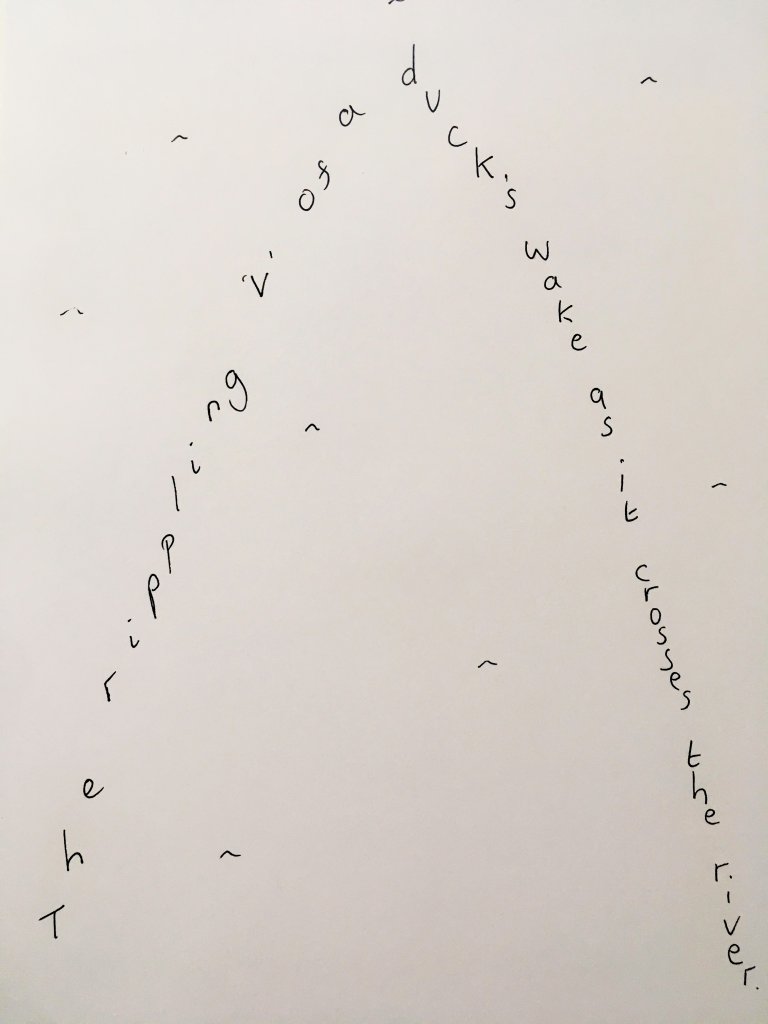
We discussed the concept of a metaphor throughout the writing, using my own writing as an example and, later on, examples that the students created. Students still had the option to develop their writing using similes, but adding metaphor gave more confident writers a wider palette of tools to draw from. Throughout, I maintained the expectation about using properly formed, punctuated sentences—an informal but important goal being developed across the lower grades.
Concrete poems can range from single words to numerous formatted verses. Pressed for time as the school year was drawing to a close, I showed the students how to turn a single poetic sentence into the shape referred to by the words. This turned out to be freeing, fun, and creative, as there is no prescribed format to follow. Then, we shared the resulting work at Art Night so that students could speak and show their words in action to their families.
One of my students was absent for the field trip, so I had him draft poetic lines about the national sporting contest he attended. His eventual poem was published in the shape of a BMX bike, proving that any engaging experience you have can be developed into a poem.
Why Poetry Still Matters
Making time for poetry always pays off. Students gain significant benefits from the opportunity to develop their imagination, curiosity, and language skills. Through these types of activities, kids also begin to observe the world around them with more intention and care and wonder, which is vital in our quickly changing world. Poetry can be an essential part of every teacher’s classroom and every child’s learning experience.