Designing a Low-Tech, High-Connection Pre-K Classroom
Preschool teachers can carve out tech-free spaces and ensure that, when technology is used, that it serves as a bridge for conversation, collaboration, and reflection.
Your content has been saved!
Go to My Saved Content.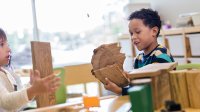
In early childhood, something remarkable still exists: learning powered more by human connection than by technology. Preschool and kindergarten classrooms are often sanctuaries of play, conversation, curiosity, and sensory exploration. These are the years when children form the neural architecture for attention, communication, and self-regulation.
Young learners thrive most when their experiences are rooted in responsive relationships and hands-on exploration, developmental needs that no digital program, however sophisticated, can fully replicate. Early childhood may be the last place in education where technology does not dominate, making it the ideal environment to model mindful tech use while preserving the essential human rhythms of childhood.
WHY EARLY CHILDHOOD THRIVES ON ANALOG LEARNING
Young children learn best through doing: touching, moving, experimenting, talking, negotiating, and imagining. This is why NAEYC’s position statement on technology and young children emphasizes that high-quality early-childhood education is grounded in active, relational, hands-on experiences rather than passive screen time.
Analog learning strengthens executive function through trial-and-error problem-solving; supports language growth through storytelling and conversation; builds social and emotional skills through turn-taking and conflict resolution; and develops early critical thinking through inquiry, prediction, and real-world observation. When screens are limited, children lean into their own creativity and curiosity: making up stories, building elaborate worlds, and engaging deeply with peers. This type of learning remains the foundation for long-term cognitive and social development.
DESIGNING LOW-TECH, HIGH-CONNECTION CLASSROOMS
A low-tech classroom offers the right kind of stimulation to children. When materials invite touch, movement, and collaboration, children naturally engage more deeply than they do with digital devices.
- Keeping tactile materials—such as blocks, clay, fabric scraps, loose parts, and natural objects—accessible to students encourages self-directed exploration.
- “Connection corners” invite children to sit together for partner games, cooperative storytelling, or shared problem-solving.
- Daily routines like arrival, snack, or clean-up become opportunities for language and relationship-building.
- Problem-solving baskets filled with recycled materials and loose parts let children take on engineering challenges such as “build a bridge,” “make something that rolls,” or “create a home for a creature,” promoting creativity and collaboration.
- Simple changes in layout, light, and color can reignite a child’s curiosity and focus. Involving families strengthens this approach further; inviting photos, artifacts, or natural items from home builds a sense of continuity and extends learning beyond the classroom walls.
MINDFUL TECH MOMENTS THAT SUPPORT CONNECTION
Technology can have a meaningful place in early childhood when used intentionally and always in service of connection. In practice, this means technology supports shared experiences rather than replacing them. In these moments, technology acts as a bridge for conversation, collaboration, and reflection, not a substitute for human interaction.
- Podcasts offer a screen-free way to expose children to stories, questions, and new vocabulary. Shows like Mini Meditations for Kids support calm and regulation, and But Why: A Podcast for Curious Kids encourages inquiry and reflection.
- Teachers can use a classroom tablet collaboratively, taking a photo of a block tower the children built together, recording a short poem performance, or documenting the growth of classroom plants. Later, you can bring the class together to discuss these images as a shared storytelling experience.
- Audio postcards—quick recordings of the class reflecting on their day, easily captured using a simple voice memo app on a phone—build listening, sequencing, and language skills when replayed during circle time.
- Collaborative sound maps, created by recording environmental sounds like footsteps, birds, or rain, turn simple technology into a sensory awareness tool. To make one, use a basic voice memo or recording app to capture sounds around the school or playground. Back in the classroom, children listen to the recordings and draw or map where they think each sound came from, then act them out or describe how the sound made them feel. The technology is minimal, but the focus stays on listening, observation, and shared reflection.
- Music apps can be used mindfully, creating a shared playlist for transition. In my lessons, we often use songs by Lenny Pearce, who reimagines familiar children’s tunes with techno beats. When the class has extra wiggles, we turn the music up and everyone dances it out. The laughter, movement, and shared joy help reset the room and make transitions feel light rather than rushed.
In these examples, technology remains a tool that enhances connection and creativity, rather than a substitute for hands-on learning. If technology starts to feel like it’s creeping into the day, try replacing digital timers or video backgrounds with child-led songs, rhythm games, or simple sensory cues like bells, chimes, or sand timers.
TEACHING GENTLE DIGITAL CRITICAL THINKING
Even in early childhood, children can begin forming the foundations of digital critical thinking by embedding simple reflective questions into the moments when technology appears. Educators might ask, “Who do you think made this story?” or “Does this picture seem real or pretend?” or “Why do you think this character made that choice?” These questions help children understand that digital content originates from somewhere and should be contemplated rather than absorbed automatically.
This matters because as children grow older, they will encounter more content that requires interpretation and skepticism. When young children are encouraged to reflect, choose, and question, they take greater ownership of their learning and engage more deeply in daily routines. Introducing this reflective language early plants the seeds for thoughtful, intentional technology use, helping children become active thinkers rather than passive consumers.
HELPING CHILDREN SEE TECHNOLOGY AS ONE OF MANY TOOLS
One of the most important lessons early educators can teach is that technology is not inherently exciting—what we do with it is. Technology shouldn’t be used as a babysitting device or a reward. When teachers treat tablets, cameras, and audio tools as occasional supports for storytelling, documentation, or inquiry, children see technology as an extension of learning rather than the center of it. After documenting a class science project using a single group photo, children can draw what they observed, dictate stories about the experience, or act it out during dramatic play.
Technology becomes a catalyst for richer play, not a replacement for it. This approach also models to families that early childhood classrooms don’t need constant digital engagement to be innovative; in fact, lower-tech environments often strengthen curiosity and connection.
Kids are at their most curious and creative when they are little. Preschool is one of the last opportunities to have no or low tech and a high human-to-human connection. The goal is not to eliminate technology, but to ensure that it enhances rather than interrupts attention and creativity.
As digital tools continue to grow more immersive, early childhood educators play a vital role in protecting the deep sensory engagement and relational learning that young children need most. With thoughtful design and intentional modeling, teachers can help children understand that their most important tools are still their hands, their imaginations, and each other.