
7 Ways to Put UDL Into Action in the Elementary Grades
Teachers can design learning experiences with an approach that supports all students where they are and helps them develop transferable skills.
Your content has been saved!
Go to My Saved Content.In August 2025, I had a very diverse grade three class: multilingual, multicultural, and “multiready” learners with remarkably different readiness levels. I use the term “multiready” instead of “multilevel” because the latter implies higher and lower achievers. As of day one, I knew that providing opportunities for them to demonstrate their prior knowledge, build on their understanding, and apply their learning through a variety of strategies and learning experiences would be instrumental to their success. The only question was how.
The Universal Design for Learning (UDL) framework was not new to me: I had applied some of its principles in my teaching practice before. However, faced with the challenge ahead, I was ready to implement it fully across subjects. My yearlong approach encouraged my students to intentionally show their learning in different ways and broadened their views on their application of knowledge and learning from each other. Above all, it changed their mindset about learning, as they understood that whether it’s through a written test, a game, or a piece of art, there is more than one way to learn, experiment, and demonstrate learning.
I designed learning experiences grounded in UDL’s three core principles of providing multiple means of engagement, representation, and expression. Here’s what worked for me.
1. Develop research skills
Throughout the year, I gave my students the option to use Google Translate—using the audio feature so that students could speak in their first language, listen to the translations, and learn how to pronounce new words—and work with same-language partners to support each other’s understanding of concepts when conducting research. In my very diverse class, my students and I spoke 11 different languages: English, Thai, Chinese, Hebrew, German, French, Japanese, Russian, Ukrainian, Norwegian, and Portuguese!
For example, when learning about simple machines, some students translated words such as “levers” and “axles” and used their preferred language to take notes. Others just went straight into making models with recyclable materials and building blocks. Another group preferred to draw and use labels. Providing a range of possibilities empowered them to make decisions and choose the strategies that worked best for them.
2. Grow thinking skills and explore new math concepts
Choice is at the heart of UDL, so I asked my students to record and show their understanding in different ways. For example, for fractions, they could choose to show their work with fraction bars, parts of a set, geometric forms, or number lines and draw in their notebooks or use concrete materials. For multiplication, they could choose from memorization, repeated addition, or making arrays when solving word problems.
With addition and subtraction, they could use partitioning or column addition and subtraction, or mentally solve equations if they preferred. As students chose different ways to focus on the same concepts, their curiosity grew and gave way to conversations and learning from each other.
3. Nurture communication and social skills
Word banks, sentence starters, voice-to-text apps, translanguaging, and lots of teacher and peer feedback supported my students in adding details, making ideas clearer, and finding joy as they saw their words take shape on a worksheet or device screen.
When it was time to publish their work, students chose from the following options: making posters or a slide show, creating a document in Canva, or writing their pieces on printer or conventional lined paper. Students taught each other how to use apps or devices and were inspired to try something new, developing flexible thinking and generating novel ideas.
4. Cultivate opportunities for self-regulation
A diverse group deserves diverse brain breaks to balance. Some of the options I offered included running laps around the courtyard, reading or sketching quietly, mindful breathing, and simply doing nothing for a few minutes.
With time and encouragement, my students learned to pause, think, and ask for a brain break when they needed one.
5. Explicitly teach self-management skills
Rather than relying solely on the school diary, I taught my students multiple organizational methods: writing notes and recording messages to themselves in the language they preferred, or using a calendar and the school timetable. Referring to the routine anchor charts in the classroom was the highlight—display boards that seemed to be part of the furniture in previous years had finally come to life because students read them and supported each other to get organized throughout the day.
6. Shift the focus to transferable skills
This was the most powerful component of the approach. I was teaching content, but the main focus was on how to demonstrate our learning. Our conversations valued ideas; we centered the physicality of learning by building projects, role-playing, manipulating objects, moving, and making art.
Embodying concepts proved to be highly engaging and transformative, as my students realized they could all demonstrate their learning and feel successful.
7. Scaffold the routine
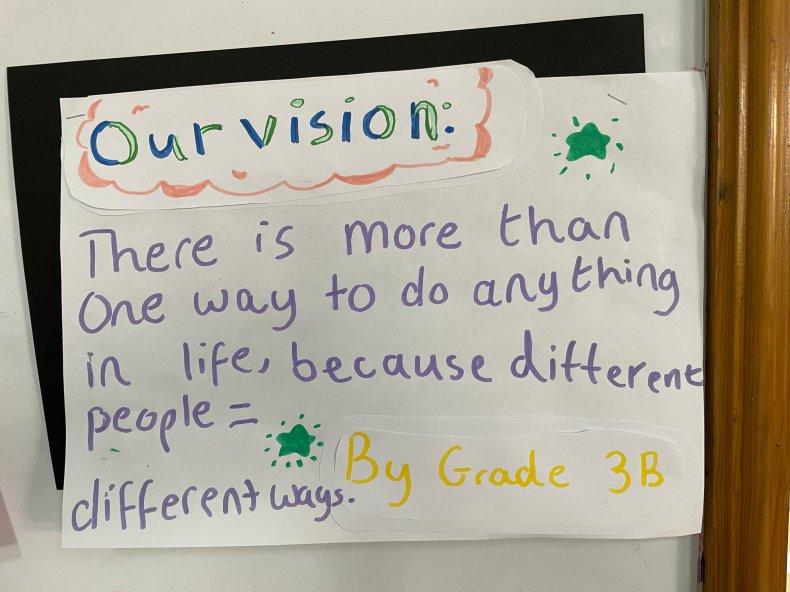
I held weekly (and sometimes daily) group discussions with students about why there were so many options available. These conversations helped my students understand their uniqueness and that they all needed a strategy that matched their needs. I also emphasized that someone’s preference or ability isn’t the only way. In their own words, “There is more than one way to do anything in life, because different people = different ways.” For our last reflection of the year, I asked my students to list what they all did differently, and their answers showed me the impact of the approach.
The culmination of the yearlong mission was our student-led conferences, when each learner presented their learning to their parents, and, as the reader might expect, the presentations were all unique. Some students chose to show their learning through games, others opted for reading, some gave their families a walk around the classroom, and a few presented some of their work.
Students Learn Self-Advocacy, and Teachers Gain Freedom
Throughout the year, I saw my students become increasingly intentional about their choices and what would best support them to be successful. That was reflected in their independence, confidence, and communication skills: They felt empowered to explain their choices and advocate for themselves in lessons. For example, they voiced when they felt something was not meaningful, helpful, or fair.
From a teacher’s perspective, I felt a lot of freedom as a result of all the planning and thinking outside the box. Looking for variety and choice for my students in my daily practice stretched my creative and flexible thinking, too, and made the year feel like professional and personal development. Ultimately, this approach brought our class together as a strong team that appreciated diversity and learned to notice and welcome different possibilities.