How to Create Highly Effective, Discussion-Worthy Multiple-Choice Questions
Well-written multiple-choice items can deepen thinking and learning, rather than simply challenging students to recall basic facts.
Your content has been saved!
Go to My Saved Content.
Multiple-choice questions have gotten a bad rap, especially over concerns that they only measure recall and other surface-level understandings. Many educators have altogether removed multiple-choice items from their practice.
But effective multiple-choice items provide formative feedback for teachers and deep-thinking opportunities for students. It all comes down to the quality of the question itself. Take, for instance, the following:
When did Abraham Lincoln deliver the Gettysburg Address?
a. January 1, 1863
b. March 3, 1861
c. November 19, 1863
d. December 29, 1865
This item is indeed an example of a poor multiple-choice question, because it only assesses basic recall—the mere memorization of facts. Now take a look at the following:
Abraham Lincoln delivered the Gettysburg Address in November 1863 to honor the soldiers who died during the battle. Considering the state of the union at this time, which line from his address best demonstrates another main purpose of the speech?
a. “Four score and seven years ago our fathers brought forth on this continent, a new nation, conceived in Liberty...”
b. “We have come to dedicate a portion of that field, as a final resting place for those who here gave their lives that that nation might live.”
c. “The world will little note, nor long remember what we say here, but it can never forget what they did here.”
d. “We here highly resolve that these dead shall not have died in vain—that this nation, under God, shall have a new birth of freedom—and that government of the people, by the people, for the people, shall not perish from the earth.”
Notice how this item measures students’ ability to infer the purpose of Lincoln’s speech and also draw a conclusion; it combines knowledge of the historical context with the skill of close-reading a primary source document.
Multiple-Choice Questions as Thinking Tools
Beyond assessment, a well-written multiple-choice item is an effective way to spark discussion and disagreement among students, so that they are compelled to explain and justify their thinking. For instance: The best answer to the question above is probably d. If you disagree, notice the amount of cognitive effort it takes for you to justify your stance.
I’ve observed seventh-grade scientists argue vehemently over the multiple-choice question below, which is used as a warm-up to review the week’s content.
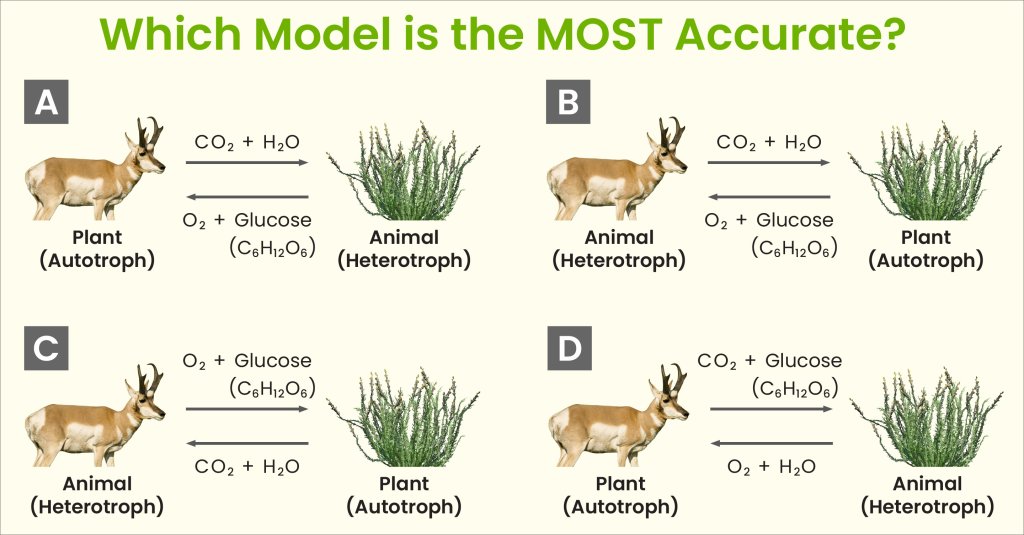
Similarly, after students read a chapter of The Outsiders in an English language arts (ELA) class, I present them with a simple question:
Which character struggles with their identity the most?
a. Dally
b. Johnny
c. Ponyboy
d. Cherry
In this instance, I’m less interested in formatively assessing, as there isn’t technically a correct answer. (Or is there?) Lesson closure becomes a literary debate, revealing connections I hadn’t realized my students were making. When there’s no risk of inaccuracy, I’ve noticed that some of my more reluctant literary analysts happily engage with these types of questions.
How to Develop Effective Multiple-Choice Items
As with all good instructional planning, the development of effective multiple-choice items begins with the end in mind. Often, standards and daily learning goals include a verb (determine, analyze, evaluate, etc.), which identifies the depth of knowledge that the lesson seeks to elicit and assess.
Using this key verb is great for crafting an open-ended question that can easily be applied to formative assessments and exit tickets. However, reworking the same question into a multiple-choice item saves time and actually promotes deeper student thinking.
Take the learning goal for a lesson in my seventh-grade ELA class: Contrast the difference in perspective of two characters on the same plot event.
I could just ask students to perform this task in writing. But the following question would also reveal their ability to meet the learning goal: Which statement best captures the contrast in perspectives between the two brothers?
This time, students need to consider the validity of multiple statements about characters’ perspectives. More thinking is required to justify their conclusions, likely by returning to the text. Multiple-choice items often present ideas that students had not considered on their own, broadening their thinking beyond what they would have written in response to an open-ended question.
The Hinge-Point Question
The gold standard of multiple-choice questions is a “hinge-point” question. Refined by education professor Dylan Wiliam, hinge-point questions are diagnostic; even wrong answers are quickly interpretable by teachers and guide their immediate instructional response. These questions inform teachers about what students understand—and crucially, what they don’t understand.
The best placement for a hinge-point question is just before the teacher moves from one key concept to another. Instead of randomly creating three incorrect answer options as distracters, teachers design incorrect answer options that reveal anticipated student misconceptions. For instance, a sixth-grade math teacher working with order of operations might present the following:
Evaluate the expression: 3 + 2 x (9 + 10) - 8 + 4 x 3
a. 35
b. 41
c. 187
d. 45
The correct answer is d., 45. However, students who make the conceptual error of not adding the integers within parentheses first will likely choose a., 35, suggesting they haven’t yet grasped the concept of order of operations. These students need intervention. Other anticipated errors are the result of common miscalculations, suggesting that those students understand the concept of order of operations but could use more practice in precise calculation.
The real power in hinge-point questions is the action that comes next: immediate intervention, practice, or enrichment.
Additional Benefits of the Multiple-Choice Question
Multiple-choice items are highly adaptable for quick implementation. Google Forms are great for assessing individual levels of understanding without peer influence. Responses on small dry-erase boards offer a low-stakes feel for students. Answers on sticky notes or index cards make for an effective exit ticket. Students can weigh in and discuss further by physically moving to specified classroom locations. Teachers can even change the answer options from “a to d” to “1 to 4,” and then have students indicate their answer with their fingers.
Another benefit of multiple-choice questions is what they encourage next. Regardless of how students respond—correctly, incorrectly, or perhaps neither, if the question isn’t intended to assess—the nonthreatening follow-up of “What makes you say that?” compels students to explain their thinking. They either justify their answer or reveal misconceptions to the teacher. In fact, an indicator of a great multiple-choice question is when the teacher doesn’t even get the chance to ask a follow-up question, because students are invested enough to explain their thinking unprompted.
Multiple-choice questions don’t actually require an assessment of the basic recall of facts. They can instead assess rigorous standards and provide formative feedback that drives instruction and improves the quality of student performance. Most important, multiple-choice questions are really, truly capable of deepening both thinking and learning.