
How Often Should You Return to What You Just Taught?
Spaced practice, used strategically to reinforce foundational concepts, helps students develop deeper, more durable learning, research shows.
Your content has been saved!
Go to My Saved Content.Good basketball players don’t learn to dribble one day, shoot the next, and pass the day after that, checking off each skill in succession. Instead, they return to these skills again and again, sharpening each through repetition and learning how to combine them fluently during the unpredictable rhythm of a game.
Classroom learning works similarly, writes former teacher Sara Delano Moore in SmartBrief: We need to “develop our skills a little bit at a time, stretching them further with each new exposure.” But what does this look like in practice?
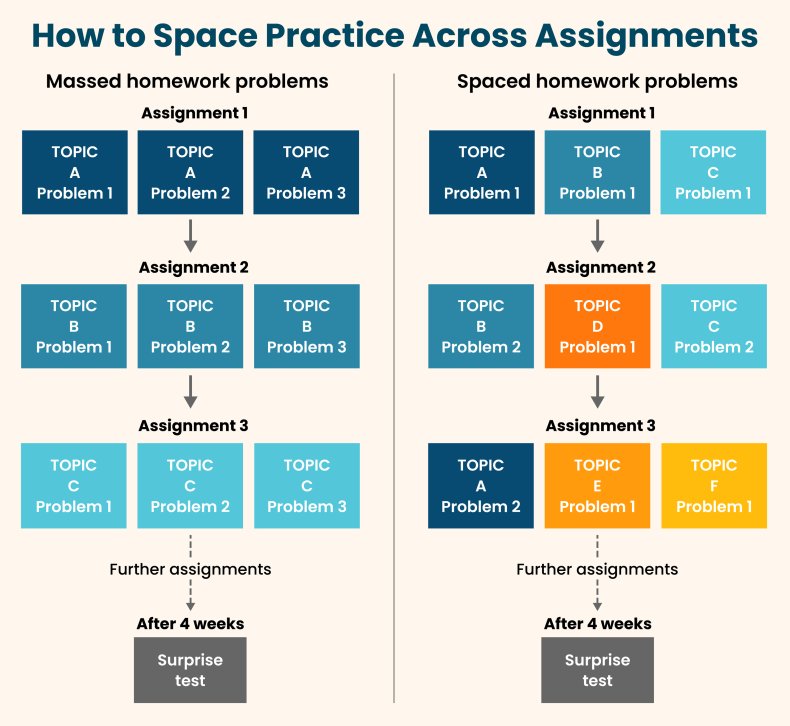
In a 2021 study, researchers at UCLA rearranged homework in an introductory physics course, giving students the same practice problems but in different sequences.
Over two months, students completed three homework assignments a week. One group worked through topics sequentially; the other tackled a mix of recently learned concepts and older ones covered in prior lessons. The problems were identical—the only difference was the order.
When the students were tested on the material—via an exam that required them to apply what they learned to unfamiliar problems on the same topics—the mixed practice students outscored their traditionally paced peers by a substantial 74 percent.
That advantage is consistent with a broader body of research. In a 2022 review, psychologist Shana Carpenter and her colleagues found widespread benefits to spaced practice—or revisiting materials over time, and an influential 2013 review offers a glimpse into what’s at play. Returning to material after a delay requires students to work to retrieve what they've learned, strengthening their ability to recall it again later. The time between sessions allows some forgetting to occur, making retrieval more effortful and giving memories more time to consolidate effectively. Encountering material in different contexts, meanwhile, can create additional cues for remembering it and help students apply it to new situations.
By contrast, practicing material in one concentrated stretch may create the illusion of mastery: Everything feels familiar and easy to recall in the moment, but proves harder to retrieve as time goes by.
Still, effective spaced practice isn’t simply a matter of revisiting old material, argues education professor Carl Hendrick in The Learning Dispatch. A quiz on disconnected facts from earlier lessons may bring information back to mind, but not necessarily help students apply it to future learning. The trick, Hendrick notes, is to plan for moments when surfacing earlier knowledge can help students make sense of new material.
Here are research-backed, teacher-tested fundamentals for making spaced practice a regular and intentional part of classroom instruction.
How to Space It Out
There is no “universal ideal spacing schedule,” Carpenter and her colleagues write. Longer gaps help when students have already developed a grasp of the material, and shorter gaps are useful when students are still building understanding. The goal, they explain, is to revisit material when it's “still familiar but not fresh in the mind.”
The classroom studies summarized in their review offer some loose guidance. In the early grades, teachers might spread lessons on a scientific principle across a few consecutive days. In middle school biology, students might return to important concepts over four weekly lessons. High school geometry teachers, meanwhile, might spread problems on the same topic across seven assignments over six weeks.
These are examples, not fixed timelines. The aim, Carpenter and her colleagues write, is to provide enough practice “to permit any forgotten information to be relearned.” When a topic resurfaces, check what students can recall without revisiting their notes. If a key idea has faded, reteach it, let them practice, and check their understanding again before moving on.
What to Focus On
Rather than trying to get students to recall every single thing they learned in a unit, Hendrick recommends prioritizing “hinge concepts, threshold ideas and high leverage knowledge” that they’ll need to draw on again and again.
For example, students reading Macbeth over several weeks might remember the famous line “Is this a dagger which I see before me?” But recalling the words is just a starting point. As the play unfolds, teachers can ask students to return to this moment and consider what Macbeth’s imagined dagger reveals about his ambition and fear—and how the scene takes on new meaning as the play goes on. This pushes students to turn remembered details into evidence for their interpretation of the play, helping them develop a more holistic, sophisticated understanding of the material. Retrieving dates and quotes without this “clear return path” to bigger thematic or conceptual ideas is “merely cosplaying building knowledge,” Hendrick argues.
Start by identifying foundational concepts and mapping opportunities to revisit them throughout a unit and beyond, rather than teaching them in isolated blocks, suggests high school math teacher Bill Hinkley. For an AP Calculus unit on optimization, for example, Hinkley plotted out opportunities for spaced practice through homework, group review, in-class exercises, and a team project. Students also revisited the material on a unit test and again on a midyear exam.
The process helped Hinkley examine how to distribute practice across classwork and independent study. It also changed how he approaches curriculum planning. Whenever he starts a new unit, he asks himself: “Which skills from previous units can I integrate to improve retention?” His answer helps him pinpoint opportunities to “integrate and effectively space” skills from one unit to the next, giving students more chances to practice what they’ve learned.
4 Ways to Space Practice
Spaced practice doesn't require a tedious cycle of repeating the same worksheets or quizzes. Small adjustments to familiar classroom activities and assessments can bring older knowledge back into the learning rotation.
1. Mix old and new questions: Low-stakes quizzes can be a simple way to regularly resurface material. Five-question mini-quizzes, for example, helped students in former middle school history teacher Patrice Bain’s class recall material from earlier lessons. She rarely graded them, and when she did, they counted for very few points. Multiple-choice, short-answer, or free-recall questions that revisit material from the previous day, the previous week, and even months earlier are all good options. Review answers afterward so students can correct errors: The goal isn't simply to assess what students remember, but to give them repeated opportunities to strengthen knowledge.
2. Write, compare, and correct: Brief in-class writing exercises offer another way to practice retrieval. Psychology researchers Yana Weinstein and Megan Smith recommend asking students to write a summary of something they learned the previous week, using their own words and working from memory. Students can then compare responses with a partner, consult their notes, and correct anything they missed. Repeat the exercise several days later, perhaps asking students to apply the concept in a new context. Even a 90-second rapid review at the start of class can create an opportunity to recall earlier learning.
3. Spread homework problems across days and topics: Instead of assigning homework exclusively on a current lesson or concept, Weinstein and Smith recommend including questions from previous weeks and months. Mixing related problems also introduces interleaving, which requires students to determine which strategy fits each problem. For instance, after teaching students several formulas for calculating volume, educator Meg Riordan uses station rotations to mix volume problems involving different solids, rather than grouping questions that use the same formula. Returning to these problem types in later assignments gives students more opportunities to practice choosing and applying the right method.
4. Build spaced practice into longer assignments: Projects can give students opportunities to revisit and apply important concepts over several days or weeks. In his calculus class, Hinkley challenged teams of students to use identical sheets of plastic to build containers that could hold as much sand as possible. The assignment required students to return to optimization concepts as they designed, tested, and revised their containers. This approach works with longer writing assignments, labs, or research projects, with scheduled checkpoints on different days where students recall relevant concepts and explain how they apply.