Upper Elementary Math Center Activities That Feature Manipulatives
Including hands-on tools in your lessons should help strengthen students’ understanding of abstract concepts.
Your content has been saved!
Go to My Saved Content.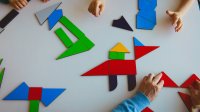
Manipulatives can be a powerful tool in any mathematician’s toolbox. Just as we might take a screw or a wrench to fix a squeaky chair, we can use manipulatives to help solve math problems.
A popular framework that is often utilized in math lessons is Concrete, Representational (or Pictorial), Abstract, sometimes referred to as CRA (or CPA). It’s a progression where students first explore math ideas using hands-on objects, then model those ideas with drawings or visual representations, and finally work with numbers and symbols to show their understanding in more traditional, abstract ways. Some lessons may invite students to move through these stages in a linear fashion (concrete to representational to abstract). Others might be more flexible, encouraging students to move back and forth, in and out of learning experiences that are concrete, pictorial, and abstract (not necessarily in that order).
We may see our students struggle if instruction moves to abstraction too quickly. During math centers, we can use manipulatives in the concrete stage to help students build their conceptual understanding. Even after students move toward more abstract work, they can return to concrete tools whenever their understanding breaks down.
Making Math Centers Manageable and Meaningful
Here are a few tips to manage math centers easily and efficiently.
First, consider how students will access materials for each center. Use colors and labels so students know where to get what they need and how to return materials once they’re finished. Photos serve as good reminders to students about how to use and put away manipulatives and other materials for centers.
Second, ensure that students use each center’s manipulatives in purposeful ways. Your students should know why they’re doing each center and how it helps or connects to what they’re learning. They’ll need plenty of practice playing at each center, and they’ll also need to be well-versed in the ways manipulatives can be used to solve math problems and help them show their thinking.
Third, try initiating some formative checks while students are engaged in center activities to help you plan for instruction. Before wrapping up at a center, students could capture an example of their work on an index card or a sticky note, or take a photo. You could also check in with one or two students at each center/in each rotation by asking a single focus question that is clearly aligned to the learning target.
Hands-On Centers for Key Content: Fractions and Base 10
Two effective manipulatives that can be used to support fractions and base 10 learning are base 10 blocks and Cuisenaire rods. Base 10 blocks work for all basic operations of addition, subtraction, multiplication, and division along with fraction concepts. Try these center ideas utilizing base 10 blocks:
Roll and Build: This activity requires mathematicians to roll a single die to solve a problem. Provide guidelines on how many digits students need for each number. After rolling the dice, students build a representation of the problem using base 10 blocks to prove their answer. The beauty of this center is that the structure doesn’t change—just the operation.
Animal Values: Students are assigned a challenge to build an animal that is worth a certain amount. For example, students could build a base 10 block animal that is 1/10 the value of 1,000. Students use blocks worth 100 to design an animal of their choice. This center is engaging and allows students to practice understanding fractional amounts.
In our observations, Cuisenaire rods are used less often in classrooms, but they offer so much value because they help students see the relationships between numbers. Try using this manipulative in the following ways:
Race to the Whole: For this center, students need a colored spinner and a set of rods. Each pair begins with the longest rod as their “whole,” and the smaller rods are used as game pieces. On their turn, a student spins the spinner and identifies the color of the rod it lands on. They then place that rod alongside the longest rod. Partners take turns, and the first player to exactly fill the length of the longest rod (one whole) wins.
Fraction Relationships: Focused on building fraction understanding, in this center, students choose two rods at random from a paper bag. Then, they write at least three sentences in their notebook explaining how the rods relate to each other. For example, if a student selects a rod that is one-third the length of the other, they might write: “It takes three red rods to equal the length of my yellow rod. That means the red rod is ⅓ of the yellow rod. One-third is smaller than the whole yellow rod.”
Geometry Through Touch and Exploration
Incorporating geometry centers into your classroom routine can act as a continuous spiral review or even as an enrichment opportunity. While geoboards and pattern blocks are commonly used for this domain, the ideas below utilize geoboards.
Guess My Shape: During this center, students write down a set of three clues for a specific shape or figure. Their partner needs to build the shape based on the clues given. Challenge your students during this center by requiring them to use certain vocabulary words in their clue, such as line segment, angles, etc. Alternatively, you could provide the clues to your mathematicians, and the partner pairs could build the shape together.
Symmetry Search: One mathematician builds a shape, then their partner needs to identify how many lines of symmetry are in it. To create an extension for this center, mathematicians can explain where the lines of symmetry in the shape are and how they know that each side is symmetrical from that line. Recording thoughts in a notebook is a great way to hold students accountable during center work.
Pattern blocks are powerful visual and versatile tools that support shape knowledge and spatial reasoning. For fun and engaging center ideas, use pattern blocks in the following ways:
Shape Collection: Students will need pattern blocks and graph paper for this activity. Mathematicians begin by selecting 20 pattern blocks from a bag. Then, they choose how they want to classify their shapes—by color, number of angles, number of right angles, side lengths, parallel lines, or another attribute. After sorting and recording their data, they create a graph to represent their findings. To differentiate, you can preselect the classification category to support learners who need additional help.
Roll and Build: This center requires both dice and pattern blocks. Students roll one die and choose a pattern block with that many sides. They roll the die 10 times. After collecting their shapes, challenge them to create a design with the shapes they rolled. Their partner needs to guess what the design is. This center provides mathematicians with practice in identifying shapes based on attributes.
Overall, these math center activities offer essential opportunities for students to use manipulatives to practice or review the skills they’re learning about each day.