Building Your Elementary Classroom Community With Drama Games
These activities help create the social glue every classroom needs. And none of them require props, a stage, or drama training.
Your content has been saved!
Go to My Saved Content.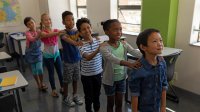
Creating a strong classroom community—one with moments of shared laughter and play—is key to helping students feel safe, connected, and open to learning. I believe drama can help build that all-important social glue that a classroom needs. Here are four drama-inspired games I come back to again and again. None of them need props, a stage, or any drama training. You just need a bit of clear floor space and a willingness to play.
The Human Machine
Ask students to sit down facing a clear space in the room. This will act as your stage area. Explain that together they are going to create a machine using their bodies, their movements, and their own sound effects (optional).
Step into the space and demonstrate two or three machine-like movements. Explain that machine movements work best when they are clear, precise, and repeated: Each one should last one to five seconds and then repeat. You can add a sound effect if you like.
Explain that students will join the machine one at a time, and ask a student to start. Students can choose when they want to join—there is no set order. Encourage them to respond to what is already happening, working with the movements beside them. For example, if one student is extending their hands forward, another might add a movement that collects something from those hands and passes it on.
Let students know that there is no “wrong” movement. All ideas are welcome. Encourage them to explore different levels (standing, sitting, kneeling, or lying down), and make it clear that there should be no physical contact.
Once the machine feels complete, ask everyone to return to sitting. You can repeat the activity with a theme, such as a chocolate-making machine. Ask the students for ideas.
In Unison
Ask the group to walk around the room and to become very aware of one another; their aim is to all walk at the same speed. This might lead to some students trying to lead by walking very slow or very fast, in the hope that others will copy. Explain that this is not the point of the exercise. The hope is that everyone together will create one collective energy.
Once everyone is walking at a similar pace, ask students to stay very aware of the group. They don’t need to stare at individuals, but they can soften their vision to get a sense of the whole room. Ask them to change the speed as a group, with no leaders.
Next, as a group, they are going to try to do one action all at the same time, with no speech and no direction, moving as one through awareness of one another. Ask your students to complete all movements at a slow pace. Things they can try in unison include stopping and standing still, sitting down, standing up, raising one hand in the air, and lying down.
Explain that if an audience were watching, they shouldn’t be able to tell who is leading the movement. The moment a whole class sits down at the same time without a word being spoken is a quiet kind of magic.
Sound-Effects Circle
Divide the class into two equal groups. One group sits in a circle on chairs. The other group stands behind them, with one student standing behind each seated person. Explain that the standing group will work together to tell a story using sound. Each team can choose how to do this: One narrator with everyone else creating sound effects; two or three narrators sharing the storytelling; or all students taking turns narrating and everyone doing sound effects.
Model a short example to get them started. The narrator might say, “Once upon a time, a girl was walking through the forest….” The group adds sound effects such as footsteps, wind in the trees, or birds calling overhead. The students sitting on the chairs close their eyes for the experience.
Send the students off into their two groups and give them about 10 minutes to create their story together. You can offer inspiration by suggesting locations, such as a forest, a jungle, a haunted house, a castle, outer space, or a magical school. Or the story can come from a fairy tale, a book you’re studying, or a scene the class already knows.
Once ready, the standing group performs their sound story while the seated group listens with their eyes closed. Then the groups swap so that everyone gets to create the story and experience it.
Making a Commercial
Get students into groups of three, four, or five. Together each group will create a 30-to-90-second commercial for one product. Ask them to think about where the imaginary camera is placed so that they face it. Remind them to work as a team, making sure everyone gets a role. They can advertise anything they like. The product can be as mundane as toothpaste or as exciting as a fancy car. It can also be magical: a magic wand or shoes that make you fly.
If a group feels a bit stuck, help them agree on a product and explain that one good formula for a commercial is setting up a problem, then showing how your product fixes that problem. The problem/solution formula almost always jump-starts a stuck group.
Once students have had about 10 minutes to create and polish their commercials, ask them to show the commercials to the class. It’s always fun to see how well this activity goes down, with students working together and then entertaining each other with what they just created.